
Mabuya tytleri
Eutropis tytleri, commonly known as Tytler's mabuya, is a large skink species endemic to the Andaman Islands, India. It inhabits forests, agricultural fields, and areas around human dwellings, adapting well to human-modified landscapes. This species is characterized by its bronzish-brown dorsal coloration and a light yellow underside, with the tail being significantly longer than its body.
Key Facts
- ›Endemic to the Andaman Islands, India.
- ›Prefers forest habitats from sea level to 150m.
- ›Can be found in agricultural fields, plantations, and near human settlements.
- ›Dorsally bronzish brown, ventrally light yellow.
- ›Preys on insects, frogs, and small reptiles.
- ›Considered the largest extant skink species native to the Indian subcontinent.

Tytler's Mabuya
Andaman Islands, India
Large Skink Species., Snout-To-Vent Length Up To 15 cm ., Tail Is Long, 1.5 To 2.2 Times Svl., Dorsally Bronzish Brown., Ventrally Light Yellow.
Insects, Frogs, Small Reptiles
Crepuscular Activity ., Observed Climbing Tree Trunks Up To 3m., Active On the Ground.
About Mabuya tytleri
Tytler's Mabuya (Eutropis tytleri)
Tytler's mabuya, scientifically classified as Eutropis tytleri, is a notable species of skink found exclusively in the Andaman Islands of India. This lizard is distinguished by its substantial size for a skink native to the Indian subcontinent, with adults potentially reaching a snout-to-vent length of up to 15 centimeters, complemented by a tail that is significantly longer than its body. Its coloration is typically a bronzish brown on its upper surfaces, transitioning to a pale yellow on its underside.
Habitat and Behavior
The preferred environment for Eutropis tytleri encompasses forest ecosystems, ranging from sea level up to altitudes of 150 meters. However, this adaptable species also thrives in a variety of human-influenced landscapes, including agricultural fields, coconut plantations, and even around human habitations and gardens. Behaviorally, Tytler's mabuya is crepuscular, meaning it is most active during the twilight hours of dawn and dusk. It exhibits a versatile lifestyle, being equally comfortable on the ground as it is climbing tree trunks to heights of up to three meters.
Diet and Reproduction
The diet of Eutropis tytleri consists of a varied predatory intake, including insects, small frogs, and other diminutive reptiles. Details regarding its reproductive methods remain largely undocumented, with the specific mode of reproduction being unknown to researchers.
Relationship with Humans and Conservation
Despite the ongoing increase in human utilization of its habitat, which leads to shrinking forest areas, the population of Eutropis tytleri does not appear to be facing a decline. This resilience is attributed to its capacity to adapt to new, human-altered environments, and its presence in many human-occupied spaces. Furthermore, the species is not known to be exploited by humans for any purpose, nor does it seem to be under any specific conservation threat at present.
Source: Wikipedia ↗
Frequently Asked Questions
What is Tytler's mabuya?
Tytler's mabuya, scientifically known as Eutropis tytleri, is a species of skink, a type of lizard belonging to the family Scincidae. It is native to the Andaman Islands in India and is notable for its size among skinks from the Indian subcontinent.
Where does Eutropis tytleri live?
This lizard species is found in the Andaman Islands, India. Its preferred natural habitat includes forests, but it has also adapted to live in agricultural fields, coconut plantations, and around human dwellings and gardens.
What does Tytler's mabuya eat?
The diet of Eutropis tytleri consists of insects, frogs, and small reptiles. They are predators that actively hunt these prey items within their varied habitats.
What are the physical characteristics of Eutropis tytleri?
Eutropis tytleri is a large skink, with a snout-to-vent length that can reach up to 15 cm (5.9 inches). Its tail is notably long, measuring between 1.5 to 2.2 times its body length. The dorsal side is typically bronzish brown, while the ventral side is a light yellow.
Is Tytler's mabuya endangered?
While the habitat of Eutropis tytleri is experiencing shrinking due to increasing human use, its population does not appear to be in decline. The species is known to adapt to human-created environments and is not currently under any specific threat.
When is Tytler's mabuya most active?
Eutropis tytleri is a crepuscular species, meaning it is most active during twilight hours, both at dawn and dusk. It has been observed active both on the ground and climbing tree trunks.
Related Lizards

Tytler's mabuya
Tytler's mabuya (Eutropis tytleri) is a large skink species endemic to the Andaman Islands in India. It is characterized by its bronzish-brown dorsal coloration and light yellow underside, with a long tail. This adaptable species thrives in various habitats, including forests and human-modified areas, and is known to climb trees.
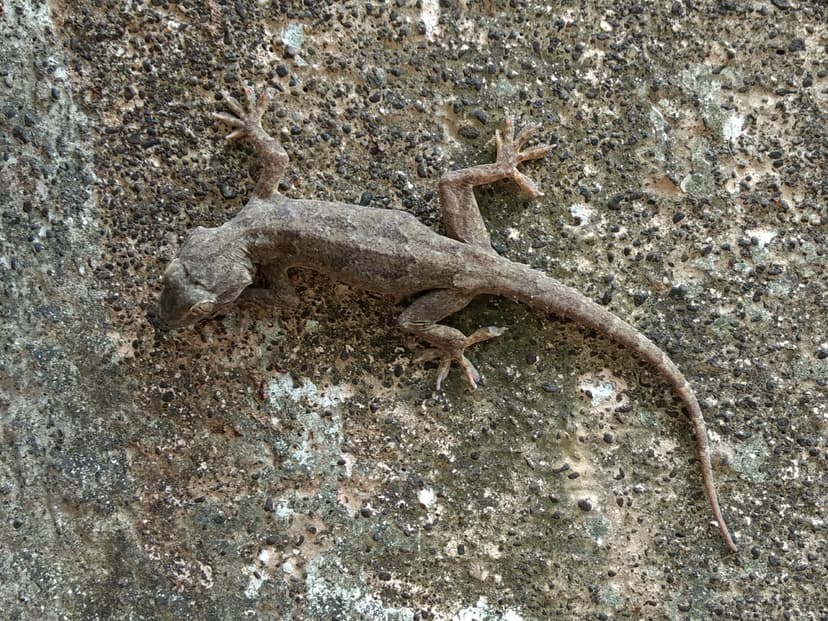
Leschenault's leaf-toed gecko
Leschenault's leaf-toed gecko is a species of gecko native to South Asia and parts of West Asia, often found inhabiting homes. This lizard is characterized by its moderate body size, granulated head, and distinctly dilated digits. Its coloration typically features grey with darker markings that can form cross-bars, spots, or bands, against a white underside.

Phelsuma laticauda
The gold dust day gecko (Phelsuma laticauda) is a vibrant, diurnal lizard known for its bright green or yellowish-green coloration, often adorned with gold speckles on its neck and back, and distinctive rust-colored bars on its snout. Primarily arboreal, it inhabits tropical forests in Madagascar and surrounding islands, and has also been introduced to Hawaii. Its diet consists of insects, nectar, and soft fruits.