
Mesalina
Mesalina·Lacertidae
Mesalina is a genus of wall lizards belonging to the family Lacertidae. These lizards are characterized by their diverse species, with 20 recognized species, and are found across various desert and arid environments. Their common names often reflect their physical attributes or the regions they inhabit.
Key Facts
- ›Mesalina is a genus of wall lizards within the Lacertidae family.
- ›There are 20 currently recognized valid species within the Mesalina genus.
- ›Species names often allude to their physical characteristics or geographic origins.
- ›The genus was first described by J.E. Gray in 1838.
- ›Mesalina lizards are typically found in arid and desert habitats.

Wall Lizards, Sand Lizards, Short-Nosed Desert Lizards, Desert Racers
About Mesalina
The genus Mesalina comprises a group of wall lizards belonging to the family Lacertidae. These lizards are primarily recognized for their diversity, with 20 distinct species currently acknowledged as valid. The common names assigned to various Mesalina species often provide clues to their physical characteristics or the geographical regions they inhabit.
Taxonomy and Discovery
The genus Mesalina was formally established by J.E. Gray in 1838, with its description appearing in the Annals and Magazine of Natural History. The classification of these lizards places them within the broader family Lacertidae, a diverse group commonly referred to as wall lizards. The specific epithets of many Mesalina species, such as M. adramitana or M. bernoullii, often reflect their geographical origins or are named in honor of scientists who have contributed to their study.
Habitat and Distribution
Mesalina lizards are predominantly found in desert and arid environments. Their specific ecological niches and geographical distributions vary among the different species, but they are generally adapted to survive in dry, often harsh conditions. This adaptation is reflected in their morphology and behavior, allowing them to thrive where other reptiles might struggle.
Source: Wikipedia ↗
Frequently Asked Questions
What family do Mesalina lizards belong to?
Mesalina lizards are classified within the family Lacertidae, which are commonly known as wall lizards. This family is diverse and includes many species adapted to various environments.
How many species are recognized in the Mesalina genus?
As of the latest classifications, there are 20 valid species recognized within the Mesalina genus. These species exhibit variations in their appearance and geographic distribution.
Where are Mesalina lizards typically found?
Mesalina lizards are generally found in desert and arid environments. Their specific habitats can vary depending on the individual species, often reflecting adaptations to harsh, dry conditions.
What is the origin of the Mesalina genus?
The genus Mesalina was established by J.E. Gray in 1838. The description was published in the Annals and Magazine of Natural History.
Do Mesalina lizards have common names?
Yes, many Mesalina species have common names. These names often describe their appearance, such as 'sand lizard' or 'short-nosed desert lizard', or are named after individuals who studied them.
Related Lizards

Brachysaura minor
Hardwicke's bloodsucker, also known as Calotes minor, is a small, stocky agamid lizard found across South Asia. It is characterized by its pot-belly, short tail, and distinct olive-brown coloration with dark-brown spots. Primarily terrestrial and diurnal, this harmless species inhabits dry forests, arid environments, and barren deserts.
Hardwicke's bloodsucker
Hardwicke's bloodsucker (Calotes minor) is a small, stocky agamid lizard native to South Asia. It is characterized by its pot-belly appearance, large head, and distinctively patterned olive-brown coloration with dark-brown, light-edged spots. This terrestrial and sometimes arboreal species inhabits arid environments and dry forests, playing a role in its ecosystem by consuming insects.
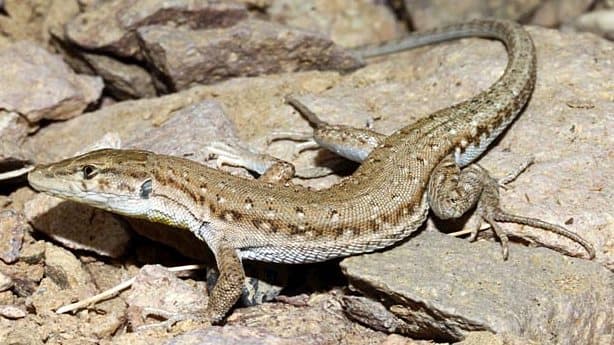
Mesalina watsonana
Mesalina watsonana, commonly known as the Persian long-tailed desert lizard, is a species of sand-dwelling lizard endemic to Asia. It is characterized by its long tail and its adaptation to arid desert environments. This species is oviparous, laying eggs as its primary method of reproduction.