
Mesalina watsonana
Mesalina watsonana, commonly known as the Persian long-tailed desert lizard, is a species of sand-dwelling lizard endemic to Asia. It is characterized by its long tail and its adaptation to arid desert environments. This species is oviparous, laying eggs as its primary method of reproduction.
Key Facts
- ›Endemic to Asia, found in Iran, Turkmenistan, Afghanistan, Pakistan, and India.
- ›Commonly referred to as the Persian long-tailed desert lizard.
- ›Belongs to the sand-dwelling lizard group within the Lacertidae family.
- ›Reproduces by laying eggs (oviparous).
- ›The specific name 'watsonana' honors Mr. H.E. Watson, a CIVIL Officer in Pakistan.
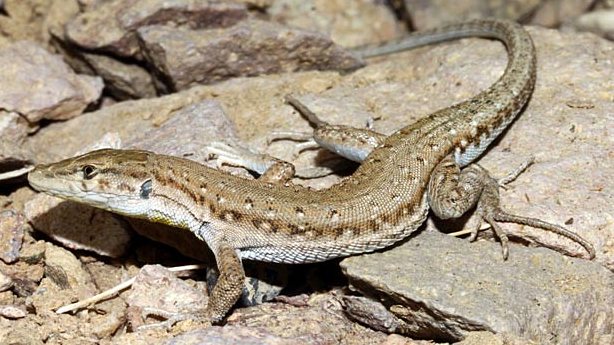
Persian Long-Tailed Desert Lizard
Iran, Turkmenistan, Afghanistan, Pakistan, India
Desert, Arid Environments, Sand-Dwelling
Characterized By A Long Tail., Adapted For Sand-Dwelling Environments.
Sand-Dwelling
About Mesalina watsonana
Mesalina watsonana: The Persian Long-Tailed Desert Lizard
Mesalina watsonana is a species of lizard recognized by its common name, the Persian long-tailed desert lizard. This species is a member of the Lacertidae family and is endemic to the Asian continent. Its adaptations are well-suited to the arid, sand-dwelling environments it inhabits.
Geographic Range and Habitat
The geographic distribution of Mesalina watsonana spans across several countries in Asia, extending from west to east through Iran, Turkmenistan, Afghanistan, Pakistan, and into India. These lizards are typically found in desert regions, where they have evolved to thrive in sandy terrains.
Reproduction and Naming
Mesalina watsonana reproduces by laying eggs, a characteristic known as being oviparous. The specific epithet, "watsonana," was chosen to honor Mr. H.E. Watson, a Civil Officer who served in Pakistan, acknowledging his contributions or observations related to the species.
Source: Wikipedia ↗
Frequently Asked Questions
What is the common name for Mesalina watsonana?
Mesalina watsonana is commonly known as the Persian long-tailed desert lizard. This name reflects its geographic origin and a notable physical characteristic.
Where can Mesalina watsonana be found?
This species is endemic to Asia and has a geographic range that includes Iran, Turkmenistan, Afghanistan, Pakistan, and India. It is typically found in desert environments within these regions.
How does Mesalina watsonana reproduce?
Mesalina watsonana is oviparous, meaning it reproduces by laying eggs. This is a common reproductive strategy among many lizard species.
What is the etymology of the scientific name Mesalina watsonana?
The specific name, watsonana, was given in honor of Mr. H.E. Watson, who served as a Civil Officer in Pakistan. This naming convention recognizes individuals who have contributed to the understanding or observation of the species.
Related Lizards

Brachysaura minor
Hardwicke's bloodsucker, also known as Calotes minor, is a small, stocky agamid lizard found across South Asia. It is characterized by its pot-belly, short tail, and distinct olive-brown coloration with dark-brown spots. Primarily terrestrial and diurnal, this harmless species inhabits dry forests, arid environments, and barren deserts.
Hardwicke's bloodsucker
Hardwicke's bloodsucker (Calotes minor) is a small, stocky agamid lizard native to South Asia. It is characterized by its pot-belly appearance, large head, and distinctively patterned olive-brown coloration with dark-brown, light-edged spots. This terrestrial and sometimes arboreal species inhabits arid environments and dry forests, playing a role in its ecosystem by consuming insects.

Regal horned lizard
The regal horned lizard (Phrynosoma solare) is a small, flat lizard native to the southwestern United States and Mexico. Characterized by spikes along its sides and the ability to squirt blood from its eyes as a defense mechanism, it inhabits arid desert environments with sparse vegetation. Its diet consists primarily of harvester ants.