
Nilgiri day gecko
The Nilgiri day gecko (Cnemaspis nilagirica) is a species of gecko native to southern India. Historically known only from a single female specimen collected in 1885, a live male was discovered in 2019, significantly expanding the understanding of this elusive species. Its precise habitat and population status beyond these two specimens remain largely undocumented.
Key Facts
- ›Endemic to southern India.
- ›First described from a single female specimen collected in 1885.
- ›A live male specimen was collected for the first time in 2019.
- ›Misidentified for many years as a variety of the Kandyan day gecko.
- ›Its natural history and distribution are poorly understood.

Nilgiri Day Gecko
Southern India
- the Species Was Formerly Known Only From A Single Female Specimen. A Live Male Was Collected In 2019.
About Nilgiri day gecko
What is the Nilgiri Day Gecko?
The Nilgiri day gecko, scientifically known as Cnemaspis nilagirica, is a species of gecko that is native to southern India. For over a century, its existence was known only through a single female specimen that was collected in 1885. This specimen was unfortunately misidentified by the taxonomist George Albert Boulenger, who used it as a syntype for his description of a variety of the Kandyan day gecko (C. kandiana var. tropidogaster).
Rediscovery and Current Understanding
After more than 130 years without any reported sightings of live individuals, a significant discovery was made in 2019 when a live male specimen of Cnemaspis nilagirica was collected. This marked the first time a male of the species had ever been documented. The limited historical records and the long gap in observations mean that much of the Nilgiri day gecko's biology, including its specific habitat, population numbers, and behavior, remains largely undocumented and subject to further research.
Source: Wikipedia ↗
Frequently Asked Questions
Where is the Nilgiri day gecko found?
The Nilgiri day gecko is endemic to southern India. Its exact geographic range beyond the initial collection sites is not well-documented.
What is the history of its discovery?
The species was first known from a single female specimen collected in 1885. This specimen was misidentified and used as a syntype for another species. A live male was not collected until 2019, over 130 years later.
Has the Nilgiri day gecko been studied extensively?
No, the Nilgiri day gecko has not been studied extensively. For over a century, it was known only from a single misidentified specimen, and recent discoveries are only beginning to shed light on the species.
Related Lizards
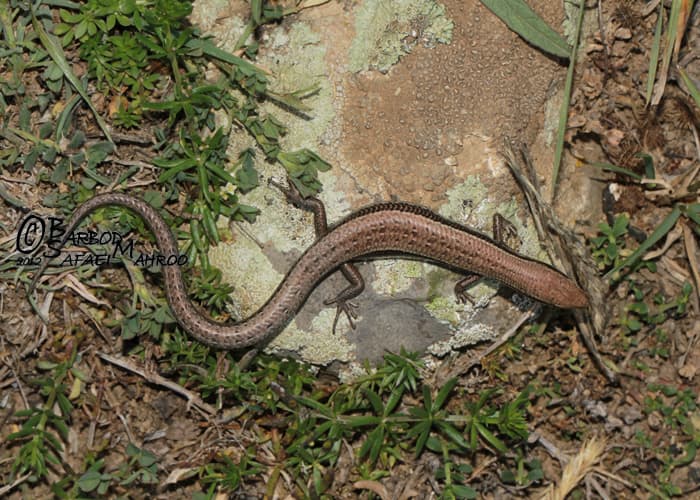
Ablepharus bivittatus
The twin-striped skink (Ablepharus bivittatus) is a species of skink found in mountainous regions of Armenia, Azerbaijan, Turkmenistan, northwestern Iran, and Turkey. It is distinguished by its habitat in high elevations, typically between 2,300 and 3,300 meters.
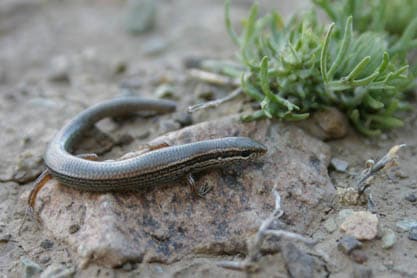
Ablepharus pannonicus
The Asian snake-eyed skink (Ablepharus pannonicus) is a species of skink native to a wide range across Asia and parts of the Middle East. It is characterized by its snake-like appearance and is found in diverse arid and semi-arid environments.

Adam's dravidogecko
Adam's dravidogecko (Dravidogecko douglasadamsi) is a species of gecko native to India. Little is documented about its specific characteristics, habitat, or behaviors, making it a relatively understudied species.