
Orange-spotted day gecko
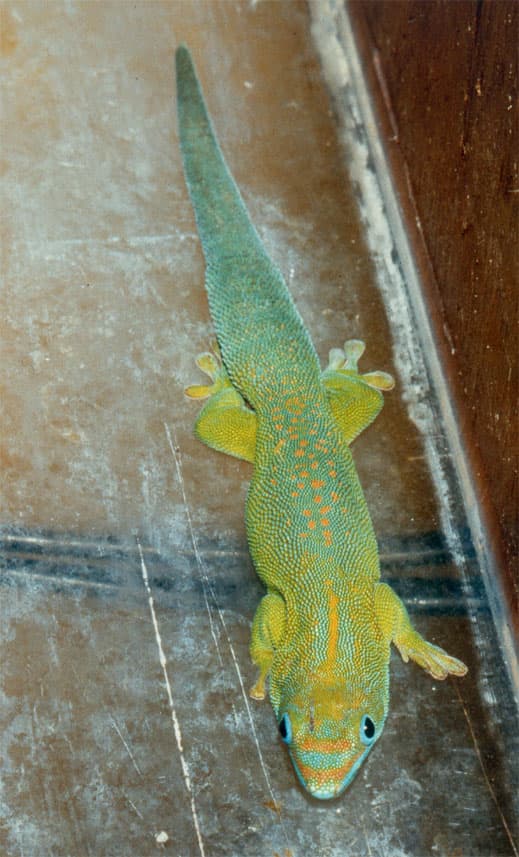
The Mauritius lowland forest day gecko, also known as Guimbeau's day gecko or the orange-spotted day gecko, is a diurnal lizard native to the western coast of Mauritius. It is characterized by its brilliant green dorsal coloration with orange-red markings and a blue neck area, and it inhabits large trees in drier, warmer regions. This species is an insectivore that also consumes nectar and fruit.
Key Facts
- ›Males can reach a total length of approximately 15.5 cm, while females are smaller, ranging from 9 to 13 cm.
- ›Its dorsal side is brilliant green with irregular orange-red bars and spots, and the chin may have brown V-shaped bars.
- ›The species is diurnal and inhabits large trees like palms and acacias in the western lowlands of Mauritius.
- ›It feeds on insects, nectar, pollen, and soft fruits.
- ›The pairing season is from March to September, with females laying up to 6 pairs of eggs.
- ›It is classified as 'endangered' by the IUCN due to habitat loss and fragmentation.

Guimbeau's Day Gecko, Orange-Spotted Day Gecko
Mauritius, Oahu
Lowland Forest, Large Trees, Palms, Acacia Species
- Mid-Sized Genus Phelsuma.
- Males Up To 15.5 cm Total Length; Females 9–13 cm.
- Short, Compact Body Form.
- Brilliant Green Dorsal Body Color With A Diffuse Blue Area On the Neck.
- Irregular Shaped Orange-Red Bars and Spots On the Back and Tail, Which May Have A Blue Tip.
- Ventral Side Is Whitish-Yellow.
- One Or Two Brown V-Shaped Bars On the Chin.
- Juveniles Are Greyish-Brown With Small White Spots, Changing Color After Six Months and Reaching Adult Appearance After 12–15 Months.
Insects, Other Invertebrates, Soft Fruits, Pollen, Nectar
- Diurnal
- Rather Shy Due To Heavy Predation By Bird Species
- Egg Gluer
- Colony Nester
Bird Species
Habitat Loss, Habitat Fragmentation, Commercial Trade As A Terrarium Pet
About Orange-spotted day gecko
Mauritius Lowland Forest Day Gecko
The Mauritius lowland forest day gecko, scientifically known as Phelsuma guimbeaui, is a vibrant diurnal lizard native to the western coastal regions of Mauritius. It is also commonly referred to as Guimbeau's day gecko or the orange-spotted day gecko, with its specific name honoring the collector of its holotype, Mr. B. Guimbeau.
Physical Characteristics
Belonging to the mid-sized Phelsuma genus, males of this species can attain a total length of approximately 15.5 cm, while females are somewhat smaller, ranging from 9 to 13 cm. The gecko possesses a short, compact body. Its dorsal coloration is a striking brilliant green, often featuring a diffuse blue area on the neck. Irregularly shaped orange-red bars and spots adorn its back and tail, the tip of which may be blue. The underside is a whitish-yellow, and one or two brown, v-shaped bars are typically present on the chin. Juveniles start as greyish-brown with small white spots and develop their adult appearance after about 12 to 15 months.
Habitat and Distribution
The Mauritius lowland forest day gecko primarily inhabits large trees, such as palms and acacia species, preferring the drier and warmer parts of Mauritius. Its original habitat, the lowland forest, has been significantly reduced due to sugar cane plantations. Populations are found in areas including Chamarel, Yemen, Tamarin, and Grande Rivière Noire. The species has also been established on the Hawaiian island of Oahu.
Diet and Behavior
As a diurnal species, the Mauritius lowland forest day gecko is active during the day. Its diet is varied, consisting of insects and other invertebrates, and it also consumes soft fruits, pollen, and nectar. The gecko is described as rather shy, largely due to being heavily preyed upon by various bird species.
Reproduction
The pairing season for Phelsuma guimbeaui typically spans from March to early September. During this period, females lay up to six pairs of eggs, often in tree holes, as they are known to be egg gluers and colony nesters. The incubation period for the eggs is approximately 60 to 90 days, and the juveniles measure between 36 and 40 mm upon hatching. They reach sexual maturity after 18 to 20 months.
Conservation Status and Threats
The Mauritius lowland forest day gecko is classified as 'endangered' by the IUCN. Its limited and fragmented habitat poses a significant threat, exacerbated by the historical extinction of many endemic reptile species on mainland Mauritius. Commercial trade as a terrarium pet may also represent a threat, although the extent of this trade is not well-documented. The species is also listed on CITES Appendix II.
Source: Wikipedia ↗
Frequently Asked Questions
What are the common names for Phelsuma guimbeaui?
Phelsuma guimbeaui is commonly known as the Mauritius lowland forest day gecko. It is also frequently referred to as Guimbeau's day gecko and the orange-spotted day gecko.
What is the typical size of the Mauritius lowland forest day gecko?
Males of the species can grow to a total length of about 15.5 cm. Females are smaller, typically measuring between 9 and 13 cm in length.
What is the natural habitat of the orange-spotted day gecko?
The Mauritius lowland forest day gecko prefers large trees, such as palms and acacia species, and is found on the western coast of Mauritius. It lives in the drier and warmer parts of the island, often in lowland forests.
What does the Mauritius lowland forest day gecko eat?
Its diet consists of various insects and other invertebrates. It also supplements its diet by licking soft, sweet fruits, pollen, and nectar.
When do Mauritius lowland forest day geckos reproduce?
The pairing season for Phelsuma guimbeaui occurs between March and the first weeks of September. During this time, females can lay up to 6 pairs of eggs, which hatch after approximately 60 to 90 days.
Is the Mauritius lowland forest day gecko endangered?
Yes, the Mauritius lowland forest day gecko has been evaluated by the IUCN and is listed as 'endangered'. This status is due to its small and fragmented habitat, and historical extinctions of other endemic reptiles on mainland Mauritius.
Related Lizards
Phelsuma flavigularis
The yellow-throated day gecko (Phelsuma flavigularis) is an endangered, diurnal gecko native to eastern Madagascar's rainforests. This medium-sized species is characterized by its bluish-green body, red snout bars, and a distinctive yellow throat. It primarily inhabits trees and feeds on insects and nectar.

Phelsuma klemmeri
The yellow-headed day gecko (Phelsuma klemmeri) is a small, diurnal lizard endemic to northwestern Madagascar. Its distinctive features include a turquoise-blue body, a yellow head, and a laterally flattened form. It primarily inhabits bamboo forests and is known to feed on insects and nectar.

Phelsuma seippi
Phelsuma seippi, also known as Seipp's day gecko, is a medium-sized, diurnal lizard native to the rainforests of northern Madagascar. Characterized by its slender, long-snouted body, it exhibits green or yellowish-green coloration with distinctive red or rust-colored spots and markings, including a rust-colored eye stripe and potential v-shaped stripes on the throat. This arboreal species primarily feeds on insects and nectar, and is considered endangered.