
Orange-throated whiptail
The orange-throated whiptail is a lizard species native to southern California and parts of Mexico, characterized by its distinctive light-colored stripes on a dark dorsal side and a notable orange throat in males. It exhibits a unique jerking gait and juveniles are recognized by their vibrant cobalt blue legs and tails. This species, previously classified under the genus Cnemidophorus, is a member of the Teiidae family.
Key Facts
- ›Native to southern California, USA, and Baja California, Mexico.
- ›Features five or six light-colored stripes on a black, brown, or grey back.
- ›Males typically display an orange throat, a feature less common or absent in females and juveniles.
- ›Juveniles are distinguished by cobalt blue legs and tails.
- ›Possesses a distinctive, jerking gait.
- ›Males have larger femoral pores than females.
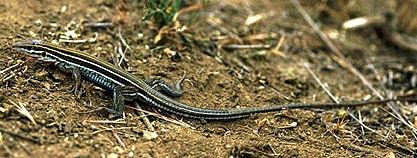
Orange-Throated Racerunner
Southern California, United States, Baja California, Mexico, Baja California Sur, Mexico
- Five Or Six Light-Colored Stripes On A Black, Brown, Or Grey Dorsal Side.
- Middle Stripe May Be Forked At Both Ends.
- Whitish-Yellow Or Cream Venter.
- Orange Throat .
- Head Is Yellow-Brown To Olive-Colored.
- Tongue Is Forked and Flicked Continually.
- Snout-To-Vent Length of 5–7.2 cm .
- Juveniles Have Cobalt Blue Legs and Tails.
- Entire Ventral Surface of Males, Including Tail, May Be Orange.
- Gravid Females May Have Some Orange, Especially Lining the Lower Jaw.
- Colors Are Most Distinct During the Breeding Season.
- Males Have Larger Femoral Pores Than Females.
Distinctive, Jerking Gait.
About Orange-throated whiptail
The orange-throated whiptail ( Aspidoscelis hyperythrus ), formerly classified under the genus Cnemidophorus, is a fascinating lizard species found in the arid and semi-arid regions of southern California in the United States and extending into the Mexican states of Baja California and Baja California Sur.
Physical Characteristics
This species is distinguished by its striking appearance. Its dorsal side is typically black, brown, or grey, adorned with five or six prominent light-colored stripes, with the central stripe sometimes bifurcating at its ends. The underside is a pale whitish-yellow or cream. A key characteristic, particularly evident in males during the breeding season, is a vibrant orange throat, though females and juveniles may lack this feature or display it less intensely. The head often presents in shades of yellow-brown to olive, and like many lizards, it possesses a forked tongue that is constantly flicked. Adult individuals measure between 5 and 7.2 centimeters (2.0 to 2.8 inches) in snout-to-vent length. Juveniles are particularly noticeable for their bright cobalt blue legs and tails.
Behavior and Reproduction
The orange-throated whiptail exhibits a unique and recognizable jerking gait. While specific details about their diet, lifespan, and natural predators are not extensively detailed in available records, they are part of the Teiidae family, which often includes insectivorous species. Reproduction is oviparous, meaning they lay eggs. Males can be differentiated from females not only by their coloration but also by having larger femoral pores.
Distribution and Habitat
The geographic range of the orange-throated whiptail is confined to the southern parts of California and the Baja California peninsula in Mexico. Its habitat typically consists of the dry scrublands, chaparral, and open areas characteristic of these regions.
Source: Wikipedia ↗
Frequently Asked Questions
What are the defining physical characteristics of the orange-throated whiptail?
The orange-throated whiptail is identifiable by five or six light-colored stripes running down its dark dorsal side. It has a whitish-yellow to cream underside and, particularly in males, a striking orange throat. The head is typically yellow-brown to olive, and its tongue is forked and frequently flicked.
Where is the orange-throated whiptail found geographically?
This species is native to the southern regions of California in the United States. It also inhabits the Mexican states of Baja California and Baja California Sur.
How can one distinguish adult males from females and juveniles?
Adult males are most notably identified by their orange throat, a characteristic that is often absent or less pronounced in females and juveniles. Additionally, males tend to have larger femoral pores compared to females. Gravid females may also show some orange coloration, particularly around the lower jaw.
What is unique about the appearance of juvenile orange-throated whiptails?
Juveniles of the orange-throated whiptail species are easily recognized by their vibrant cobalt blue legs and tails. This coloration is a striking contrast to the adult coloration and helps in their identification.
What is the typical size of an adult orange-throated whiptail?
Adult orange-throated whiptails generally have a snout-to-vent length ranging from 5 to 7.2 centimeters (approximately 2.0 to 2.8 inches).
Does the orange-throated whiptail have any unusual behaviors?
Yes, the orange-throated whiptail exhibits a distinctive and somewhat jerky gait as it moves. This unique way of locomotion is a notable behavioral trait of the species.
Related Lizards

Aaron Bauer's house gecko
Aaron Bauer's house gecko is a species of lizard found in the Western Ghats of Maharashtra, India. It is notable for its relatively large size within its genus, reaching up to 13 cm in snout-to-vent length. This species prefers rocky outcrops within forested areas as its natural habitat.

Ablepharus
Ablepharus, commonly known as snake-eyed skinks, are small lizards distinguished by fused eyelids that prevent blinking, similar to snakes. They inhabit dry fields, hills, and rocky areas, often concealed within leaf litter. These skinks possess shiny, bronze scales and a characteristic dark stripe along their sides, feeding primarily on small insects and mollusks.

Abor hills agama
The Abor Hills agama, scientifically known as Japalura austeniana, is a rare lizard species belonging to the Agamidae family, endemic to Asia. This species is characterized by its notably long tail relative to its body length. It has been documented in parts of India and Bhutan, with a significant rediscovery occurring in 2006.