
Ornate Crevice-Dragon
The Ornate Crevice-Dragon, also known as the ornate dragon, is a species of lizard belonging to the Agamidae family, endemic to the granite outcrops of Western Australia. It is characterized by its greatly flattened body, a distinctly banded tail, and a common habit of head-bobbing when basking.
Key Facts
- ›Found on granite outcrops in Western Australia.
- ›Distinguished by a flattened body and a banded tail.
- ›Commonly observed basking on warm rocks.
- ›Exhibits head-bobbing behavior, typical of rock dragons.
- ›Distribution spans from the Goldfields to the Darling Range and southern coastline.
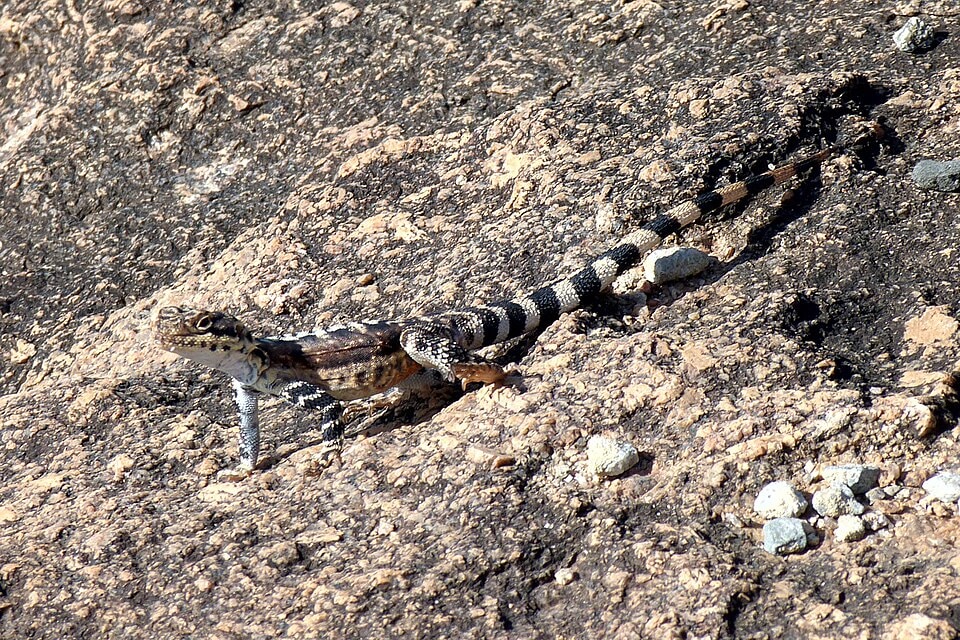
Ornate Dragon
Western Australia, Goldfields, Darling Range, Southern Coastline, Archipelago of the Recherche, Murchison District
Greatly Flattened Body, Total Length Around 290 mm, Snout-To-Vent Length of 95 mm, Distinctly Banded Tail, Reddish Form Noted In Murchison District
Basking On Warm Rocks, Head-Bobbing Behavior, Shelters Under Slabs and Boulders
About Ornate Crevice-Dragon
The Ornate Crevice-Dragon, scientifically known as Ctenophorus ornatus, is a distinctive lizard species belonging to the Agamidae family. This species is native to the striking granite outcrops found across Western Australia, where it has adapted to life among these rocky formations.
Physical Characteristics
This lizard is easily identified by its remarkably flattened body, which can reach an approximate total length of 290 mm, with a snout-to-vent length measuring around 95 mm. A notable feature is its distinctly banded tail, which adds to its unique appearance. While the general description applies, a reddish color variation has been observed in the Murchison district, indicating some regional diversity.
Habitat and Distribution
The Ornate Crevice-Dragon is a common inhabitant of granite outcrops. It prefers to shelter beneath rock slabs and boulders, especially in areas that are less disturbed by human activity. Its geographic range is quite extensive, covering regions from the Goldfields to the Darling Range and extending to the southern coastline of Western Australia. The species has also been recorded on the granite islands of the Archipelago of the Recherche.
Behavior
When seeking warmth, the Ornate Crevice-Dragon is often observed basking on sun-heated rocks. During these times, it exhibits a characteristic head-bobbing behavior, a common trait among many species within the rock dragon group, to which it belongs. This behavior is part of its display repertoire and likely plays a role in communication or thermoregulation.
Source: Wikipedia ↗
Frequently Asked Questions
What are the distinguishing physical features of the Ornate Crevice-Dragon?
The Ornate Crevice-Dragon is recognized for its greatly flattened body, which can reach a total length of around 290 mm with a snout-to-vent length of 95 mm. It also possesses a distinctly banded tail.
Where can the Ornate Crevice-Dragon be found?
This species inhabits the granite outcrops of Western Australia. Its distribution range extends from the Goldfields to the Darling Range and along the southern coastline, including offshore islands.
What kind of habitat does the Ornate Crevice-Dragon prefer?
The Ornate Crevice-Dragon is commonly found on granite outcrops, where it seeks shelter under slabs and boulders, particularly in undisturbed areas. They are often seen basking on warm rocks when out in the open.
Does the Ornate Crevice-Dragon exhibit any specific behaviors?
Yes, when basking on warm rocks, the Ornate Crevice-Dragon displays a characteristic head-bobbing behavior, which is common among many related rock dragon species.
Are there different color variations of the Ornate Crevice-Dragon?
A reddish form of the Ornate Crevice-Dragon has been noted in the Murchison district, suggesting some regional color variations within the species.
Related Lizards

Bezy's night lizard
Bezy's night lizard (Xantusia bezyi) is a small, smooth-skinned lizard found in central Arizona. Its habitat includes desert highlands and pine woodlands, where it shelters under exfoliating rock in granite outcrops. Distinctive features include a flattened head, dark splotches on its back, and eyes lacking eyelids with vertical pupils.

Anandan's day gecko
Anandan's day gecko (Cnemaspis anandani) is a diurnal, rock-dwelling gecko species found in Tamil Nadu, India. As an insectivore, its diet consists of insects, and it is a small lizard adapted to its rocky habitat.

Broadleysaurus major
The Sudan plated lizard, scientifically known as Broadleysaurus major, is a medium-sized, diurnal African lizard characterized by its heavily armored appearance with plate-like keeled scales. It inhabits rocky, semi-open areas across eastern and central Africa, including Tanzania, Kenya, and Mozambique. Primarily an omnivore, its diet consists mainly of insects but also includes fruits, vegetation, and small vertebrates.