
Paracontias hildebrandti
Paracontias hildebrandti, commonly known as Hildebrandt's skink, is a legless lizard species native to Madagascar. It inhabits forests and disturbed areas, and is distinguished by its lack of external ear openings. This species is oviparous, laying eggs as its primary mode of reproduction.
Key Facts
- ›Endemic to Madagascar, including the island of Nosy be.
- ›Possesses no legs and lacks external ear openings.
- ›Inhabits forests and can be found in disturbed areas like cacao plantations.
- ›Reproduces by laying eggs (oviparous).
- ›Named in honor of German botanist Johann Maria Hildebrandt.

Hildebrandt's Skink, Hildebrand's Skink
Madagascar, Nosy Be
Forest, Disturbed Areas, Cacao Plantations
Legless, No External Ear Openings
About Paracontias hildebrandti
Paracontias hildebrandti: Hildebrandt's Skink
Paracontias hildebrandti, commonly referred to as Hildebrandt's skink, is a unique species of lizard belonging to the Scincidae family. This species is endemic to the island of Madagascar, with documented populations found in the northern regions, including the island of Nosy Be.
Habitat and Distribution
Hildebrandt's skink thrives in forest environments, inhabiting areas that range from sea level up to elevations of 1,500 meters (approximately 4,900 feet). Beyond its preferred natural forests, the species has also adapted to and can be found in disturbed landscapes, such as cacao plantations. This adaptability suggests a resilience to human-altered environments.
Physical Characteristics
One of the most striking physical features of Paracontias hildebrandti is its complete lack of legs, presenting a serpentine form. Further distinguishing it from many other lizard species, it also possesses no discernible external ear openings. These traits contribute to its specialized morphology.
Reproduction
The reproductive method of Paracontias hildebrandti is oviparous, meaning that the species reproduces by laying eggs. While specific details regarding clutch size and incubation periods are not extensively documented in available records, the oviparous nature is a key aspect of its life cycle.
Etymology
The specific name, hildebrandti, was given in honor of Johann Maria Hildebrandt, a German botanist. This naming convention highlights the contributions of individuals to the scientific exploration and documentation of biodiversity.
Source: Wikipedia ↗
Frequently Asked Questions
What is Paracontias hildebrandti commonly known as?
Paracontias hildebrandti is commonly known as Hildebrandt's skink or Hildebrand's skink. These common names refer to its distinctive appearance and habitat.
Where is Hildebrandt's skink found?
Hildebrandt's skink is found in northern Madagascar, including the island of Nosy Be. Its natural range extends from sea level up to altitudes of 1,500 meters.
What are the distinctive physical characteristics of Paracontias hildebrandti?
A notable characteristic of Paracontias hildebrandti is that it has no legs. Additionally, it lacks external ear openings, which sets it apart from many other lizard species.
What type of habitat does Hildebrandt's skink prefer?
The preferred natural habitat for Paracontias hildebrandti is forest environments. However, it has also been observed in disturbed areas, such as cacao plantations.
How does Paracontias hildebrandti reproduce?
Paracontias hildebrandti is oviparous, meaning it reproduces by laying eggs. The specifics of its nesting behavior are not detailed, but egg-laying is its established reproductive method.
Related Lizards
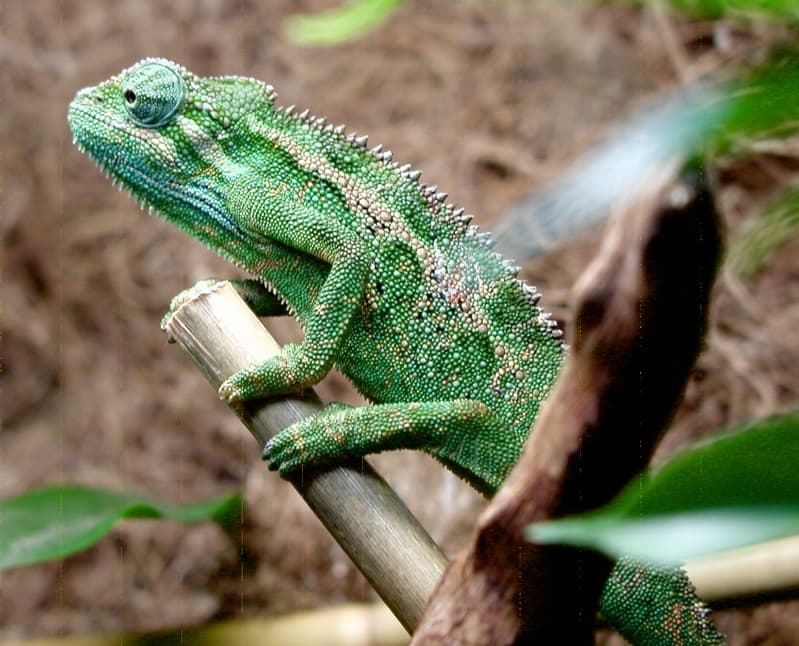
Trioceros ellioti
Trioceros ellioti, commonly known as Elliot's chameleon, is a species of lizard native to Africa. It inhabits diverse environments from forests to grasslands at moderate altitudes. This chameleon is characterized by its viviparous or ovoviviparous reproductive strategy.

Black spiny-tailed iguana
The black spiny-tailed iguana (Ctenosaura similis) is a large iguanid lizard native to Mexico and Central America, known for the distinctive black, keeled spines on its tail. It inhabits grasslands and forests, and is an excellent climber, capable of remarkable speeds. While primarily herbivorous, it will opportunistically consume small animals and eggs.

Calumma brevicorne
The short-horned chameleon (Calumma brevicorne) is a species endemic to Madagascar, characterized by its compressed body, spindly limbs, and prehensile tail adapted for an arboreal lifestyle. Males possess a distinctive short bony rostral appendage on their snout and ear-like occipital lobes, which they raise when threatened. Generally grayish, its coloration can vary between sexes and regions, with males sometimes displaying lighter heads and greener specimens having blue legs.