
Phelsuma guttata
The speckled day gecko (Phelsuma guttata) is a medium-sized, diurnal lizard found in eastern Madagascar's rainforests. Characterized by its dark green body with orange spots and a distinctive black eye stripe, it inhabits trees and bushes. This species feeds on insects, nectar, and soft fruits, and is often observed in pairs.
Key Facts
- ›Diurnal species inhabiting rainforests of eastern Madagascar.
- ›Reaches a total length of approximately 13 cm.
- ›Possesses a dark green body with orange spots, a black eye stripe, and V-shaped throat stripes.
- ›Diet consists of insects, nectar, and soft fruits.
- ›Females lay a pair of eggs, typically hidden on the ground or under tree bark.
- ›Juveniles hatch after 40-45 days at 28°C and measure 45 mm.
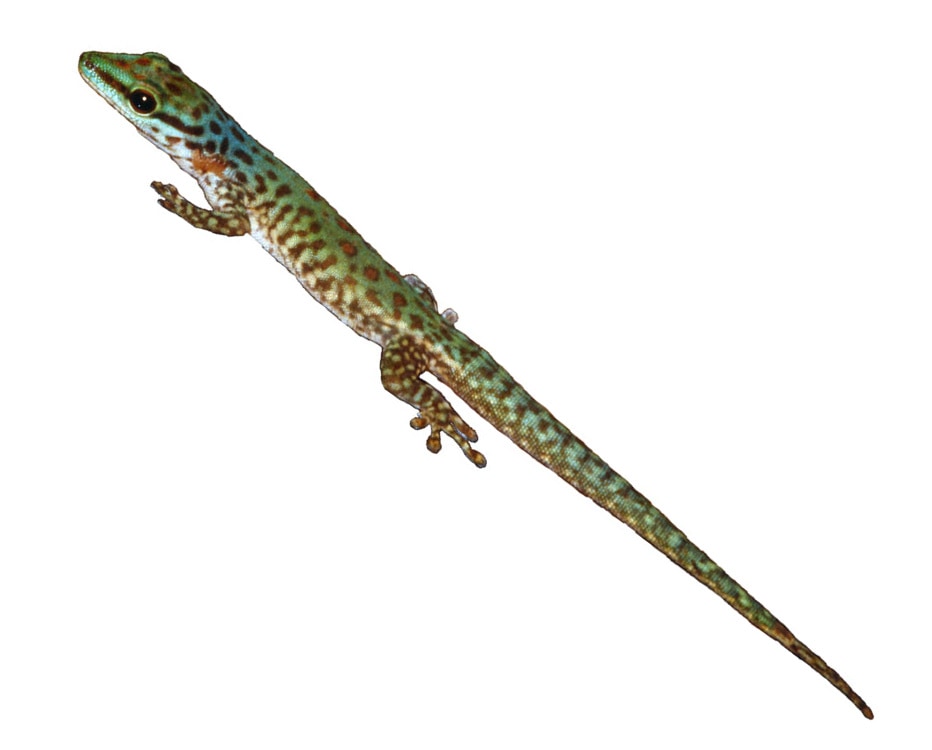
Speckled Day Gecko
Madagascar
- Medium-Sized Day Gecko.
- Can Reach A Total Length of About 13 cm.
- Slender and Long-Snouted.
- Body Color Is Dark Green.
- Several Small Orange Spots On the Middle and Lower Portion of the Back.
- Black Eye Stripe Extends From the Nostril To Above the Ear Opening.
- Several V-Shaped Stripes On the Throat.
- Flanks, Legs, and Toes Are White Speckled.
- Some Populations Have Blue Spots In the Neck Region.
- Ventral Side Is Grayish White.
Insects, Nectar, Soft Fruits, Pollen, Invertebrates
- Diurnal.
- Often Found In Pairs On A Tree.
- Juveniles Mainly Inhabit Surrounding Low Shrubs.
About Phelsuma guttata
Speckled Day Gecko (Phelsuma guttata)
The speckled day gecko, scientifically identified as Phelsuma guttata, is a diurnal reptile species native to the eastern rainforests of Madagascar. This medium-sized gecko is characterized by its slender, long-snouted build and a striking dark green coloration. Its back is marked with numerous small orange spots, and a distinct black stripe runs from its nostril to its ear opening. A notable feature is the presence of several v-shaped stripes on its throat, and its flanks, legs, and toes are adorned with white speckling. Some populations also exhibit blue spots in the neck region, while its underside is a grayish white.
Habitat and Distribution
Phelsuma guttata inhabits the coastal regions of north-east Madagascar and can also be found on nearby islets. It primarily resides in rainforest environments, where it typically lives on trees. While it tends to avoid direct, bright sunlight, it has adapted to secondary habitats as primary rainforest has diminished. Consequently, it can now also be observed on bushes and on introduced banana trees.
Diet and Behavior
As a day gecko, Phelsuma guttata is active during daylight hours. Its diet is varied, consisting of insects and other invertebrates, alongside a preference for soft, sweet fruits, pollen, and nectar. These geckos are often encountered in pairs while inhabiting trees, suggesting a social structure that involves companionship. Juveniles, however, tend to occupy lower-lying shrubs in the surrounding areas.
Reproduction
Reproduction in the speckled day gecko involves the female laying a clutch of two eggs. These eggs are carefully hidden, either on the ground beneath foliage or wood, or within tree crevices under loose bark. The incubation period is approximately 40 to 45 days when maintained at a temperature of 28°C. Upon hatching, the juveniles measure around 45 mm in length.
Source: Wikipedia ↗
Frequently Asked Questions
What is the speckled day gecko?
The speckled day gecko, scientifically known as Phelsuma guttata, is a diurnal lizard species. It is recognized for its distinctive coloration and its habitat within the rainforests of eastern Madagascar.
What does the speckled day gecko look like?
This medium-sized gecko has a slender, long-snouted body that is dark green in color. It is adorned with small orange spots on its back, a black stripe extending from the nostril to the ear, and v-shaped stripes on its throat. White speckling is present on its flanks, legs, and toes.
Where does the speckled day gecko live?
The speckled day gecko is native to north-east Madagascar, found along the coast and on some adjacent islets. It typically resides in rainforests, dwelling on trees and sometimes bushes.
What is the diet of the speckled day gecko?
Their diet primarily consists of various insects and other invertebrates. They also supplement their food intake by licking soft, sweet fruits, pollen, and nectar.
How does the speckled day gecko reproduce?
Females of this species lay a pair of eggs, which they conceal on the ground under foliage or wood, or under loose bark on trees. The young hatch after about 40–45 days at a temperature of 28°C.
What are the habitat preferences of Phelsuma guttata?
Phelsuma guttata prefers rainforest environments, where they generally live on trees. However, due to habitat changes, they have adapted to living on bushes and introduced banana trees.
Related Lizards

Phelsuma cepediana
The blue-tailed day gecko (Phelsuma cepediana), also known as Lacépède's gecko, is a diurnal lizard endemic to Mauritius. This mid-sized gecko is known for its striking coloration, with males displaying vibrant blue tails and red spots, while females are a bright green. It inhabits warm, humid environments on trees and bushes, playing a crucial role as the sole pollinator and seed disperser for the endemic shrub Roussea simplex.

Phelsuma seippi
Phelsuma seippi, also known as Seipp's day gecko, is a medium-sized, diurnal lizard native to the rainforests of northern Madagascar. Characterized by its slender, long-snouted body, it exhibits green or yellowish-green coloration with distinctive red or rust-colored spots and markings, including a rust-colored eye stripe and potential v-shaped stripes on the throat. This arboreal species primarily feeds on insects and nectar, and is considered endangered.

Phelsuma breviceps
Phelsuma breviceps is a small, diurnal gecko species native to the dry regions of southwestern Madagascar. Known for its short snout, this lizard typically inhabits trees and bushes, often found on the thorny succulent *Euphorbia stenoclada*. Its diet primarily consists of insects, though it will also consume nectar.