
Phoenicolacerta troodica
The Phoenicolacerta troodica, commonly known as the Troodos wall lizard, is a small lizard endemic to Cyprus. It is characterized by its brownish-green to greyish-green coloration, featuring a distinct dark brown stripe along its sides. During the breeding season, males exhibit vibrant orange blotches and spots.
Key Facts
- ›Endemic to the island of Cyprus.
- ›Small lizard, typically reaching up to 10 cm (3.9 in) in length.
- ›Coloration is brownish-green to greyish-green with a dark brown lateral stripe.
- ›Males develop orange markings on the head and flanks during breeding season.
- ›Inhabits a variety of environments from sea level to 1,600 meters, with a need for shade.
- ›Belongs to the Lacertidae family, commonly known as "typical lizards".

Troodos Wall Lizard, Troodos Rock Lizard, Troodos Lizard, Cyprus Lizard, Cyprus Wall Lizard
Cyprus
Varied Habitats, Areas With Shade
- Small Lizard With A Maximum Length of 15 cm , Typically Around 10 cm .
- Overall Coloration Is Brownish Green To Greyish Green.
- Features A Broad, Longitudinal Dark Brown Stripe Running Along the Sides From Snout To Tail.
- A White Line Runs Along the Lower Margin of the Dark Stripe, Separating It From the Pale Underside.
- Breeding Males Develop Orange Blotches On the Sides of the Head.
- Breeding Males' Undersides Change To Orange With Blue and Red Spots Along the Flanks.
About Phoenicolacerta troodica
Phoenicolacerta troodica: The Troodos Wall Lizard
The Phoenicolacerta troodica, widely recognized by common names such as the Troodos wall lizard, Troodos rock lizard, or Cyprus lizard, is a species of reptile belonging to the Lacertidae family, often referred to as "typical lizards." This small lizard is exclusively found on the island of Cyprus, making it an endemic species to this Mediterranean locale.
Description and Characteristics
Phoenicolacerta troodica is characterized by its modest size, with adults typically reaching about 10 cm (3.9 inches) in snout-to-vent length, though they can grow up to a maximum of 15 cm (5.9 inches). Its coloration is generally a brownish-green to greyish-green, distinguished by a prominent dark brown stripe that extends longitudinally along its sides, running from the snout all the way to the tail. This dark stripe is bordered below by a thin white line, which in turn separates it from the lizard's pale underside. A notable feature of the species is the seasonal transformation observed in males; during the breeding season, they develop vivid orange blotches on the sides of their heads, and their ventral surfaces become orange, often adorned with blue and red spots along their flanks.
Distribution and Habitat
This lizard's range is confined entirely to Cyprus, where it is distributed across the entire island. Phoenicolacerta troodica demonstrates a remarkable adaptability to various environments, inhabiting areas from sea level up to elevations of 1,600 meters (5,200 feet). Regardless of the specific locale, the availability of shade appears to be a critical factor in its habitat selection.
Taxonomy
The species was formally described in 1936 by Austrian herpetologist Franz Werner, initially as Lacerta laevis troodica. It is now classified as a distinct species within the genus Phoenicolacerta. The genus name itself is derived from "Phoenice" (Phoenicia) and "lacerta" (lizard), referencing the geographical origin of many species within the group. The specific name, troodica, directly points to its type locality in the Troodos Mountains of Cyprus.
Source: Wikipedia ↗
Frequently Asked Questions
What is the scientific name of the Troodos wall lizard?
The scientific name of the Troodos wall lizard is Phoenicolacerta troodica. It was first described as Lacerta laevis troodica in 1936.
Where is the Phoenicolacerta troodica found?
Phoenicolacerta troodica is endemic to Cyprus and can be found all over the island. It inhabits diverse environments ranging from sea level up to altitudes of 1,600 meters.
What are the physical characteristics of the Troodos wall lizard?
This is a small lizard, typically measuring around 10 cm (3.9 in) in length, with a maximum of 15 cm (5.9 in). Its body is usually brownish-green to greyish-green, marked by a prominent dark brown stripe along its sides, bordered by a white line below. Males display distinctive orange markings on their heads and undersides during the breeding season.
What kind of habitat does the Troodos wall lizard prefer?
Phoenicolacerta troodica thrives in a wide array of habitats across Cyprus, from coastal areas to mountainous regions. A key requirement for its habitat is the availability of shade.
Are there any notable changes in appearance for males during breeding season?
Yes, during the breeding season, male Phoenicolacerta troodica develop striking orange blotches on the sides of their heads. Their undersides also turn orange, and they exhibit blue and red spots along their flanks.
Related Lizards
Abrolhos bearded dragon
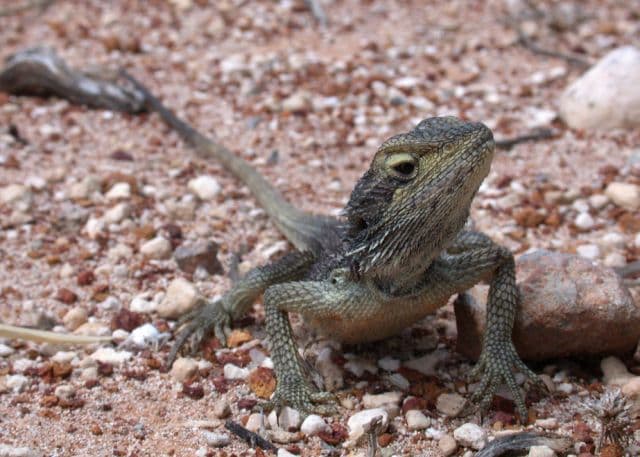
The Abrolhos bearded dragon (Pogona minor minima) is a small agamid lizard endemic to the islands of the Houtman Abrolhos archipelago off the coast of Western Australia. It is characterized by its smaller size compared to related bearded dragons and inhabits sandy or limestone outcrop environments.

Algerian sand racer
The Algerian sand racer, scientifically known as Psammodromus algirus, is a lizard species found in southwestern Europe and northwestern Africa. It typically inhabits dense bushy vegetation and can be found at high elevations, though it is more common at lower altitudes. This species is characterized by its metallic brownish dorsal coloration with conspicuous white or yellowish stripes.

Amphiglossus decaryi
The rock skink, scientifically known as Flexiseps decaryi, is a species of skink found exclusively on the island of Madagascar. As a member of the skink family, it is characterized by its smooth, overlapping scales and typically elongated body. Its specific ecological niche and behavioral patterns are not extensively detailed in available records.