
Pholidoscelis plei
The Anguilla Bank ameiva (Pholidoscelis plei) is a lizard species found across several Caribbean islands including Anguilla, Saint Martin, and Saint Barthélemy. Its appearance varies significantly between island populations, with adults often exhibiting gray-brown or green-brown coloration and distinct spotting or striping. This oviparous species inhabits forests and marine intertidal zones.
Key Facts
- ›Found on the Caribbean islands of Anguilla, Saint Martin, and Saint Barthélemy.
- ›Coloration and markings vary between populations on different islands.
- ›Adults on Anguilla are gray-brown with green-blue tinges and white to light green spots.
- ›Juveniles are brown with seven light stripes.
- ›Inhabits forest and marine intertidal habitats.
- ›Reproduces by laying eggs (oviparous).

Anguilla Bank Ameiva, Caribbean Ameiva
Anguilla, Saint Martin, Saint BarthéLemy
- Adult Coloration Varies, Often Gray-Brown Tinged With Green-Blue.
- Adults May Have White To Light Green Spots On Flanks, Sometimes Merging Into A Barred Pattern.
- Ventral Surface Is Unspotted and Light Blue To White.
- Juveniles Are Brown With Seven Light Stripes, Which Can Be Broken.
- Males Reach A Maximum Snout-To-Vent Length of 181 mm; Females Reach 139 mm Svl.
- Saint Martin Subspecies Has Faded Stripes and 3-5 Vertical Black Bars On the Shoulder Area In Larger Individuals.
- Saint BarthéLemy Populations Show Variation: Main Island Is Green-Brown With Green-Blue Sides and Heavy Spotting; îLe Fourchue Population Is Uniformly Reddish-Brown With Side Spots Or Bars.
Mongoose
Predation From Mongoose
About Pholidoscelis plei
The Anguilla Bank ameiva, scientifically known as Pholidoscelis plei, is a species of lizard belonging to the Teiidae family. This species is endemic to a few Caribbean islands, specifically Anguilla, Saint Martin, and Saint Barthélemy in the Lesser Antilles. Its common names, Anguilla Bank ameiva and Caribbean ameiva, directly reference its geographic range and taxonomic classification.
Physical Characteristics and Variation
A notable characteristic of Pholidoscelis plei is the significant variation in its coloration and markings across different island populations. On Anguilla, adults typically display a gray-brown base color with hints of green-blue. Their flanks are adorned with white to light green spots that can coalesce to form a barred pattern, though the distinctiveness of these markings can differ. The underside is plain, ranging from light blue to white. Juveniles on Anguilla are brown and distinguished by seven light stripes, which may sometimes be interrupted. Adult males can reach a snout-to-vent length (SVL) of up to 181 mm, while females are generally smaller, with a maximum SVL of 139 mm. Maximum sizes, however, can vary among island populations.
On Saint Martin, a distinct subspecies, P. p. analifera, has been described. This subspecies is characterized by faded stripes and, in larger individuals, three to five vertical black bands across the shoulder region. The presence of the widespread mongoose on Saint Martin poses a significant threat, restricting the ameiva population to very specific areas where it might otherwise thrive.
Populations on Saint Barthélemy exhibit further distinctiveness. On the main island, the ground color is green-brown with green-blue sides, heavily marked with green to cream-colored spots. In contrast, the population on Île Fourchue is a uniform reddish-brown, with minimal dorsal markings and spots or bars along its sides.
Habitat and Reproduction
The natural habitats of Pholidoscelis plei are diverse, encompassing both forest environments and marine intertidal zones. The species is oviparous, meaning it reproduces by laying eggs. Detailed information regarding nesting behavior or clutch sizes is not extensively documented in available records.
Source: Wikipedia ↗
Frequently Asked Questions
What are the common names for Pholidoscelis plei?
Pholidoscelis plei is commonly known as the Anguilla Bank ameiva and the Caribbean ameiva. These names reflect its geographic distribution and taxonomic family.
Where is the Anguilla Bank ameiva found?
The Anguilla Bank ameiva is naturally found on the Caribbean islands of Anguilla, Saint Martin, and Saint Barthélemy, which are part of the Lesser Antilles.
How does the appearance of Pholidoscelis plei vary?
The coloration and markings of Pholidoscelis plei vary considerably between island populations. For instance, adults on Anguilla have gray-brown bodies with green-blue tinges and spots, while those on Saint Barthélemy can be green-brown with heavy spotting or uniformly reddish-brown.
What are the natural habitats of the Anguilla Bank ameiva?
The natural habitats of Pholidoscelis plei include forests and marine intertidal zones. These environments provide the necessary conditions for its survival and foraging.
How does the Anguilla Bank ameiva reproduce?
Pholidoscelis plei is oviparous, meaning it reproduces by laying eggs. Specific details about nesting or clutch size are not extensively documented.
Are there different subspecies of Pholidoscelis plei?
Yes, two subspecies of Pholidoscelis plei are recognized as valid. One of these, P. p. analifera, was described from the population on Saint Martin, differing by having faded stripes and shoulder bands.
Related Lizards
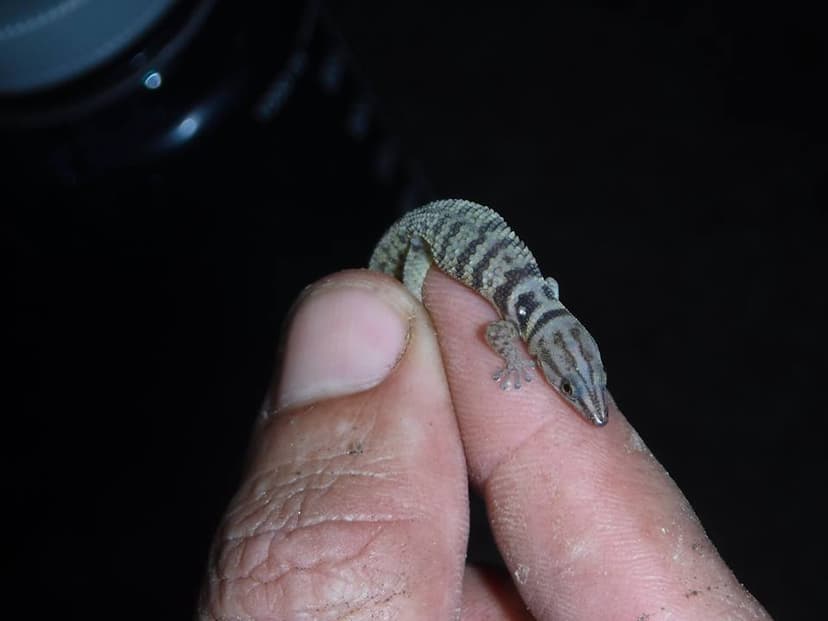
Richard's banded sphaero
Richard's banded sphaero, scientifically known as Sphaerodactylus richardi, is a small gecko species endemic to Cuba. It is characterized by its large, non-overlapping dorsal scales and a distinct pattern of bold dark crossbands on its body. This species inhabits forests, shrublands, and marine intertidal zones.

Aaron Bauer's house gecko
Aaron Bauer's house gecko is a species of lizard found in the Western Ghats of Maharashtra, India. It is notable for its relatively large size within its genus, reaching up to 13 cm in snout-to-vent length. This species prefers rocky outcrops within forested areas as its natural habitat.

Adolfus jacksoni
Adolfus jacksoni, also known as Jackson's forest lizard, is a species of lizard belonging to the Lacertidae family, native to East Africa. It prefers forest habitats at significant altitudes and exhibits diurnal and semi-arboreal behaviors. This oviparous species lays clutches of three to five eggs, and communal nesting sites have been observed.