
Phrynocephalus mystaceus
Phrynocephalus mystaceus·Agamidae
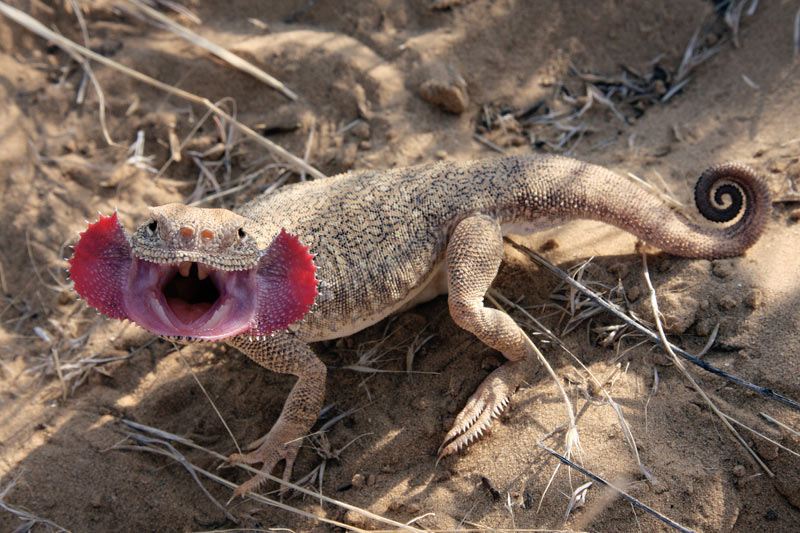
Phrynocephalus mystaceus, commonly known as the secret toadhead agama, is a species of agamid lizard found across parts of Asia, including southern Russia, Kazakhstan, and northwestern China. Its most striking characteristic is its unique defense mechanism, where it flattens its body, opens its mouth wide to reveal brightly colored flaps, and hisses to deter predators.
Key Facts
- ›Found in sandy desert environments across Central Asia and parts of Russia and China.
- ›Possesses a distinctive defense mechanism involving body flattening, gaping mouth, and hissing.
- ›Inhabits the tops of large, high sand dunes, often in arid, unvegetated areas.
- ›Two subspecies are recognized: P. M. mystaceus and P. M. khorasanus.
- ›The species is known for its ability to scare off predators with its defensive display.
Secret Toadhead Agama, Toad-Headed Agama
Southern Russia, Kazakhstan, Northwestern China, Northern Iran, Afghanistan, Turkmenistan, Tajikistan, Kyrgyzstan, Uzbekistan
- Exhibits A Unique Defense Mechanism When Threatened, Involving Body Flattening, Mouth Gaping With Bright Flaps, and Hissing.
About Phrynocephalus mystaceus
Phrynocephalus mystaceus: The Secret Toadhead Agama
The Phrynocephalus mystaceus, more commonly known as the secret toadhead agama or toad-headed agama, is a species of lizard belonging to the Agamidae family. This reptile is notable for its distinctive appearance and a rather dramatic defense mechanism.
Geographic Range and Habitat
The secret toadhead agama's natural habitat spans a considerable region across Asia. It is found in southern Russia, Kazakhstan, and the Xinjiang region of northwestern China. Its range extends southward to include northern Iran, Afghanistan, Turkmenistan, Tajikistan, Kyrgyzstan, and Uzbekistan. This species is specifically associated with the harsh, arid environments of sand dunes, preferring the unvegetated tops of large, high sand dunes. They can be found at elevations ranging from -45 to 1,000 meters above sea level.
Defense Mechanism
One of the most fascinating aspects of the secret toadhead agama is its sophisticated defense strategy. When faced with a perceived threat, the lizard flattens its body against the ground and opens its mouth wide. This action reveals brightly colored flaps within its mouth, which likely serve to startle or disorient predators. The display is often accompanied by continuous hissing, further enhancing its ability to deter potential attackers.
Subspecies
Two subspecies of Phrynocephalus mystaceus are currently recognized by scientists, reflecting subtle variations within the species across its broad distribution:
- Phrynocephalus mystaceus mystaceus (Pallas, 1776)
- Phrynocephalus mystaceus khorasanus (Solovyeva, Dunayev, Nazarov, Radjabizadeh & Poyarkov, 2018)
Source: Wikipedia ↗
Frequently Asked Questions
What are the common names for Phrynocephalus mystaceus?
Phrynocephalus mystaceus is commonly known as the secret toadhead agama and the toad-headed agama. These names refer to its appearance and its unique head shape.
Where is the secret toadhead agama found?
This lizard species is found in southern Russia, Kazakhstan, and northwestern China (Xinjiang). Its range extends southward to northern Iran, Afghanistan, Turkmenistan, Tajikistan, Kyrgyzstan, and Uzbekistan.
What is the most notable defense mechanism of Phrynocephalus mystaceus?
When threatened, the secret toadhead agama flattens its body and opens its mouth wide, revealing brightly colored flaps. This display, combined with continuous hissing, is used to scare away potential predators.
What kind of habitat does Phrynocephalus mystaceus prefer?
Phrynocephalus mystaceus is typically found on the unvegetated tops of large, high sand dunes. It inhabits elevations ranging from -45 to 1,000 meters above sea level.
Are there different types of secret toadhead agamas?
Yes, two subspecies of Phrynocephalus mystaceus are recognized. These are Phrynocephalus mystaceus mystaceus and Phrynocephalus mystaceus khorasanus.
Related Lizards

Anguis veronensis
Anguis veronensis, also known as the Italian slow worm, is a legless lizard species found across Italy and parts of southeastern France. It is distinguished from similar species by its relatively longer tail, more subcaudal scales, and a more robust head, although genetic analysis is often required for definitive identification. This species inhabits a variety of environments, from forest-steppes and urban areas to Mediterranean shrublands, and is primarily active during the day or twilight.

Gerrhosauridae
The Gerrhosauridae, commonly known as plated lizards, are a family of lizards native to Africa and Madagascar. Their physical forms are variable, with some species possessing four fully developed limbs while others have only vestigial hind limbs. Most species within this family are believed to reproduce by laying eggs.
Italian slow worm
The Italian slow worm (Anguis veronensis) is a European legless lizard belonging to the Anguidae family, primarily found across Italy and southeastern France. It is morphologically similar to other slow worms, with key distinctions including a relatively longer tail, more subcaudal scales, and a more robust head. This species inhabits a variety of environments, from forest-steppes to maquis shrublands, and is generally diurnal but can exhibit crepuscular or nocturnal activity depending on the region.