
Phrynosoma hernandesi
Viviparous (gives live birth)
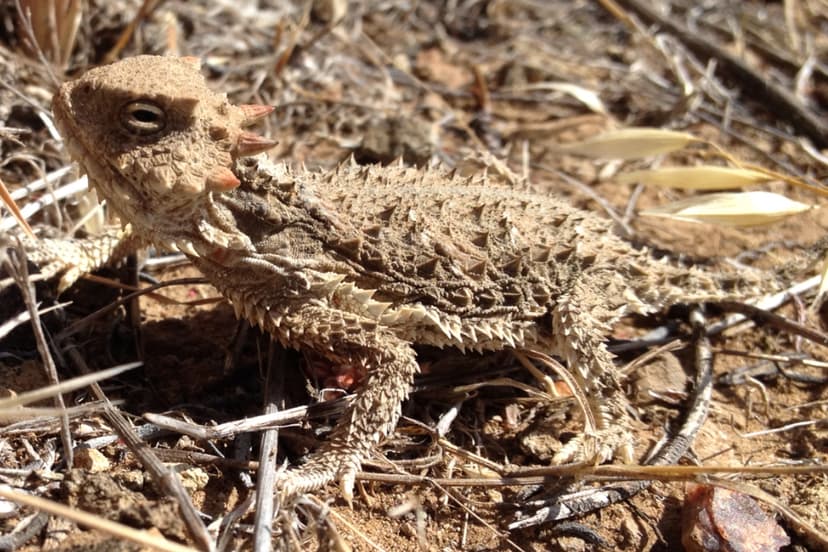
The greater short-horned lizard (Phrynosoma hernandesi) is a widely distributed reptile native to western North America, often called a "horned toad" but not a true toad. It inhabits a variety of environments from arid plains to high mountain forests, distinguished by its flat, squat body, a "crown" of pointed scales on its head, and a snub-nosed profile. This diurnal species primarily feeds on ants and employs camouflage and blood-squirting from its eyes as defense mechanisms.
Key Facts
- ›Endemic to western North America, it is the most widely distributed horned lizard.
- ›Occupies diverse habitats including prairies, deserts, and forests, often in arid mountain regions.
- ›Features a flat, squat body with a "crown" of pointed head scales and a snub-nosed profile.
- ›Primarily feeds on ants, using a "sit-and-wait" predatory strategy.
- ›Can squirt blood from its eyes as a defense mechanism, primarily against canids.
- ›Is viviparous, giving birth to live young in late summer.

Mountain Short-Horned Lizard, HernáNdez's Short-Horned Lizard, Horned Toad, Horny Toad
Western North America, Central Nevada, North Dakota, South Dakota, Southern Saskatchewan, Southern Alberta, Eastern New Mexico, Central Mexico, Trans-Pecos Texas
Semi-Arid Plains, Shortgrass Prairies, Sagebrush Deserts, Juniper Forests, Pine Forests, Fir Forests, Arid Mountain Regions
- Flat-Bodied, Squat Lizard.
- Small Pointed Scales Around the Head, Forming A "Crown".
- Snub-Nosed Profile.
- Short Legs.
- Trunk Fringed By One Row of Pointed Scales.
- Smooth Belly Scales.
- Coloration Is Gray, Yellowish, Or Reddish-Brown.
- Two Rows of Large Dark Spots On the Back.
- Colors Become More Intense When Threatened Or Aggressive.
- Females Are Larger Than Males.
- Adult Males Have A Dermatocranial Shape Resembling A Subadult Female of the Same Size.
Ants, Grasshoppers, Beetles
- Diurnal, Most Active During the Evening.
- Burrows At Night.
- "Sit-and-Wait" Predator.
- Relies Extensively On Camouflage To Avoid Predators.
- Can Darken Skin When Threatened Or To Regulate Temperature.
- Can Squirt Blood From Behind Eyes As A Defense Mechanism, Primarily Against Canids.
Endangered In Saskatchewan and Alberta
About Phrynosoma hernandesi
The Greater Short-Horned Lizard
The greater short-horned lizard, scientifically known as Phrynosoma hernandesi, is a distinctive reptile native to western North America. Often colloquially called a "horned toad" due to its appearance, it is actually a lizard, not an amphibian. This species is notable for being the most widely distributed of all horned lizards, inhabiting a diverse array of environments from arid plains and deserts to the higher elevations of mountainous regions, including pine and fir forests.
Physical Characteristics and Adaptations
Phrynosoma hernandesi possesses a characteristically flat, squat body, a snub-nosed profile, and short legs. Its head is adorned with a "crown" of small, pointed scales, and the trunk is bordered by a single row of similar pointed scales, contrasting with smooth scales on its belly. Coloration typically ranges from gray to yellowish or reddish-brown, often marked with two rows of large dark spots on its back. When agitated or threatened, its colors can intensify. Females generally grow larger than males.
Behavior and Defense
This species is diurnal, with peak activity in the evening, and it burrows into the ground at night. It is a "sit-and-wait" predator, primarily feeding on ants, though it will also consume grasshoppers and beetles. Camouflage is its primary defense, allowing it to blend seamlessly with its surroundings. A remarkable defense mechanism observed in Phrynosoma hernandesi is the ability to squirt blood from the region behind its eyes, a tactic used to deter predators, particularly canids like foxes and coyotes. This blood-squirting behavior is rare in other horned lizard species.
Reproduction and Status
Phrynosoma hernandesi is viviparous, giving birth to live young. Mating occurs in the spring, with females delivering their offspring, numbering between five and 48, from July to September. The young are precocial and can care for themselves shortly after birth. While widespread, the species faces conservation challenges in certain areas, being listed as endangered in the Canadian provinces of Saskatchewan and Alberta.
Source: Wikipedia ↗
Frequently Asked Questions
What is the greater short-horned lizard commonly called?
The greater short-horned lizard is often referred to as a "horned toad" or "horny toad." However, it is important to note that despite this common name, it is a reptile and not an amphibian like a toad.
Where can the greater short-horned lizard be found?
This species has a wide distribution across western North America. Its range extends from central Nevada eastward to the Dakotas, northward to Saskatchewan and Alberta in Canada, and southward into eastern New Mexico and central Mexico, with some populations in Texas.
What kind of habitat does Phrynosoma hernandesi prefer?
Phrynosoma hernandesi is adaptable and can be found in a broad spectrum of habitats. These include semiarid plains, shortgrass prairies, sagebrush deserts, and juniper, pine, or fir forests, often in mountainous areas with stony, rocky, or sandy soil.
How large does the greater short-horned lizard get?
Adult females typically reach a snout-to-vent length (SVL) of about 7 cm (2.75 inches) and a total length of about 15 cm (6 inches), weighing around 18 grams. Males are smaller, with an SVL of about 5 cm (2 inches) and an average weight of 10 grams.
What does the greater short-horned lizard eat?
The diet of Phrynosoma hernandesi consists primarily of ants. They are "sit-and-wait" predators, often found near ant nests or trails, and may also consume occasional grasshoppers or beetles.
How does the greater short-horned lizard defend itself?
This species relies heavily on camouflage to avoid detection. If threatened, it may also darken its skin. A remarkable defense is its ability to squirt blood from behind its eyes, primarily to deter canid predators like foxes and coyotes.
What is the reproductive method of Phrynosoma hernandesi?
Phrynosoma hernandesi is viviparous, meaning it gives birth to live young. Mating occurs in the spring, and females give birth to between five and 48 offspring from July to September.
Are there any conservation concerns for this species?
Yes, the greater short-horned lizard is considered an endangered species in the Canadian provinces of Saskatchewan and Alberta. This indicates localized conservation concerns within parts of its extensive North American range.
Related Lizards
Desert horned lizard
The desert horned lizard (Phrynosoma platyrhinos) is a medium-sized lizard native to western North America, known for its flat, broad body and distinctive cranial spines that give it a "horned" appearance. Primarily found in desert climates, they are often found near ant hills, which form a significant part of their diet. These lizards are generally gentle but possess unique defense mechanisms, including puffing up their bodies and, rarely, squirting blood from their eyes.

Gran Canaria skink
The Gran Canaria skink (Chalcides sexlineatus) is a species of skink endemic to the Canary Island of Gran Canaria. This lizard is characterized by its flattened body, wide head, and strong legs, with distinct striping patterns and coloration that vary between its subspecies and geographic locations on the island. It inhabits a wide range of environments, from coastal areas to higher altitudes, and primarily feeds on invertebrates.

Striped plateau lizard
The striped plateau lizard, scientifically known as Sceloporus virgatus, is a small lizard native to the Sierra Madre Occidental mountains of Mexico and parts of the southwestern United States. It is characterized by distinct light stripes on its dorsolateral sides and a gray, brown, or tan body, with males exhibiting more vivid coloration and specific scale and pore features related to signaling aggression and territory. These diurnal lizards are terrestrial and inhabit temperate forests and savannas, preying on insects and arthropods through an ambush technique.