
Phrynosomatidae
The Phrynosomatidae are a diverse family of lizards native to North America, ranging from Panama to southern Canada. Many species inhabit arid desert environments, particularly hot, sandy deserts, though some prefer rocky terrain or even moist forest edges. This family includes both egg-laying (oviparous) and live-bearing (viviparous) species, with the latter being more prevalent at higher altitudes.
Key Facts
- ›Found from Panama to southern Canada.
- ›Includes both egg-laying and live-bearing species.
- ›Many species are adapted to desert environments.
- ›Some species prefer rocky deserts or forest edges.
- ›Fossil remains suggest a wider prehistoric distribution.
- ›Comprises nine distinct genera.

Panama, Canada
About Phrynosomatidae
The Phrynosomatidae are a widespread and diverse family of lizards found throughout North America, with a geographic range extending from Panama in the south to the southern reaches of Canada. This family is notable for its adaptation to a variety of environments, with many species thriving in hot, sandy desert landscapes. However, the family's diversity is also reflected in habitat preferences, as some members, such as spiny lizards, are more at home in rocky deserts or even the edges of more moist forest environments. The short-horned lizard, a well-known member, inhabits prairie and sagebrush ecosystems.
A significant characteristic of the Phrynosomatidae is their varied reproductive strategies. The family includes both oviparous species, which lay eggs, and viviparous species, which give birth to live young. Interestingly, viviparity is more common among species that inhabit higher elevations, a common adaptation to colder climates where egg development might be more challenging. Oviparous and viviparous species can even be found coexisting in the same regions, such as certain areas of the United States.
The evolutionary history of the Phrynosomatidae is supported by fossil evidence. The earliest discovered fossil remains of this group originate from the Late Cretaceous period in Mongolia, identified as belonging to the genus Desertiguana. Given that phrynosomatids are presently known only from North America, these ancient fossils suggest that the family likely possessed a much broader geographic distribution in prehistoric times, hinting at a complex migratory and evolutionary past.
Source: Wikipedia ↗
Frequently Asked Questions
What is the geographic range of the Phrynosomatidae family?
The Phrynosomatidae family of lizards is found across a wide geographic area, extending from Panama in the south to the extreme southern regions of Canada in the north.
What types of habitats do Phrynosomatidae lizards typically inhabit?
Many species within this family are adapted to hot, sandy deserts. However, some, like the spiny lizards, are found in rocky deserts or even at the edges of relatively moist forests. The short-horned lizard, for instance, lives in prairie or sagebrush environments.
Are all Phrynosomatidae lizards egg-layers?
No, the Phrynosomatidae family includes both oviparous (egg-laying) and viviparous (live-bearing) species. Viviparous species are more commonly found at higher elevations.
What does the fossil record indicate about the Phrynosomatidae family?
The earliest known fossil remains of this group date back to the Late Cretaceous period in Mongolia, belonging to the genus Desertiguana. Since phrynosomatids are currently only known from North America, these fossils suggest a broader distribution during prehistoric times.
How many genera are included in the Phrynosomatidae family?
The Phrynosomatidae family is organized into nine distinct genera, each with its own set of species and characteristics.
Related Lizards
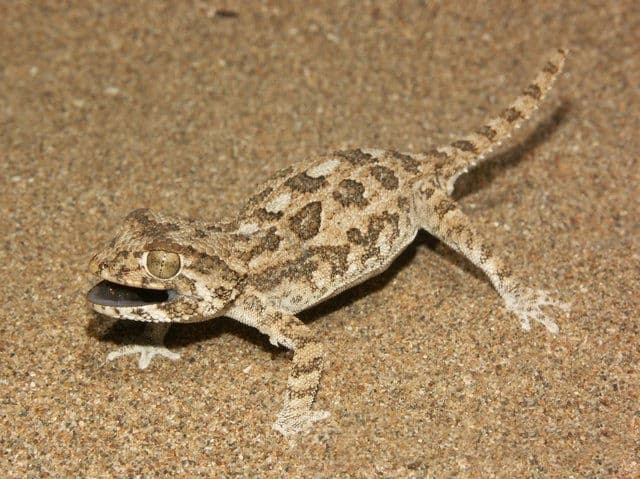
Tarentola chazaliae
The helmethead gecko (Tarentola chazaliae) is a species of lizard native to the sandy and rocky desert coastlines of northwestern Africa. Characterized by a distinctive casque formed by enlarged tubercles at the back of its head, this nocturnal gecko possesses extraordinary color vision in low light conditions. Its populations are currently considered vulnerable due to habitat degradation and collection for the pet trade.

Calumma nasutum
The Calumma nasutum, commonly known as the Madagascar pimple-nose chameleon or big-nosed chameleon, is a small arboreal lizard native to Madagascar. It is distinguished by a prominent, paddle-like appendage on its nose, which is thought to aid in mate identification, particularly in males who also possess a more noticeable casque. This species inhabits dense rainforests and is primarily nocturnal, feeding on small invertebrates.

Sceloporus occidentalis
The western fence lizard (Sceloporus occidentalis), also known as the blue-belly, is a common lizard found across the western United States and northern Mexico, easily recognizable by its bright blue ventral abdomen. It inhabits diverse environments from grasslands to forests and is known for its diurnal basking behavior and a diet primarily consisting of terrestrial invertebrates. Its unique blood composition also plays a role in reducing Lyme disease transmission.