
Ristella travancorica
The Travancore cat skink, scientifically known as Ristella travancorica, is a small lizard species found exclusively in the Western Ghats of India. Characterized by its reddish-brown coloration with dark brown dots on its dorsal scales, it measures approximately 3.8 cm from snout to vent. This oviparous species lays its eggs during the monsoon season, typically in clutches of two, hidden beneath dead leaves and rocks.
Key Facts
- ›Endemic to the Western Ghats of India.
- ›Dorsal scales are sharply bicarinate and typically number 24 around the middle of the body.
- ›Adult females lay clutches of 2 eggs during the southwestern monsoons.
- ›Each egg measures approximately 11 mm by 5–6 mm.
- ›The snout-to-vent length is around 3.8 cm.
- ›Coloration is reddish-brown above with dark brown dots on dorsal scales.
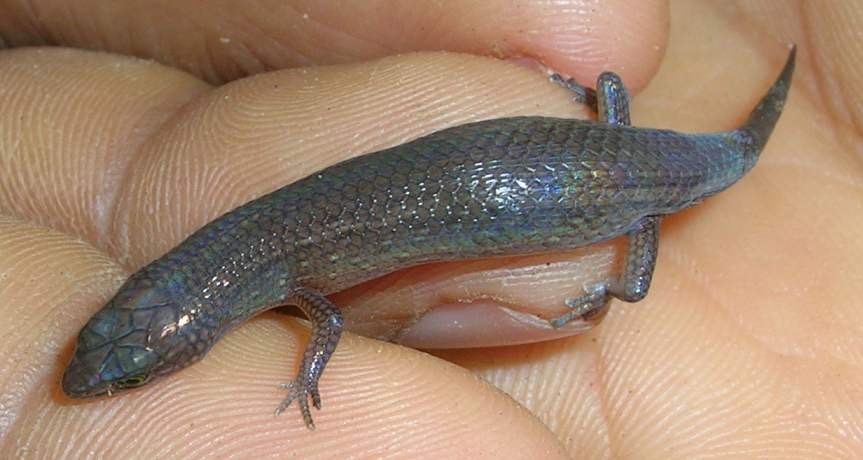
Travancore Cat Skink, Travancore Ristella
India, Western Ghats, Ponmudi Hills, Tirunelveli Hills
Forest Floor, Under Dead Leaves, Under Rocks
- Dorsal Scales Are Sharply Bicarinate.
- 24, Rarely 26, Scales Around the Middle of the Body.
- Ear-Opening Not Or But Slightly Larger Than the Nostril.
- Third To Sixth Upper Labials Below the Eye.
- Reddish Brown Above, Each Dorsal Scale Usually With A Dark Brown Dot.
- Usually A Rather Indistinct Darker Lateral Band.
- Lower Surfaces Uniform Whitish.
- Snout To Vent Length: 3.8 cm .
Unknown From Provided Text.
Females Lay Eggs Under Dead Leaves and Rocks.
About Ristella travancorica
Ristella travancorica: The Travancore Cat Skink
The Travancore cat skink, scientifically known as Ristella travancorica, is a small lizard species endemic to the Western Ghats of India. Its known geographic range includes the Ponmudi Hills in Tamil Nadu and the Tirunelveli Hills in Kerala, indicating a localized distribution within this biodiversity hotspot.
Description and Characteristics
This skink is characterized by its reddish-brown coloration, with individual dorsal scales often marked by a dark brown dot. A subtle, darker lateral band may also be present, while the underside is a uniform whitish hue. Anatomically, its dorsal scales are sharply bicarinate, and typically 24 scales encircle the body at its midsection, though occasionally 26 are found. The ear-opening is either absent or only slightly larger than the nostril, and the third to sixth upper labial scales are located below the eye. Adult specimens measure approximately 3.8 cm from snout to vent.
Reproduction
Ristella travancorica is an oviparous species, meaning it reproduces by laying eggs. The reproductive cycle is timed with the southwestern monsoons, during which adult females lay clutches consisting of two eggs. These eggs are typically deposited in concealed locations, such as beneath dead leaves and rocks, providing them with protection and moisture.
Source: Wikipedia ↗
Frequently Asked Questions
What is the scientific name of the Travancore cat skink?
The scientific name for the Travancore cat skink is Ristella travancorica. This binomial nomenclature identifies it as a distinct species within the Ristella genus.
Where is Ristella travancorica found?
Ristella travancorica is naturally found in India, specifically within the Western Ghats mountain range. Its known distribution includes the Ponmudi Hills in Tamil Nadu state and the Tirunelveli Hills in Kerala state.
What are the physical characteristics of the Travancore cat skink?
This skink is typically reddish-brown above, with each dorsal scale usually featuring a dark brown dot. A less distinct darker lateral band may be present, and its lower surfaces are uniformly whitish. The snout to vent length is approximately 3.8 cm.
How does Ristella travancorica reproduce?
Ristella travancorica is oviparous, meaning it lays eggs. Egg-laying coincides with the southwestern monsoons, and adult females deposit clutches of two eggs in protected locations like under dead leaves and rocks.
What are the common names for Ristella travancorica?
This species is commonly known as the Travancore cat skink or the Travancore ristella. These common names refer to its geographic origin and its taxonomic classification.
Related Lizards

Beddome's day gecko
Beddome's day gecko is a diurnal lizard species endemic to the Western Ghats of India. It is typically found under rocks in forest environments and primarily feeds on insects. The species is oviparous and its exact threats are not fully understood, though human disturbance is a possibility.
Cnemaspis beddomei
Beddome's day gecko, scientifically known as Cnemaspis beddomei, is a species of lizard endemic to the Western Ghats of India. This diurnal reptile is typically found under rocks in forested areas and primarily feeds on insects. It is named in honor of Richard Henry Beddome.

Hemitheconyx caudicinctus
The African fat-tailed gecko, scientifically known as Hemitheconyx caudicinctus, is a ground-dwelling reptile native to West Africa and Cameroon. This species is characterized by its ability to store fat in its tail, which also aids in defense by detaching to help it escape predators. They are nocturnal and inhabit dry or savannah environments.