
Cnemaspis beddomei
Beddome's day gecko, scientifically known as Cnemaspis beddomei, is a species of lizard endemic to the Western Ghats of India. This diurnal reptile is typically found under rocks in forested areas and primarily feeds on insects. It is named in honor of Richard Henry Beddome.
Key Facts
- ›Endemic to the Western Ghats of India.
- ›Diurnal, meaning it is active during the day.
- ›Inhabits forests and is often found under rocks.
- ›Feeds primarily on insects.
- ›Reproduces by laying eggs (oviparous).
- ›Named after British army officer and botanist Richard Henry Beddome.

Beddome's Day Gecko
India
Insects
Diurnal, Found Under Rocks
Human Disturbance
About Cnemaspis beddomei
Beddome's Day Gecko (Cnemaspis beddomei)
Beddome's day gecko, scientifically classified as Cnemaspis beddomei, is a species of lizard native to the Western Ghats region of India. This reptile belongs to the Gekkonidae family and is named in honor of Richard Henry Beddome, a British army officer and botanist.
Habitat and Ecology
Cnemaspis beddomei is a diurnal species, meaning it is active during daylight hours. It is typically found inhabiting forested environments, where it seeks shelter and hunts under rocks. The gecko's diet consists mainly of insects, reflecting its role as a predator in its ecosystem.
Distribution and Conservation
The geographic range of Beddome's day gecko is confined to the Western Ghats of India. The specific type locality for this species includes the South Tinnevelly and Travankor hills, at elevations between 914 and 1,524 meters (3000 to 5000 feet). While the exact threats to Cnemaspis beddomei are not precisely documented, human disturbance is considered a potential risk. Fortunately, the species benefits from protection within established wildlife reserves, including the Kalakkad Mundanthurai Tiger Reserve and Meghamalai.
Reproduction
In terms of reproduction, Cnemaspis beddomei is oviparous, which means it reproduces by laying eggs. Further details regarding its reproductive behavior, such as nesting sites or clutch sizes, are not extensively recorded in available literature.
Source: Wikipedia ↗
Frequently Asked Questions
What is Beddome's day gecko?
Beddome's day gecko, or Cnemaspis beddomei, is a species of lizard belonging to the Gekkonidae family. It is native to India and is distinguished by its diurnal activity and habitat preferences.
Where is Cnemaspis beddomei found?
This lizard species is found in the Western Ghats of India. Its type locality includes the South Tinnevelly and Travankor hills, at elevations ranging from 914 to 1,524 meters (3000 to 5000 feet).
What does Beddome's day gecko eat?
Cnemaspis beddomei is primarily an insectivore. Its diet consists mainly of insects, which it likely hunts in its forested habitat.
How does Cnemaspis beddomei reproduce?
This species is oviparous, meaning it reproduces by laying eggs. Details about its nesting habits or clutch size are not specified in the available information.
What are the conservation concerns for Beddome's day gecko?
The exact threats to Cnemaspis beddomei are not fully understood but may include human disturbance. However, the species does inhabit protected areas such as Kalakkad Mundanthurai Tiger Reserve and Meghamalai.
Related Lizards
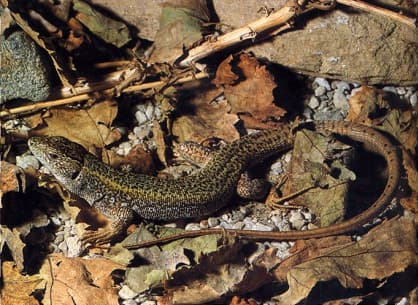
Balkan green lizard
The Balkan green lizard (Lacerta trilineata) is a widespread lizard species found throughout the Balkans and parts of the Eastern Mediterranean. It inhabits diverse environments such as Mediterranean shrubland, sandy shores, and agricultural areas. A key characteristic is its reproductive cycle, which typically spans from April to July, with individuals reaching sexual maturity around 80 millimeters in body size.

Chalcides parallelus
Chalcides parallelus, commonly known as the Chafarinas's skink, is a species of skink found in parts of North Africa and Southern Europe. This lizard inhabits Mediterranean coastal environments, including shrubland, rocky areas, and sandy shores. Its primary threat is habitat loss.
Gallotia intermedia
The Tenerife speckled lizard (Gallotia intermedia) is a small lacertid lizard endemic to the island of Tenerife in the Canary Islands. Discovered in 1996, it is the smallest member of a clade that includes larger giant species. Its populations are currently restricted to small coastal areas in the northwest and a location in the south of the island, with conservation efforts focused on controlling introduced predators.