
Scincella lateralis
Not of conservation concern in most of its range, but of concern on the northern edge.·Oviparous
The Scincella lateralis, commonly known as the little brown skink or ground skink, is a small lizard found in the eastern United States and northern Mexico. It is characterized by its coppery brown back, white or yellow underside, and dark lateral stripe. This species is primarily a forest dweller, preferring habitats with deep leaf litter for cover and moisture.
Key Facts
- ›One of the smallest reptiles in North America, with a total length of 3-5.5 inches.
- ›Typically has a coppery brown back, a white or yellow underside, and a dark lateral stripe from eyes to tail.
- ›Spends most of its time buried in leaf litter and is considered a fossorial species.
- ›Diet consists of small insects, spiders, and other arthropods.
- ›Known for tail autotomy, where it can drop its tail to escape predators.
- ›Found throughout much of the Eastern United States and into northern Mexico.

Little Brown Skink, Ground Skink
Eastern United States, Mexico
Deciduous Forests, Mixed Forests, Coniferous Forests, Hedgerows, Palmetto Hammocks, Coastal Plains, Edges of Streams and Ponds, Leaf Litter
- Smallest Reptiles In North America.
- Total Length of 3 - 5.5 Inches .
- Body Mass of 1 To 2 Grams.
- Back Is Typically Coppery Brown.
- Underside Is White Or Yellow.
- Dark Coloration Runs Laterally From Eyes To Tail.
- Elongated Body and Short Legs.
- Transparent Disks In the Lower Eyelids Allow Vision With Eyes Closed.
- Females Tend To Be Larger Than Males.
- Males Have Larger Heads, Which May Be More Orange In Color.
Small Insects, Spiders, Arthropoda
- Fossorial, Spending Most Time Buried In Leaf Litter.
- Seldom Climbs Trees.
- Locomotion Involves Wriggling Through Leaf Litter.
- May Dive Under Water When Pursued.
- Largely Diurnal, But May Be Active At Night.
- Hibernates During Coldest Months.
- Home Range Can Be As Small As 20 Square Meters.
- Exhibits Tail Autotomy When Seized.
- Males Are More Aggressive Than Females and May Bite.
- Dominant Males Lunge At and Chase Away Subordinate Males.
- Neonates Are Docile and May Share Retreats.
- Effective Thermoregulator, Adjusting Activity Based On Temperature.
Eastern Racer, Ringneck Snake, Scarlet Kingsnake, Pigmy Rattlesnake, Barred Owl, Red-Shouldered Hawk, Eastern Bluebird, Wolf Spiders
About Scincella lateralis
Scincella lateralis: The Little Brown Skink
The Scincella lateralis, commonly referred to as the little brown skink or ground skink, is a diminutive lizard native to the eastern half of the United States and extending into northern Mexico. This species is notable among North American lizards for its preference for forest environments, where it typically resides within deep leaf litter. Its physical characteristics include a coppery brown dorsal side, a pale underside, and a distinctive dark stripe running along its flanks from the eyes to the tail. The ground skink's small size, with a total length typically between 3 and 5.5 inches, and its elongated body with short legs are characteristic features.
Habitat and Distribution
Scincella lateralis inhabits a diverse range of forest types, including deciduous, mixed, and coniferous woodlands, as well as hedgerows, coastal plains, and the margins of water bodies. A critical requirement for this species is a deep layer of leaf litter or other ground cover, which provides essential protection and maintains moisture levels. While widespread across the Eastern United States, from states like New Jersey and Kansas down to Texas and Florida, it is absent from higher elevations in the Appalachian Mountains. Genetic studies suggest that major rivers may have historically isolated populations, but some gene flow continues to occur across these barriers.
Behavior and Diet
As a fossorial species, the ground skink spends the majority of its existence concealed beneath the forest floor's detritus, utilizing undulating movements to navigate through the leaf litter. It is primarily diurnal but can exhibit activity during nocturnal periods, and it hibernates during the coldest months. When threatened, Scincella lateralis is known for its ability to shed its tail (autotomy) as a defense mechanism, though this can impair its escape speed. Males tend to be more aggressive than females, a trait linked to their often larger heads, which may provide an advantage in male-male contests. The diet of the little brown skink consists of small invertebrates such as insects, spiders, and other arthropods, which it locates using a combination of visual cues and chemical sensing through tongue-flicking.
Reproduction and Conservation
Female Scincella lateralis lay small clutches of one to six eggs, typically in moist soil, rotting logs, or beneath rocks, primarily during the summer months. Unlike some related species, the female does not guard the eggs. Hatchlings emerge within one to two months and reach sexual maturity by the age of one year, with females generally maturing earlier than males. The species is considered widespread and common throughout most of its range. However, it faces conservation concerns on the northernmost edges of its territory.
Source: Wikipedia ↗
Frequently Asked Questions
What are the common names for Scincella lateralis?
Scincella lateralis is commonly known as the little brown skink and the ground skink. However, the name 'ground skink' can also refer to any species within the genus Scincella.
What is the size of a Scincella lateralis?
This species is one of the smallest reptiles in North America, with a total length ranging from 3 to 5.5 inches (7.5 to 14.5 cm) and a body mass of only 1 to 2 grams.
Where does Scincella lateralis live?
The ground skink is found across much of the Eastern United States, from New Jersey, Ohio, and Kansas south to Texas and Florida, and extends into northern Mexico. It is also found along the Atlantic coast and has been sighted in isolated regions like central Illinois and southern New York.
What kind of habitat does Scincella lateralis prefer?
Scincella lateralis inhabits a variety of forest environments, including deciduous or mixed forests, hedgerows, and coastal plains. They require a deep substrate, such as leaf litter, for protection and moisture, and are known to occasionally shelter in palmetto trees.
What does Scincella lateralis eat?
The diet of the little brown skink primarily consists of small insects, spiders, and other arthropods like isopods. They utilize both their visual and chemical senses, aided by tongue-flicking, to locate prey.
How does Scincella lateralis defend itself from predators?
When threatened, Scincella lateralis employs several defense mechanisms. It uses its cryptic coloration to hide, flees when necessary, and can practice tail autotomy, dropping its tail to distract predators. Males may also exhibit aggression, lunging and chasing potential threats.
What are the predators of Scincella lateralis?
Ground skinks are preyed upon by various animals, including snakes such as the eastern racer, ringneck snake, scarlet kingsnake, and pigmy rattlesnake. Predatory birds like the barred owl and red-shouldered hawk, as well as wolf spiders, also feed on this lizard.
How does Scincella lateralis reproduce?
Females lay clutches of 1-6 eggs (usually 2-3) in moist soil, rotting logs, or under rocks during the summer months. Unlike some other skink species, female ground skinks do not guard their eggs. Young hatch in one to two months and reach sexual maturity by one year of age.
Related Lizards

Chinese short-limbed skink
The Chinese short-limbed skink is a terrestrial lizard found in China and Vietnam, inhabiting secondary and mixed forests. It is characterized by its elongated body, short limbs, and a brownish coloration with distinctive black and white spots on its flanks. This insectivorous species reproduces by laying eggs and is oviparous.
Sceloporus graciosus
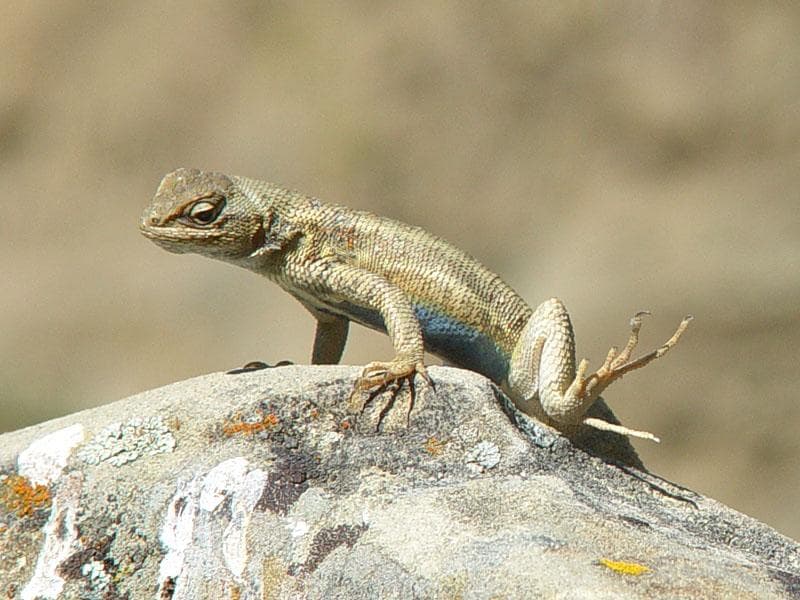
The sagebrush lizard (Sceloporus graciosus) is a common lizard found in the western United States, typically inhabiting shrublands and woodlands at mid to high altitudes. It is distinguished by its keeled and spiny scales, often exhibiting gray or tan coloration with lighter stripes along its back and sides. Males are recognizable by their blue abdominal patches, which can develop into orange during the breeding season.

Sagebrush lizard
The sagebrush lizard (Sceloporus graciosus) is a common spiny lizard found in the western United States, typically inhabiting shrublands, coniferous forests, and piñon-juniper woodlands. Characterized by keeled, spiny scales that are usually gray or tan, it features lighter stripes along its back and often has orange markings on its sides. Males are distinguished by blue patches on their abdomen and throat, which can intensify to orange during the breeding season.