
Sagebrush lizard
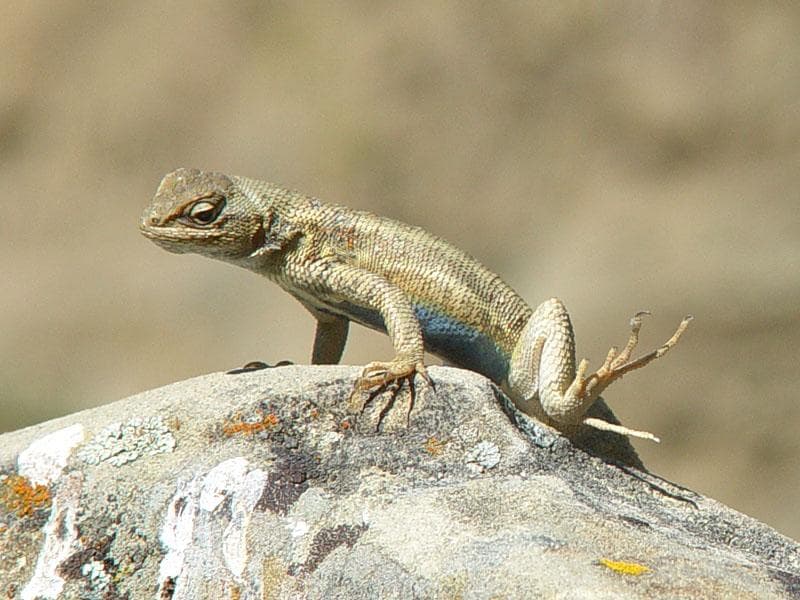
The sagebrush lizard (Sceloporus graciosus) is a common spiny lizard found in the western United States, typically inhabiting shrublands, coniferous forests, and piñon-juniper woodlands. Characterized by keeled, spiny scales that are usually gray or tan, it features lighter stripes along its back and often has orange markings on its sides. Males are distinguished by blue patches on their abdomen and throat, which can intensify to orange during the breeding season.
Key Facts
- ›Found in MID to high altitudes in the western United States.
- ›Distinguished by keeled and spiny scales along its dorsal surface.
- ›Males exhibit blue abdominal and throat patches, which can turn orange during breeding season.
- ›Typically measures 4.7–8.9 cm (1.9–3.5 in) in snout-to-vent length as an adult.
- ›Omnivorous diet includes insects, arachnids, and some plant matter.
- ›Active during daylight hours (diurnal).

Sagebrush Swift
Western United States, Utah, Nevada, Idaho, Arizona, New Mexico, Texas, Colorado, Wyoming, Oregon, California, Washington, North Dakota, South Dakota, Nebraska
- Keeled and Spiny Scales On Dorsal Surface.
- Typically Gray Or Tan Ground Color With Lighter Vertebral and Dorsolateral Stripes.
- Can Have Orange Markings On Sides.
- Males Have Blue Patches On Abdomen and Throat, Which Can Intensify To Orange During Breeding Season.
- Males Have Enlarged Postanal Scales and Swelling At the Base of the Tail.
- Females Have White Or Yellow Bellies.
- Snout-To-Vent Length of 4.7–8.9 cm For Adults.
- Hatchlings Are Approximately 25 mm Svl.
- Finer Scales Compared To Western Fence Lizard.
- Hints of Blue Or Green On Dorsal Surface During Light Phase.
- Irregular Banding Patterns On Body and Tail.
- Often Display A Black Bar On the Shoulder.
- Rust-Colored Armpit and Lateral Body Surface.
Insects, Arachnids
- Diurnal .
- Easily Frightened, Seeks Refuge In Crevices, Brush, Burrows, Rocks, Or Trees.
- May Play Dead When Threatened.
- Basks On the Ground, Low Branches of Bushes, and Low Boulders.
- Mammal Burrows and Rock Crevices Used As Hibernation Sites.
- Activity Season Varies Geographically, Typically March/April To September/October.
- Juveniles Appear Active Later In Autumn Than Adults.
- Males Are More Active and Have Larger Home Ranges Than Females.
- Brumates During Winter.
- Males Defend Territories Through Posturing and Physical Combat.
- Courtship Involves Head Bob and Shudder Displays.
- Exhibit Population-Level Discrimination Through Male Attraction and Female Avoidance.
- Males Tend To Associate With Larger Females.
- Males Display More Towards Females Less Far Along In the Reproductive Cycle and Unmated Females.
Snakes, Birds of Prey, Carnivorous Mammals, Domesticated Cats
About Sagebrush lizard
The sagebrush lizard, scientifically known as Sceloporus graciosus, is a common species of spiny lizard native to the western United States. It is a prominent inhabitant of mid to high-altitude regions, frequently found in shrublands, coniferous forests, and piñon-juniper woodlands.
Physical Characteristics
Adult sagebrush lizards typically measure between 4.7 to 8.9 centimeters (1.9 to 3.5 inches) in snout-to-vent length. Their scales are keeled and spiny, giving them a rough texture, and their coloration is generally gray, brown, or olive. They are often marked with lighter stripes down the center of their back and along their sides. A distinctive feature is the presence of blue patches on the abdomen and throat of males, which can develop into vibrant orange hues during the breeding season. Females, in contrast, usually have white or yellow bellies. Juveniles resemble adults but lack the prominent dark blue markings.
Habitat and Distribution
This species thrives in a variety of western U.S. environments, from the arid shrublands that give it its name to more wooded areas. They are commonly observed basking on rocks, logs, and low-lying vegetation. Their geographic distribution encompasses a broad swath of the western United States, including states such as Utah, Nevada, Idaho, Arizona, New Mexico, Colorado, Wyoming, Oregon, California, and Washington, at elevations ranging from 150 to 3,200 meters.
Behavior and Reproduction
Sagebrush lizards are diurnal, meaning they are primarily active during daylight hours. They are known to be easily startled and will quickly retreat into crevices, burrows, or under rocks when threatened. During cooler periods, they hibernate in mammal burrows or rock crevices. The breeding season occurs in the spring, with females laying clutches of two to ten eggs in loose soil during late spring or midsummer. The incubation period lasts approximately 45 to 75 days. Males are territorial and engage in courtship rituals that include head bobbing and shudder displays. Research indicates complex social interactions, with male and female lizards exhibiting preferences and avoidance behaviors that can influence reproductive isolation and speciation.
Diet and Predators
The diet of the sagebrush lizard consists mainly of insects, such as ants, beetles, and grasshoppers, as well as arachnids. They share food resources with other species, like the western fence lizard, in areas where their ranges overlap. Their natural predators include snakes, birds of prey, small carnivorous mammals, and domestic cats.
Source: Wikipedia ↗
Frequently Asked Questions
What are the main physical characteristics of the sagebrush lizard?
Sagebrush lizards are typically gray, brown, or olive, with keeled and spiny scales. They usually have a light vertebral stripe and dorsolateral stripes. Adult males are notable for having blue patches on their abdomen and throat, which can become orange during the breeding season.
What is the typical habitat of the sagebrush lizard?
These lizards are commonly found in shrublands, but also inhabit coniferous forests and piñon-juniper woodlands. They often bask on logs and rocky outcrops and spend most of their time on the ground, though they can climb to escape predators.
What do sagebrush lizards eat?
Their diet consists of a variety of insects, including ants, beetles, grasshoppers, flies, hemipterans, and lepidopterans. They also consume arachnids. Western fence lizards are noted as a primary food competitor in overlapping territories.
How do male and female sagebrush lizards differ?
Adult males often have distinctive blue patches on their abdomen and throat, which can develop orange breeding colors. Males also have enlarged postanal scales and two areas of swelling at the base of the tail. Females typically have white or yellow bellies. Males are also generally slightly larger than females.
Where are sagebrush lizards geographically distributed?
The sagebrush lizard's range covers much of the western United States, including states like Utah, Nevada, Idaho, Arizona, New Mexico, Colorado, Wyoming, Oregon, California, Washington, North Dakota, South Dakota, and Nebraska. They can be found at elevations from 150 to 3,200 meters (500 to 10,500 feet).
What are the primary predators of the sagebrush lizard?
Snakes, particularly striped whipsnakes and night snakes, are the main predators. Birds of prey also consume them in large numbers, and smaller carnivorous mammals and domestic cats are known to prey on them as well.
How does the sagebrush lizard reproduce?
Sagebrush lizards mate in the spring, and females lay one or two clutches of two to ten eggs during late spring to midsummer. The eggs are deposited about 2.5 cm deep in loose soil. Hatching occurs within 45–75 days.
Are there different types of sagebrush lizards?
Yes, two valid subspecies are recognized: Sceloporus graciosus graciosus (northern sagebrush lizard) and Sceloporus graciosus gracilis (western sagebrush lizard). These subspecies differ in their geographic distribution, markings, and scale counts.
Related Lizards
Sceloporus graciosus
The sagebrush lizard (Sceloporus graciosus) is a common lizard found in the western United States, typically inhabiting shrublands and woodlands at mid to high altitudes. It is distinguished by its keeled and spiny scales, often exhibiting gray or tan coloration with lighter stripes along its back and sides. Males are recognizable by their blue abdominal patches, which can develop into orange during the breeding season.

Scincella lateralis
The Scincella lateralis, commonly known as the little brown skink or ground skink, is a small lizard found in the eastern United States and northern Mexico. It is characterized by its coppery brown back, white or yellow underside, and dark lateral stripe. This species is primarily a forest dweller, preferring habitats with deep leaf litter for cover and moisture.

Hemidactylus scabriceps
The scaly gecko (Hemidactylus scabriceps) is a nocturnal, terrestrial, and insectivorous lizard species native to South India and northern Sri Lanka. It is characterized by its short, stout body, convex forehead, blunt snout, and a cylindrical tail. The dorsal scales are imbricate and leaf-shaped, while the venter is creamy white, often with mottled patterns of black and yellow.