
Shanghai skink
The Shanghai skink, scientifically known as Plestiodon elegans, is a distinct species of skink recognized by its five stripes and often blue tail. This lizard is native to East Asia, with its range extending across China, northern Vietnam, Taiwan, and the Japanese Senkaku Islands. It is a medium-sized lizard adapted to various terrestrial environments within its geographical distribution.
Key Facts
- ›Also known as the five-striped blue-tailed skink.
- ›Found in China, northern Vietnam, Taiwan, and the Senkaku Islands of Japan.
- ›Belongs to the genus Plestiodon.
- ›Distinctive feature is its five stripes and often blue tail.
- ›Information on its specific diet and detailed behavioral traits is limited in available records.

Five-Striped Blue-Tailed Skink, Shanghai Elegant Skink
China, Northern Vietnam, Taiwan, Senkaku Islands of Japan
Medium-Sized Lizard., Characterized By Five Stripes Along the Body., Often Possesses A Blue Tail.
About Shanghai skink
The Shanghai skink, scientifically designated as Plestiodon elegans, is a species of skink native to East Asia. It is commonly recognized by its distinctive five stripes and a tail that frequently exhibits a blue hue.
Geographic Range and Habitat
This lizard's natural habitat spans across several countries and islands in East Asia. It can be found in China, the northern regions of Vietnam, Taiwan, and the Senkaku Islands of Japan. Specific details regarding its preferred habitat types within these regions are not extensively documented in available records.
Physical Characteristics
Plestiodon elegans is a medium-sized lizard. Its most notable physical attributes are the presence of five longitudinal stripes along its body and its characteristically blue tail. The exact dimensions and scale patterns are not detailed in the provided information.
Diet and Behavior
Information concerning the specific diet of the Shanghai skink is limited. Similarly, comprehensive details about its behavioral patterns, social structure, and reproductive methods are not readily available in the current documentation. Research has touched upon aspects like thermal tolerance and locomotor performance in adult specimens, suggesting an interest in its physiological adaptations.
Source: Wikipedia ↗
Frequently Asked Questions
What is another name for Plestiodon elegans?
Plestiodon elegans is commonly known as the five-striped blue-tailed skink. It is also referred to as the Shanghai elegant skink.
Where can the Shanghai skink be found?
The Shanghai skink has a natural distribution across East Asia. It is found in China, northern Vietnam, Taiwan, and the Senkaku Islands of Japan.
What are the distinguishing physical features of the Shanghai skink?
This skink is characterized by five stripes running along its body. A notable feature is its tail, which is often blue in coloration.
What is the scientific classification of the Shanghai skink?
The Shanghai skink is scientifically classified as Plestiodon elegans. It belongs to the family Scincidae, commonly known as skinks.
Related Lizards
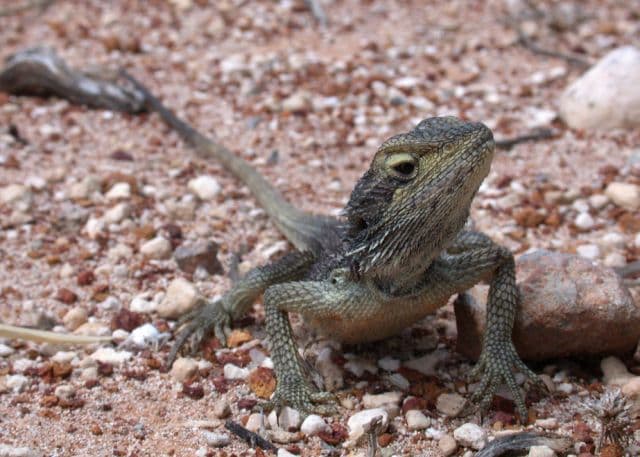
Abrolhos bearded dragon
The Abrolhos bearded dragon (Pogona minor minima) is a small agamid lizard endemic to the islands of the Houtman Abrolhos archipelago off the coast of Western Australia. It is characterized by its smaller size compared to related bearded dragons and inhabits sandy or limestone outcrop environments.

Algerian sand racer
The Algerian sand racer, scientifically known as Psammodromus algirus, is a lizard species found in southwestern Europe and northwestern Africa. It typically inhabits dense bushy vegetation and can be found at high elevations, though it is more common at lower altitudes. This species is characterized by its metallic brownish dorsal coloration with conspicuous white or yellowish stripes.

Amphiglossus decaryi
The rock skink, scientifically known as Flexiseps decaryi, is a species of skink found exclusively on the island of Madagascar. As a member of the skink family, it is characterized by its smooth, overlapping scales and typically elongated body. Its specific ecological niche and behavioral patterns are not extensively detailed in available records.