
Southeastern five-lined skink
The southeastern five-lined skink (Plestiodon inexpectatus) is a common lizard species found in the southeastern United States. Characterized by five narrow stripes along its body that fade with age and a bright blue tail in juveniles, this diurnal species inhabits wooded areas and coastal islands. They are insectivores, primarily feeding on larger prey like grasshoppers, and are oviparous, with females guarding their eggs.
Key Facts
- ›Possesses five characteristic narrow stripes along its body that become lighter with age.
- ›Juveniles display a bright blue or purplish tail and reddish-orange stripes towards the head.
- ›Inhabits wooded areas and small coastal islands in the southeastern United States.
- ›Primarily feeds on insects, with a preference for larger prey such as grasshoppers.
- ›Is oviparous, with females brooding and protecting their eggs.
- ›Can be distinguished from the similar American five-lined skink by its slightly larger size and stripe patterns, though differentiation can be difficult.
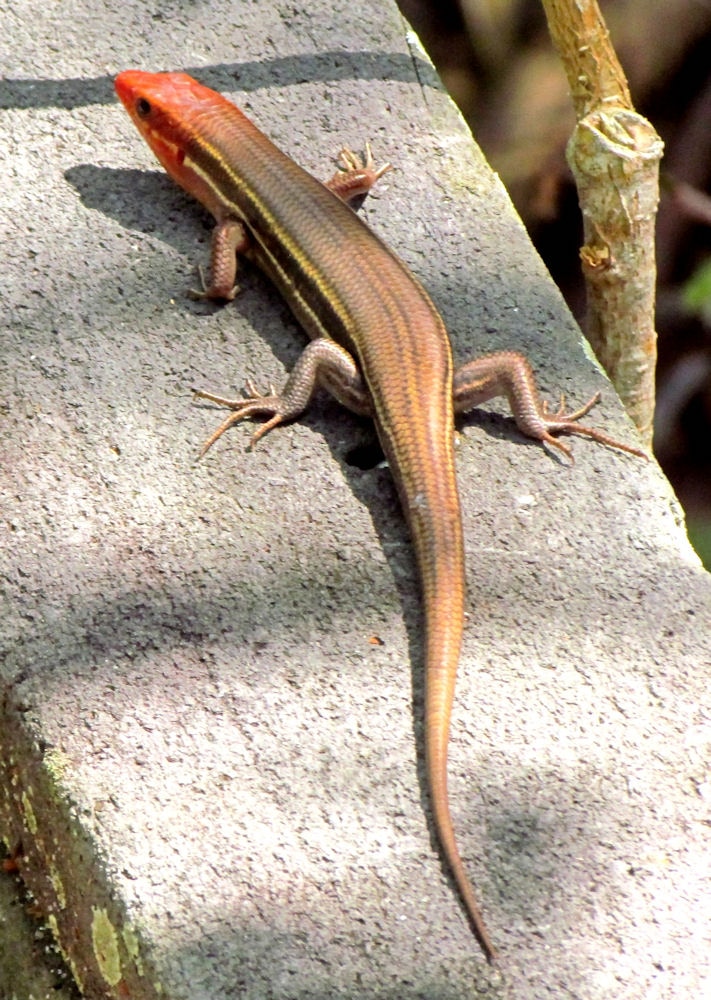
Southeastern Five-Lined Skink
Southeastern United States
- Possesses Five Characteristic Narrow Stripes Along Its Body That Become Lighter With Age.
- the Middle Stripe Is Typically Narrower Than the Others.
- Dark Areas Between Stripes Are Black In Young Skinks and Turn Brown With Age.
- Young Skinks Have A Bright Blue Or Purplish Tail, Especially Towards the Tip.
- Stripes On Young Skinks Become Bright Reddish-Orange Towards the Head.
- Juvenile Coloration Can Persist Into Adulthood, Giving the Head An Orange-Brown Appearance.
Insects, Larger Prey Such As Grasshoppers
Diurnal, Ground-Dwelling, Females Brood and Protect Eggs
Other Skinks
About Southeastern five-lined skink
The southeastern five-lined skink, scientifically known as Plestiodon inexpectatus, is a prevalent lizard species indigenous to the southeastern United States. Its name, inexpectatus, meaning "the unexpected," likely refers to its recognition as a distinct species relatively late in scientific history, nearly two centuries after its close relative was described.
Physical Characteristics and Identification
This skink is easily identified by its common name, featuring five narrow stripes running lengthwise down its body. These stripes tend to fade and become less distinct as the lizard matures. The coloration of the stripes and the interspaces changes with age; young skinks have black between their stripes, which turns brown in adults. A notable characteristic of juveniles is their vibrant blue or purplish tail, particularly towards the tip, and stripes that display a bright reddish-orange hue near the head. This juvenile coloration can persist into adulthood, giving the head a distinctly orange-brown look.
Distinguishing the southeastern five-lined skink from the similar American five-lined skink (Plestiodon fasciatus) can be challenging, though the former is generally slightly larger and exhibits narrower stripes. However, subtle differences in stripe width mean that visual identification in the field may not always be definitive.
Habitat and Behavior
Southeastern five-lined skinks are commonly found in wooded areas across their native range. They have also adapted to life on small islands off the southeastern coast, demonstrating a remarkable ability to survive even in the absence of freshwater sources and significant vegetation. These lizards are diurnal, meaning they are active during the day, and are primarily ground-dwelling.
Diet and Reproduction
As with other skinks in the Plestiodon genus, the southeastern five-lined skink is an insectivore. Their diet primarily consists of insects, with a notable preference for larger prey items such as grasshoppers.
Reproductively, this species is oviparous, laying eggs. The clutch size typically ranges from six to twelve eggs, with the number of eggs tending to decrease at higher latitudes. A significant aspect of their reproductive behavior is the female's dedication to brooding and protecting the eggs from potential predators, including other skinks. Hatchlings usually emerge approximately one month after the eggs are laid, typically around the beginning of summer.
Source: Wikipedia ↗
Frequently Asked Questions
What are the distinctive physical features of the southeastern five-lined skink?
Southeastern five-lined skinks are recognized by their five narrow body stripes, which lighten as the animal ages. Young skinks have a striking bright blue or purplish tail, and stripes that are reddish-orange near the head. Their coloration can develop into an overall orange-brown appearance on the head in adulthood.
What is the habitat of the southeastern five-lined skink?
This skink species is commonly found in wooded environments throughout the southeastern United States. They are also known to inhabit small islands off the coast, even in areas lacking fresh water and vegetation.
What does the southeastern five-lined skink eat?
The diet of the southeastern five-lined skink consists mainly of insects. They show a preference for larger insect prey, such as grasshoppers.
How do southeastern five-lined skinks reproduce?
Southeastern five-lined skinks are oviparous, meaning they lay eggs. The female skink will brood and protect the eggs from predators, including other skinks. Hatchlings typically emerge about a month after the eggs are laid, near the beginning of summer.
How can I tell a southeastern five-lined skink from an American five-lined skink?
While similar, the southeastern five-lined skink is generally slightly larger than the American five-lined skink (Plestiodon fasciatus) and tends to have narrower stripes. However, distinguishing between the two species based on physical appearance alone can be quite challenging.
Are southeastern five-lined skinks active during the day or night?
Southeastern five-lined skinks are diurnal, meaning they are active during daylight hours. They are ground-dwelling animals.
Related Lizards

Plestiodon inexpectatus
The Plestiodon inexpectatus, commonly known as the southeastern five-lined skink, is a widespread lizard found throughout the southeastern United States. This diurnal species is characterized by its five distinct stripes, which fade with age, and a bright blue tail in juveniles. They inhabit wooded areas and are notable for their ability to survive on coastal islands even without fresh water.

Desert monitor
The desert monitor (Varanus griseus) is a large carnivorous lizard found across North Africa and Central and South Asia. It exhibits varied coloration from light brown to grey and can reach up to 2 meters in length. Known for its adaptability, the desert monitor inhabits arid and semi-arid regions, preying on a wide range of vertebrates and invertebrates.
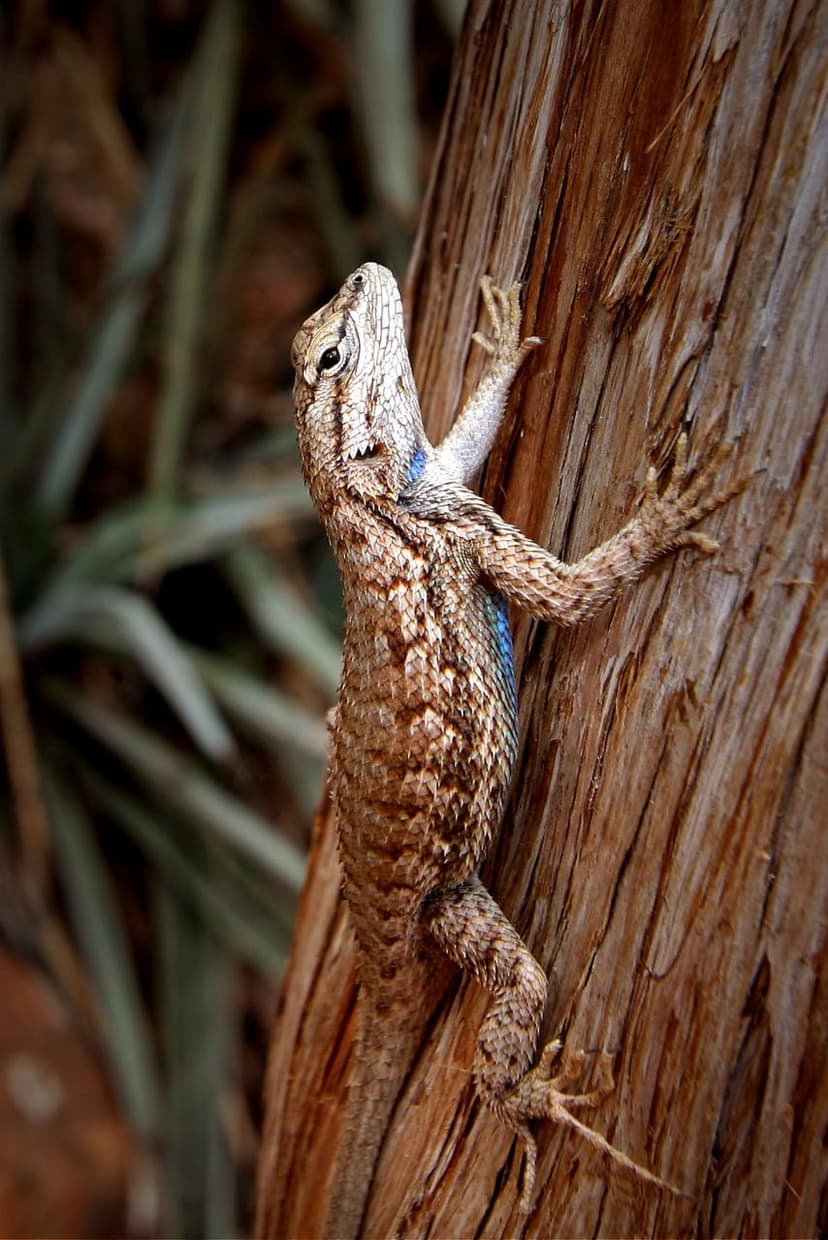
Plateau fence lizard
The plateau fence lizard (Sceloporus tristichus) is a spiny lizard found in the rocky and wooded areas of central Arizona, southwestern Utah, western Colorado, and parts of New Mexico and Wyoming. This grayish, brownish, or greenish reptile is characterized by keeled scales, dark cross-bands on its back, and distinctive metallic blue patches on its belly and throat. It is known to be inactive during extreme temperatures and primarily feeds on insects and other arthropods.