
Sphenomorphus dussumieri
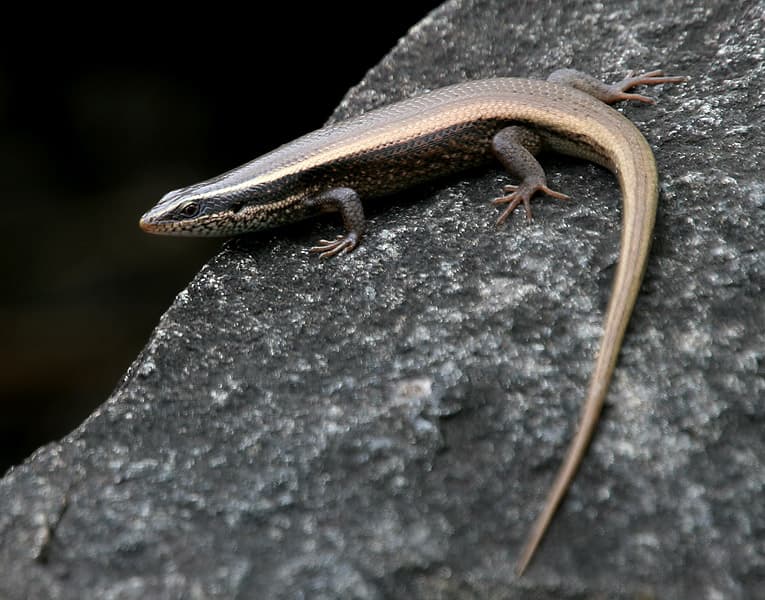
Sphenomorphus dussumieri, also known as Dussumier's forest skink, is a species of skink endemic to the Western Ghats of southern India. This diurnal lizard is characterized by its slender body, smooth bronze-brown scales with dark spots, and distinctive light dorso-lateral stripes. It inhabits a range of forest types, from evergreen to plantations, at moderate altitudes.
Key Facts
- ›Endemic to the Western Ghats of southern India, specifically in Kerala and Tamil Nadu.
- ›Diurnal, meaning it is active during the day.
- ›Inhabits evergreen, moist deciduous, and plantation forests.
- ›Possesses a slender body with smooth, bronze-brown scales and dark spots.
- ›Features a light dorso-lateral stripe running from the eye.
- ›Named in honor of French voyager Jean-Jacques Dussumier.

Dussumier's Forest Skink, Dussumier's Litter Skink, അരണ
India
Evergreen Forest, Moist Deciduous Forest, Plantation Forest, Closed Forest, Open Forest
- Head Is Distinct From the Neck.
- Snout Is Short.
- Tympanum Is Situated On the Surface.
- Body Is Slender.
- Dorsal Scales Are Smooth With Fine Striations.
- Limbs Are Relatively Short.
- Dorsum Is Bronze Brown With Dark Spots.
- Features A Light Dorso-Lateral Stripe Running From the Eye To the Side of the Body, With A Dark Brown, White-Spotted Streak On Its Inner Edge.
- Has A Broad Stripe On the Sides Edged With White Below.
- Venter Is Creamy.
Diurnal
About Sphenomorphus dussumieri
Sphenomorphus dussumieri, commonly known as Dussumier's forest skink or Dussumier's litter skink, is a species of skink belonging to the family Scincidae. This lizard is endemic to the Western Ghats of southern India, specifically found within the Indian states of Kerala and Tamil Nadu.
Ecology and Habitat
The Dussumier's forest skink is a diurnal species, meaning it is active during daylight hours. Its preferred habitats include a variety of forest types, ranging from dense evergreen forests and moist deciduous forests to plantation areas such as rubber plantations. It can be found in both closed forest canopies and more open woodland environments. The species typically inhabits altitudes between 15 and 500 meters (49 to 1,640 feet).
Physical Description
This skink possesses a slender body with a short snout and a head that is distinctly separate from its neck. Unlike many other skinks, its tympanum is located on the surface rather than being sunk. The dorsal scales are smooth and exhibit fine striations. Its limbs are relatively short. The coloration of Sphenomorphus dussumieri is a bronze brown on its dorsum, marked with dark spots. A characteristic feature is a light dorso-lateral stripe that extends from the eye along the side of the body, which has a dark brown, white-spotted streak on its inner edge. Additionally, a broad stripe runs along the sides, bordered by white below. The underside, or venter, is a creamy color.
Etymology
The specific name, 'dussumieri', was given in honor of Jean-Jacques Dussumier, a French voyager who was active in collecting zoological specimens in South Asia during the early 19th century. Locally, the species is known by the name "അരണ (arana)".
Source: Wikipedia ↗
Frequently Asked Questions
What is the scientific name for Dussumier's forest skink?
The scientific name for Dussumier's forest skink is Sphenomorphus dussumieri. This binomial nomenclature is used to classify it within the scientific community.
Where can Sphenomorphus dussumieri be found?
Sphenomorphus dussumieri is found in the Western Ghats region of southern India. Its range includes the Indian states of Kerala and Tamil Nadu.
What types of forests does this skink inhabit?
This skink inhabits a variety of forest environments, including evergreen forests, moist deciduous forests, and plantation forests like rubber plantations. It can be found in both closed and open forest areas.
What are the key physical characteristics of Sphenomorphus dussumieri?
Sphenomorphus dussumieri has a slender body, a short snout, and a head distinct from its neck. Its dorsal scales are smooth with fine striations, and its coloration is bronze brown with dark spots, often featuring light dorso-lateral stripes.
Is Sphenomorphus dussumieri active at night?
No, Sphenomorphus dussumieri is a diurnal skink. This means it is active and primarily hunts or forages during daylight hours.
What is the origin of the name 'dussumieri'?
The specific name, dussumieri, honors Jean-Jacques Dussumier, a French voyager who collected zoological specimens in South Asia during the early 19th century.
Related Lizards

Egernia kingii
King's skink (Egernia kingii) is a large, heavy-bodied lizard endemic to the coastal regions of south-western Australia. This omnivorous species primarily feeds on softer plant matter, supplemented with insects and bird eggs. It is notable for being viviparous, giving birth to live young after a gestation period of approximately 20-22 weeks.

Hemidactylus frenatus
Hemidactylus frenatus, commonly known as the common house gecko, is a nocturnal lizard native to South and Southeast Asia and Near Oceania. These adaptable geckos are easily recognizable by their chirping sounds and are often found in urban environments, climbing walls of buildings to hunt insects attracted to lights. They are non-venomous and generally docile but can bite if threatened.
Mabuya macularia
The bronze grass skink, also known as the bronze mabuya or speckled forest skink, is a common and shy lizard found across South and Southeast Asia. This ground-dwelling species is distinguished by its cylindrical body, keeled dorsal scales, and a distinctive pair of light dorso-lateral bands. It inhabits a variety of environments, including forests, grasslands, and rocky areas, and feeds primarily on insects and other invertebrates.