
Subansiri forest lizard
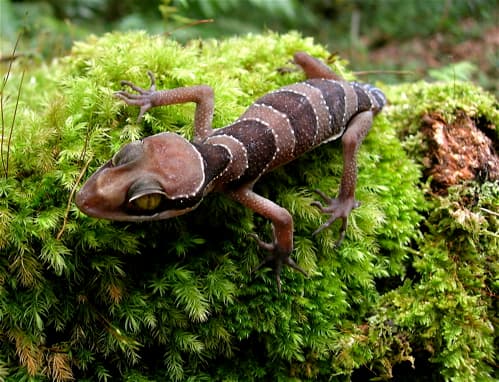
The Subansiri forest lizard, also known as the Sinyik dragon lizard, is a species found in Arunachal Pradesh, India. Adults are noted for their ability to change color and reach a length of approximately 8.5 inches. It possesses a long, broad head with a short snout and large eyes, and its long limbs end in slender fingers with strong, curved claws.
Key Facts
- ›Found in Arunachal Pradesh, India.
- ›Adults can change color.
- ›Reaches an average length of about 8.5 inches (21.59 cm).
- ›Features a long, broad head with a short snout and large eyes.
- ›Has long limbs with slender fingers and strong, curved claws.

Sinyik Dragon Lizard, Subansiri Dragon Lizard
Arunachal Pradesh, India
Forest, River Basin
- Long, Broad Head.
- Short Snout.
- Large Eyes.
- Long Limbs.
- Slender Fingers.
- Strong, Slightly Curved Claws.
- Adults Can Change Color.
- Average Adult Length of Approximately 8.5 Inches .
Adults Exhibit Color Change.
About Subansiri forest lizard
The Subansiri Forest Lizard (Calotes sinyik)
The Subansiri forest lizard, scientifically known as Calotes sinyik, is a distinct species of lizard native to the Arunachal Pradesh region of India. Commonly referred to as the Sinyik dragon lizard or Subansiri dragon lizard, this reptile is part of the Agamidae family, which includes a wide array of lizards often characterized by their distinctive features.
Description and Characteristics
This lizard is characterized by its physical form, which includes a long and broad head, complemented by a notably short snout and large, prominent eyes. Its limbs are elongated, featuring slender fingers that terminate in strong, slightly curved claws, suggesting adaptations for its environment. A remarkable trait observed in adult specimens is their ability to change color, a characteristic that adds to their mystique. The average adult length of the Subansiri forest lizard is approximately 8.5 inches, or about 21.59 centimeters.
Etymology and Distribution
The species' specific epithet, 'sinyik,' is derived from the local Tagin language, where it serves as the name for the Subansiri River. The Tagin people are a significant tribal group inhabiting Arunachal Pradesh, particularly the Upper Subansiri District. This linguistic connection highlights the geographical and cultural context from which the lizard's name originates. The primary known distribution of Calotes sinyik is within Arunachal Pradesh, India, specifically in areas associated with the Subansiri River basin.
Source: Wikipedia ↗
Frequently Asked Questions
What is the scientific name of the Subansiri forest lizard?
The scientific name of the Subansiri forest lizard is Calotes sinyik. This binomial nomenclature follows the standard scientific classification for species.
What are other common names for Calotes sinyik?
Calotes sinyik is also commonly referred to as the Sinyik dragon lizard or Subansiri dragon lizard. The specific epithet 'sinyik' is derived from the local Tagin name for the Subansiri River.
Where is the Subansiri forest lizard found?
This lizard species is found in Arunachal Pradesh, a state in northeastern India. Its habitat is associated with the Subansiri River basin.
What are the physical characteristics of the Subansiri forest lizard?
The Subansiri forest lizard has a long, broad head with a short snout and large eyes. Its limbs are long, with slender fingers tipped with strong, slightly curved claws.
Can the Subansiri forest lizard change color?
Yes, once the Subansiri forest lizard matures into an adult, it is said to be capable of changing its color. This ability is a notable characteristic of the adult individuals.
How large does the Subansiri forest lizard get?
Adult Subansiri forest lizards reach approximately 8.5 inches in length, which is equivalent to about 21.59 centimeters. This size is considered relatively small for the species.
Related Lizards

Brookesia dentata
The toothed leaf chameleon, *Brookesia dentata*, is a species of chameleon native to northwestern Madagascar. Known for its small size and leaf-like camouflage, it inhabits forests and areas affected by human activity. This species is currently classified as endangered due to habitat decline.

Burmese false bloodsucker
The Burmese false bloodsucker, scientifically known as Pseudocalotes microlepis, is a species of agamid lizard native to Southeast Asia and southern China. It is characterized by its small scales and is found in forested environments within its geographic range.
Cyrtodactylus pulchellus
The Malayan forest gecko, scientifically known as Cyrtodactylus pulchellus, is a species of gecko native to Southeast Asia. It is characterized by its depressed, oviform head, elongated body and limbs, and distinct coloration featuring broad chestnut-brown cross bands with light edges. This gecko inhabits forest environments across several Southeast Asian countries.