
Tarentola angustimentalis
The East Canary gecko, scientifically known as Tarentola angustimentalis, is a species of lizard endemic to the eastern Canary Islands. This sturdy, plump gecko is characterized by its flattened head and body, adhesive toe pads with strong claws, and a variable greyish-brown coloration often marked with paler stripes and darker bars. It thrives in a variety of habitats, from rocky shores and shrublands to urban areas, and is commonly observed at night on outdoor walls.
Key Facts
- ›Endemic to the eastern Canary Islands, including Fuerteventura and Lanzarote.
- ›Possesses adhesive toe pads for climbing on various surfaces.
- ›Diet consists primarily of insects, spiders, and other small invertebrates.
- ›Females lay clutches of two oval eggs, with offspring sex determined by incubation temperature.
- ›Listed as 'least concern' by the IUCN due to its commonality and stable population.
- ›Can live up to 17 years in captivity.

East Canary Gecko, Canary Wall Gecko
Canary Islands
- Sturdy, Plump Gecko With A Dorsally Flattened Head and Body.
- Short, Sideways Projecting Legs.
- Feet Have Adhesive Pads Along the Toes, Widest At the Tips.
- Strong Claws On the Third and Fourth Digits of Each Foot.
- Skin Is Fairly Smooth With Small, Often Multi-Keeled Tubercles.
- Eyes Have Vertical Pupils In Bright Light and Are Brown Or Golden.
- Body Coloration Is Variable, Generally Greyish-Brown With A Paler, Sometimes Intermittent, Stripe Along the Spine and Darker Transverse Bars.
- Underside Is Paler and Sometimes Tinged Yellow, Especially Near the Vent.
Insects, Spiders, Other Small Invertebrates
- Males Are Larger Than Females and Territorial During the Breeding Season.
- Vocal, Possessing A Range of Calls.
- Often Seen At Night On Outdoor Walls and Ceilings.
About Tarentola angustimentalis
East Canary Gecko (Tarentola angustimentalis)
The East Canary gecko, scientifically known as Tarentola angustimentalis, is a distinctive lizard species endemic to the eastern Canary Islands. This resilient reptile is a common sight in a variety of habitats, including rocky shores, shrublands, and even urban environments, often observed at night scaling outdoor walls and ceilings.
Physical Characteristics and Habitat
This sturdy gecko is easily recognizable by its plump body and flattened head, measuring up to approximately 8 centimeters from snout to vent, with a tail of similar length. Its feet are equipped with specialized adhesive pads along the toes, aiding in its remarkable climbing ability, further enhanced by strong claws on its third and fourth digits. The skin is characterized by small, often multi-keeled tubercles, and its coloration varies, typically presenting as greyish-brown with a paler spinal stripe and darker transverse bars, while its underside is paler, sometimes with a yellowish tint near the vent. The eyes feature vertical pupils in bright light and are typically brown or golden.
Biology and Reproduction
The East Canary gecko's diet consists mainly of insects, spiders, and other small invertebrates, making it an important part of its ecosystem's invertebrate population control. Males of the species are generally larger than females and exhibit territorial behavior during the breeding season, often communicating through a variety of calls. Females lay one or more clutches, each containing two oval eggs, which are deposited in sheltered locations such as cracks, under stones, or buried in sand. A fascinating aspect of their reproduction is temperature-dependent sex determination; eggs incubated at 27°C (81°F) or above will hatch as females, while lower temperatures yield males. Hatchlings measure between 2 to 3 centimeters from snout to vent, displaying more vivid coloration than adults. In captivity, these geckos have been known to live for up to 17 years.
Conservation Status
The East Canary gecko is currently listed as 'least concern' by the International Union for Conservation of Nature (IUCN). This favorable status is due to its common occurrence across its range, the lack of significant threats to its varied habitats, and a seemingly stable population. Its adaptability to human-modified landscapes, such as rural gardens and urban areas, further contributes to its successful survival.
Source: Wikipedia ↗
Frequently Asked Questions
What are the common names for Tarentola angustimentalis?
Tarentola angustimentalis is commonly known as the East Canary gecko or the Canary wall gecko. These names reflect its geographic origin and its tendency to inhabit walls and other vertical surfaces.
Where is the East Canary gecko found?
This species is endemic to the eastern Canary Islands. Its distribution includes Fuerteventura, Lanzarote, Lobos, and several smaller islands north of Lanzarote.
What does the East Canary gecko eat?
The diet of the East Canary gecko is primarily composed of insects, spiders, and other small invertebrates. They are opportunistic hunters, preying on any suitable small creatures they encounter.
How does Tarentola angustimentalis reproduce?
The female East Canary gecko lays one or more clutches of two oval eggs, typically in sheltered locations like cracks or under stones. A unique aspect of its reproduction is that the sex of the offspring is determined by the incubation temperature of the egg.
What is the conservation status of the East Canary gecko?
The East Canary gecko is classified as 'least concern' by the IUCN. This status is attributed to its widespread presence within its limited range, its adaptability to various habitats, and no apparent population decline.
What are the physical characteristics of the East Canary gecko?
It is a sturdy, plump gecko with a flattened head and body, measuring about 8 cm from snout to vent with a tail of similar length. Its feet have adhesive pads and strong claws, and its skin is fairly smooth with small tubercles. Coloration is typically greyish-brown with a paler spinal stripe and darker transverse bars.
Does the East Canary gecko have any unique features?
Yes, a notable feature is that the sex of the embryo is determined by the incubation temperature of the egg. Higher temperatures (27°C or above) result in females, while lower temperatures produce males.
Related Lizards

East Canary gecko
The East Canary gecko, also known as the Canary wall gecko (Tarentola angustimentalis), is a species of lizard native to the eastern Canary Islands. This plump, dorsally flattened gecko is characterized by adhesive toe pads, small tubercles on its skin, and variable greyish-brown coloration with darker bars. It inhabits a wide range of environments, from rocky shores and shrubland to urban areas, and is commonly observed at night on walls and ceilings.

Spotted Ground Gecko
The Spotted Ground Gecko, scientifically known as *Cyrtodactylus triedrus*, is a small, dark gecko endemic to Sri Lanka's midhills. It is characterized by its turnip-shaped tail and a body covered in granular scales mixed with larger keeled ones. This species is primarily found in decaying logs and under wood piles, with a diet presumed to consist of small arthropods.
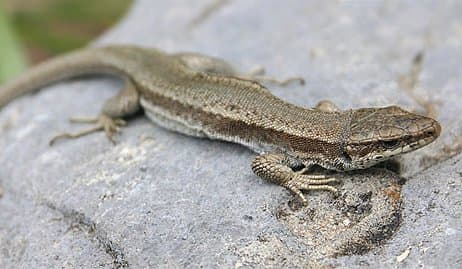
Iberolacerta bonnali
The Pyrenean rock lizard, scientifically known as Iberolacerta bonnali, is a species of lizard endemic to the high-altitude regions of the Pyrenees Mountains. Distinguished by its greyish-brown dorsal coloration and a tail approximately twice its snout-to-vent length, this species inhabits rocky terrains and is only active during the summer months.