
Teira dugesii
The Madeiran wall lizard (Teira dugesii) is a common species endemic to the Madeira Archipelago, Portugal, notable for its variable coloration that often camouflages it with its surroundings. It inhabits a wide range of environments, from coastal areas to altitudes of 1,850 meters, and has also become naturalized in the Azores. This lizard is characterized by its small size, easily shed tail, and insectivorous-herbivorous diet.
Key Facts
- ›Endemic to the Madeira Archipelago, Portugal, and naturalized in the Azores.
- ›Inhabits diverse environments including temperate forests, shrublands, rocky areas, sandy shores, and urban settings.
- ›Possesses variable coloration, typically brown or grey, often flecked with darker markings, to match its surroundings.
- ›Adults reach a snout-to-vent length of about 8 cm, with a tail approximately 1.7 times its body length.
- ›Feeds on small invertebrates like ants and also consumes vegetable matter such as bananas.
- ›Can act as a reservoir for Lyme disease due to tick parasitism.

Madeiran Wall Lizard
Madeira Archipelago, Portugal, Azores, Portugal
- Snout-To-Vent Length of About 8 cm.
- Tail Is Approximately 1.7 Times the Length of Its Body.
- Coloration Is Variable and Tends To Match Surroundings, Typically Shades of Brown Or Grey, Occasionally With A Greenish Tinge.
- Finely Flecked With Darker Markings.
- Underparts Are White Or Cream, Sometimes With Dark Spots.
- Some Males Exhibit Orange Or Red Underparts and Blue Throats, Which May Fade When Disturbed.
- Juveniles Are Approximately 3 cm Long When They Hatch.
Small Invertebrates, Vegetable Matter
- Common and Widely Distributed From Sea Coasts To Altitudes of 1,850 Meters.
- Often Found In Rocky Places Or Among Scrub.
- May Climb Into Trees.
- Found In Gardens and On Building Walls.
- Tail Is Easily Shed and Regenerates Slowly.
About Teira dugesii
Teira dugesii: The Madeiran Wall Lizard
The Madeiran wall lizard, scientifically known as Teira dugesii, is the sole member of its genus and a common inhabitant of the Madeira Archipelago in Portugal. This adaptable lizard has also successfully established itself in the Azores due to human introduction via shipping.
Habitat and Distribution
Teira dugesii displays remarkable adaptability, thriving in a diverse array of environments. Its natural habitats range from sea coasts to elevations of 1,850 meters (6,070 ft). It is commonly found in temperate forests, shrublands, rocky areas, and along shores. Furthermore, this species has readily integrated into human-altered landscapes, including arable land, pastureland, plantations, rural gardens, and urban areas. This broad habitat tolerance contributes to its widespread presence.
Physical Characteristics
The Madeiran wall lizard is a relatively small reptile. Adult individuals typically reach a snout-to-vent length of approximately 8 cm (3.1 inches). A distinctive feature is its tail, which is considerably longer than its body, measuring about 1.7 times its length. The lizard's coloration is highly variable, a trait that aids in camouflage. It generally presents shades of brown or grey, sometimes with a subtle greenish hue, and is often finely flecked with darker markings. The underparts are usually white or cream, occasionally marked with dark spots. In some males, particularly striking bright colors emerge, such as orange or red underparts and blue throats, though these vibrant colors may diminish if the animal becomes stressed.
Behavior and Diet
Teira dugesii is a diurnal species, active during the day. It is frequently observed in rocky outcrops or amidst scrub vegetation. The lizard is also known to climb trees and is a common sight in gardens and on the walls of buildings, reflecting its adaptation to both natural and human-dominated environments. A notable behavioral trait is its easily shed tail, which can be a defense mechanism against predators; the lost tail regenerates slowly.
The diet of the Madeiran wall lizard is omnivorous, consisting primarily of small invertebrates such as ants. It also supplements its diet with vegetable matter, with bananas being cited as an example of plant food consumed.
Reproduction
Female Madeiran wall lizards are prolific breeders, capable of laying two to three clutches of eggs within a single year. Hatchlings emerge at a small size, typically around 3 cm (1.2 inches) in length.
Ecological Role and Health Implications
Beyond its ecological role as both predator and prey, Teira dugesii has implications for public health. The species can be parasitized by ticks and may act as a reservoir for tick-borne zoonoses, including Lyme disease. This highlights the interconnectedness of wildlife, vectors, and potential disease transmission in its environment.
Source: Wikipedia ↗
Frequently Asked Questions
What is the scientific name for the Madeiran wall lizard?
The scientific name for the Madeiran wall lizard is Teira dugesii. It is the sole species within the genus Teira and belongs to the family Lacertidae.
Where is the Madeiran wall lizard found?
This lizard is endemic to the Madeira Archipelago in Portugal. It has also been introduced and become naturalized in the Azores, likely through shipping activities.
What kind of habitats does Teira dugesii prefer?
Teira dugesii is highly adaptable, found in a variety of habitats. These include temperate forests, Mediterranean shrublands, rocky areas, shores, agricultural land, gardens, and urban environments.
How large does the Madeiran wall lizard get?
Adult Madeiran wall lizards typically grow to a snout-to-vent length of around 8 cm (3.1 inches). Their tail is notably long, measuring about 1.7 times the length of their body.
What does the Madeiran wall lizard eat?
The diet of Teira dugesii consists of small invertebrates, with ants being a common food source. They also supplement their diet with some vegetable matter, such as bananas.
Does the Madeiran wall lizard have any ecological significance regarding diseases?
Yes, Teira dugesii can be a host for ticks and may serve as a secondary reservoir for tick-borne diseases like Lyme disease.
Related Lizards
Chalcides viridanus
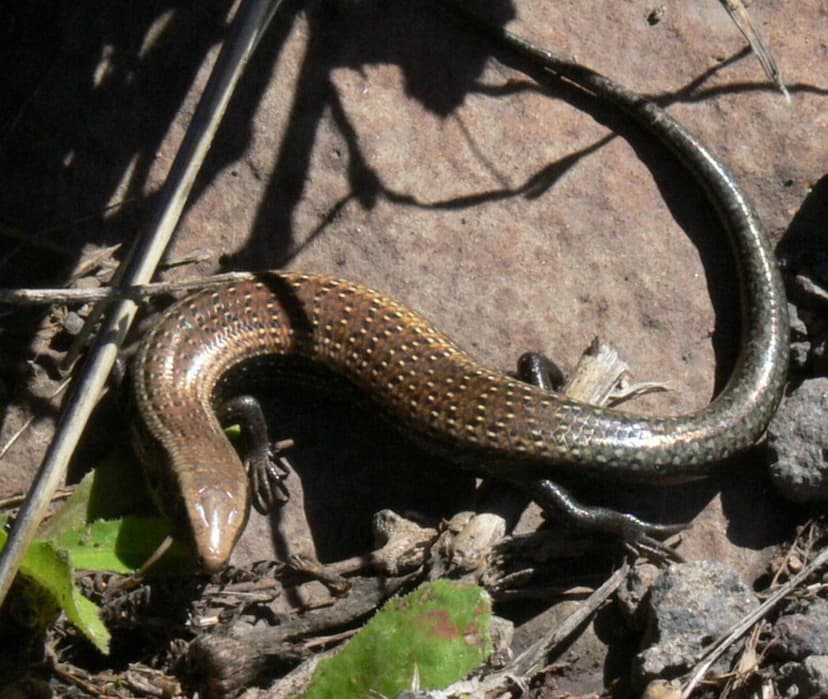
The West Canary skink, scientifically known as Chalcides viridanus, is a species of lizard endemic to the Canary Islands. This skink inhabits a diverse range of environments, from temperate forests and grasslands to urban areas, and can be found at elevations up to 2,000 meters. It is characterized by its cylindrical body and can reach a total length of approximately 18 cm.

West Canary skink
The West Canary skink, also known as the Canaryan cylindrical skink, is a species of lizard endemic to the Canary Islands. It inhabits a variety of environments, from temperate forests to urban areas, and can be found at altitudes up to 2,000 meters. This viviparous lizard is active during the day and at dusk, reaching a total length of about 18 cm.

East Canary gecko
The East Canary gecko, also known as the Canary wall gecko (Tarentola angustimentalis), is a species of lizard native to the eastern Canary Islands. This plump, dorsally flattened gecko is characterized by adhesive toe pads, small tubercles on its skin, and variable greyish-brown coloration with darker bars. It inhabits a wide range of environments, from rocky shores and shrubland to urban areas, and is commonly observed at night on walls and ceilings.