
Tenerife gecko
The Tenerife gecko, also known as Delalande's gecko, is a species of lizard found exclusively on the Canary Islands of Tenerife and La Palma. This oviparous reptile inhabits a diverse range of environments, from sea level to high altitudes, including rocky areas, shrublands, and urban settings. Its primary threat is habitat loss, impacting its survival on these islands.
Key Facts
- ›Endemic to Tenerife and La Palma in the Canary Islands, Spain.
- ›Inhabits a wide range of habitats including rocky areas, shrubland, and urban environments.
- ›Reproduces by laying eggs, typically found under rocks.
- ›Faces threats primarily from habitat loss.
- ›Named in honor of French naturalist Pierre Antoine Delalande.

Delalande's Gecko, Tenerife Wall Gecko
Tenerife, La Palma, Canary Islands, Spain
Habitat Loss
About Tenerife gecko
The Tenerife gecko, scientifically known as Tarentola delalandii and also commonly referred to as Delalande's gecko or the Tenerife wall gecko, is a distinct lizard species native to the Canary Islands. Its natural range is confined to the islands of Tenerife and La Palma, off the coast of northwestern Africa.
Habitat and Distribution
This adaptable species thrives in a broad spectrum of environments, demonstrating its resilience. Its habitats range from sea level up to altitudes of 2,300 meters (7,500 feet). These include temperate forests, temperate shrublands, and Mediterranean-type shrubby vegetation. It is also found in rocky areas, along rocky shores, in pastureland, and has successfully integrated into human-modified landscapes such as rural gardens and urban areas, highlighting its ability to coexist with human development.
Reproduction and Conservation
The Tenerife gecko is oviparous, meaning it reproduces by laying eggs. These eggs are typically deposited in protected locations, such as beneath rocks, offering them a degree of safety. Unfortunately, the species faces significant challenges to its continued survival. The primary threat identified is habitat loss, which can reduce the availability of suitable breeding grounds and foraging areas, impacting population numbers. The specific name, delalandii, honors the French naturalist Pierre Antoine Delalande.
Source: Wikipedia ↗
Frequently Asked Questions
What is the scientific name of the Tenerife gecko?
The scientific name of the Tenerife gecko is Tarentola delalandii. This binomial nomenclature helps classify it within the broader scientific understanding of lizard species.
Where can the Tenerife gecko be found?
The Tenerife gecko is endemic to the Canary Islands, specifically found on the islands of Tenerife and La Palma in Spain. Its natural range is limited to these locations.
What types of environments does the Tenerife gecko live in?
This species is adaptable and can be found in a variety of natural and human-influenced habitats. These include temperate forests, shrublands, Mediterranean-type vegetation, rocky areas, rocky shores, pastureland, rural gardens, and urban areas.
How does the Tenerife gecko reproduce?
The Tenerife gecko is oviparous, meaning it reproduces by laying eggs. These eggs are typically laid in concealed locations, such as under rocks.
What are the main dangers to the Tenerife gecko population?
The primary threat identified for the Tenerife gecko is habitat loss. This loss of suitable living spaces can significantly impact the species' ability to thrive and reproduce.
Related Lizards

Trogonophis wiegmanni wiegmanni
The checkerboard worm lizard, Trogonophis wiegmanni, is a legless, worm-like reptile endemic to North Africa. It inhabits a variety of environments including temperate forests, shrublands, grasslands, and sandy areas. This species is distinguished by its rounded head, the absence of external ears, and a short, stout body with a tail that lacks autotomy.

Psammodromus hispanicus
The Spanish psammodromus (Psammodromus hispanicus) is a small, slender lizard found across the Iberian Peninsula and along the Mediterranean coast of France. Characterized by its keeled, overlapping scales and distinctive blotchy coloration, it inhabits dry, open Mediterranean areas, including sandy shores and grasslands. This species is active during the day and feeds primarily on insects and spiders, facing threats from habitat loss.
Chalcides viridanus
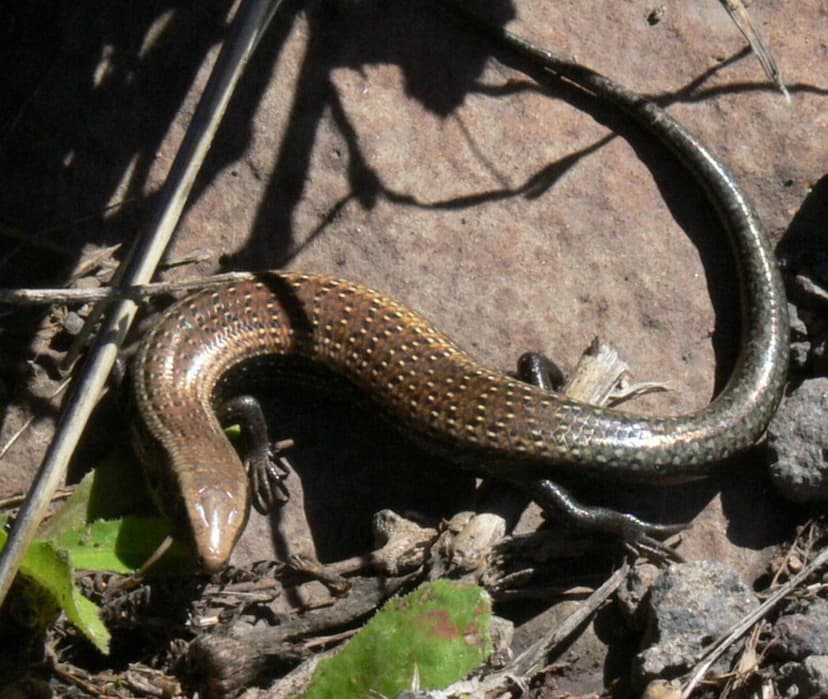
The West Canary skink, scientifically known as Chalcides viridanus, is a species of lizard endemic to the Canary Islands. This skink inhabits a diverse range of environments, from temperate forests and grasslands to urban areas, and can be found at elevations up to 2,000 meters. It is characterized by its cylindrical body and can reach a total length of approximately 18 cm.