
Trogonophis wiegmanni wiegmanni
The checkerboard worm lizard, Trogonophis wiegmanni, is a legless, worm-like reptile endemic to North Africa. It inhabits a variety of environments including temperate forests, shrublands, grasslands, and sandy areas. This species is distinguished by its rounded head, the absence of external ears, and a short, stout body with a tail that lacks autotomy.
Key Facts
- ›Trogonophis wiegmanni is the only extant species in the genus Trogonophis.
- ›It is native to Algeria, Morocco, the Chafarinas Islands (Spain), and Tunisia.
- ›The species is viviparous, meaning it gives birth to live young.
- ›Its diet consists of insects and other soil invertebrates.
- ›Individuals of the same sex are not found together, indicating intrasexual intolerance.
- ›Habitat loss is a significant threat to this lizard species.

Wiegmann's Worm Lizard, Checkerboard Worm Lizard, Trogonophis, Schachbrett-Doppelschleiche, Wiegmanns Spitzschwanz Doppelschleiche
Algeria, Morocco, Chafarinas Islands, Tunisia
Temperate Forest, Mediterranean-Type Shrubby Vegetation, Temperate Grassland, Sandy Shores, Arable Land, Pastureland, Oak Forest, Oak-Juniper Forests, Steppe Habitat
- Head Is Rounded and Slightly Compressed Dorso-Ventrally.
- Snout Is Slightly Protruding.
- Possesses Two Pairs of Cephalic Shields.
- Nostrils Open Forward.
- External Ears Are Absent.
- Skull Is Elongate Compared To Other Trogonophidae.
- Body Is Wormlike: Legless, Elongate, Cylindrical, and Annulated.
- Features Sunken Lateral Lines.
- Short Conical Tail Lacks Autotomy.
- Body Is Short and Stout Relative To Other Legless Lizards.
- Both Sexes Lack Pre-Anal Pores.
Insects, Soil Invertebrates
- Found Mostly Under Rocks/Stones.
- Sometimes Found In Pairs.
- Individuals of the Same Sex Are Never Found Together Under the Same Rock, Indicating Intrasexual Intolerance.
- Females May Benefit From Male Presence Through Enhanced Vigilance Or Reduced Harassment By Other Males.
Habitat Loss
About Trogonophis wiegmanni wiegmanni
Trogonophis wiegmanni wiegmanni, commonly known as the checkerboard worm lizard or Wiegmann's worm lizard, is a unique species of amphisbaenian, a group of limbless reptiles. It is the sole living member of the genus Trogonophis and is found exclusively in North Africa. This lizard exhibits a distinctive worm-like appearance, characterized by its legless, cylindrical, and annulated body. Its head is rounded and slightly compressed, with a subtle protrusion at the snout, and it lacks external ears.
The checkerboard worm lizard thrives in a variety of habitats, including temperate forests, Mediterranean shrublands, grasslands, sandy areas, and cultivated lands. It prefers environments with ample leaf litter, sandy or moist soil, and is often found under stones and rocks. The species is viviparous, meaning it gives birth to live young, and its diet consists mainly of insects and other soil invertebrates. Intrasexual intolerance is a noted behavioral trait, as individuals of the same sex are not found together under the same rock, while females may benefit from the presence of males.
Taxonomy and Subspecies
Trogonophis wiegmanni belongs to the family Trogonophidae. There are two recognized subspecies. The nominotypical subspecies, Trogonophis w. wiegmanni, is distinguished by its pale yellow ground color. The other subspecies, T. w. elegans, presents with a gray-white or light pink ground color.
Geographic Distribution and Habitat
This species' natural range encompasses northern Algeria, western Morocco, the Chafarinas Islands of Spain, and northwestern Tunisia. It can be found from sea level up to elevations of 1,900 meters (6,200 ft). Its habitat preference includes areas with stones, ground cover, and a tolerance for both natural and agricultural landscapes.
Conservation
Habitat loss is identified as a primary threat to the population of Trogonophis wiegmanni. Conservation efforts are therefore focused on protecting its diverse natural environments.
Source: Wikipedia ↗
Frequently Asked Questions
What are the common names for Trogonophis wiegmanni?
Trogonophis wiegmanni is commonly known in English as the 'checkerboard worm lizard' or 'Wiegmann's worm lizard'. In French, it is referred to as 'Trogonophis', and in German, it is called 'Schachbrett-Doppelschleiche' or 'Wiegmanns Spitzschwanz Doppelschleiche'.
Where is Trogonophis wiegmanni found?
This species is native to North Africa, specifically found in northern Algeria, western Morocco, the Chafarinas Islands of Spain, and northwestern Tunisia.
What kind of habitats does the checkerboard worm lizard prefer?
Trogonophis wiegmanni can be found in areas with abundant leaf litter, sandy soil, and moist soil covered with stones. It also inhabits roadsides, traditionally cultivated areas, oak and oak-juniper forests, sandy patches without vegetation, and steppe habitats.
What is the diet of Trogonophis wiegmanni?
The diet of Trogonophis wiegmanni primarily consists of a variety of insects and other soil invertebrates.
How does Trogonophis wiegmanni reproduce?
Trogonophis wiegmanni is viviparous, which means that the females give birth to live young rather than laying eggs.
What are the physical characteristics of Trogonophis wiegmanni?
This lizard has a worm-like, legless, elongate, and cylindrical body that is annulated. It possesses a rounded head slightly compressed dorso-ventrally with a slightly protruding snout and lacks external ears. The tail is short and conical and does not have autotomy.
Are there different subspecies of Trogonophis wiegmanni?
Yes, there are two subspecies: the nominotypical subspecies, Trogonophis w. wiegmanni, which has a pale yellow ground color, and T. w. elegans, which has a gray-white or light pink ground color.
Related Lizards

Psammodromus hispanicus
The Spanish psammodromus (Psammodromus hispanicus) is a small, slender lizard found across the Iberian Peninsula and along the Mediterranean coast of France. Characterized by its keeled, overlapping scales and distinctive blotchy coloration, it inhabits dry, open Mediterranean areas, including sandy shores and grasslands. This species is active during the day and feeds primarily on insects and spiders, facing threats from habitat loss.
Chalcides viridanus
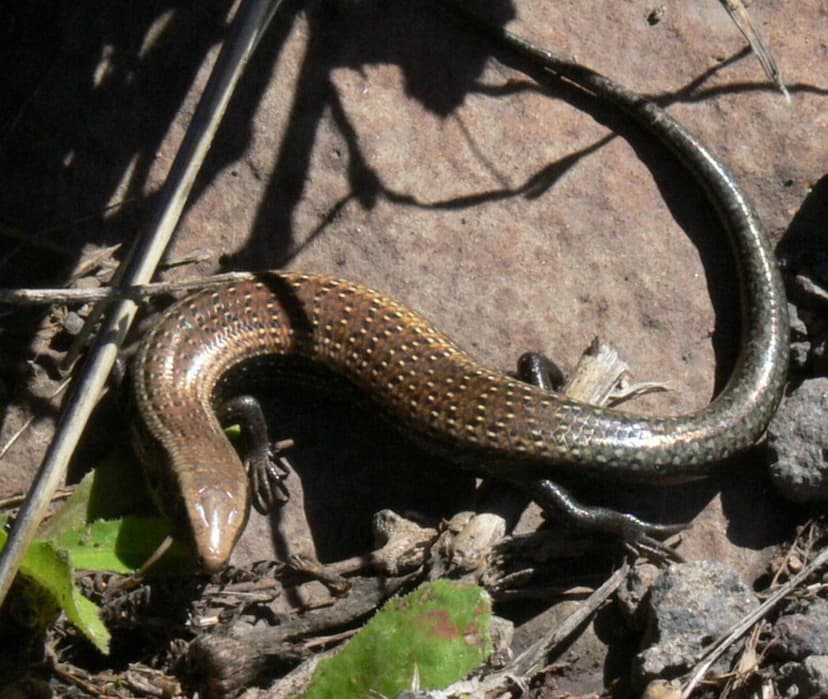
The West Canary skink, scientifically known as Chalcides viridanus, is a species of lizard endemic to the Canary Islands. This skink inhabits a diverse range of environments, from temperate forests and grasslands to urban areas, and can be found at elevations up to 2,000 meters. It is characterized by its cylindrical body and can reach a total length of approximately 18 cm.

West Canary skink
The West Canary skink, also known as the Canaryan cylindrical skink, is a species of lizard endemic to the Canary Islands. It inhabits a variety of environments, from temperate forests to urban areas, and can be found at altitudes up to 2,000 meters. This viviparous lizard is active during the day and at dusk, reaching a total length of about 18 cm.