
Tiger whiptail
The western whiptail is a lizard species found across the southwestern United States and northern Mexico, inhabiting diverse arid and semi-arid environments. Characterized by its long, slender body, small grainy back scales, and larger belly scales, it often displays light stripes and a pinkish or orange throat. This species is known for its unique tail-dropping defense mechanism and its bisexual reproduction, unlike many of its all-female relatives.
Key Facts
- ›Inhabits deserts, semiarid shrublands, woodlands, and riparian areas.
- ›Possesses small grainy scales on its back and larger rectangular scales on its belly.
- ›Adults can reach a maximum snout-to-vent length of 102 mm and a total length of 305 mm.
- ›Diet consists primarily of insects, spiders, scorpions, and other small invertebrates.
- ›Employs tail autotomy (tail dropping) as a defense mechanism against predators.
- ›Unlike many related species, the western whiptail reproduces bisexually, with distinct males and females.

Tiger Whiptail
Southwestern United States, Northern Mexico
- Long and Slender Body.
- Small Grainy Scales On Its Back.
- Larger Rectangular Scales On Its Belly.
- Upper Side Often Has Light Stripes.
- Throat Can Be Pinkish Or Somewhat Orange In Adults.
- Hatchlings Are Orange-Yellow With Dark Brown-Black Spots Or Stripes.
Insects, Spiders, Scorpions, Lepidopterans, Crickets, Grasshoppers, Beetles
- Lives In Burrows.
- Drops Tail As A Defense Mechanism.
- Uses Jaws To Capture Prey.
- Adults Aestivate During Midsummer In Northern Parts of Range.
- Emerges From Hibernation In May In Northern Range, April In Southern Range.
Domestic Cats, Feral Cats
About Tiger whiptail
Western Whiptail
The western whiptail, scientifically known as Aspidoscelis tigris, is a lizard species native to the arid and semi-arid regions of the southwestern United States and northern Mexico. It is a common inhabitant of deserts, shrublands, woodlands, and riparian zones, often seeking refuge in burrows to escape extreme temperatures.
Physical Characteristics
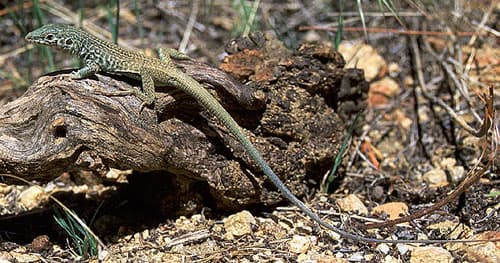
This lizard is distinguished by its long, slender body. Its back is covered with small, grainy scales, contrasting with the larger, rectangular scales found on its belly. Adult western whiptails frequently display light stripes along their dorsal side, and their throats may exhibit a pinkish or orangey hue. Newly hatched individuals are typically orange-yellow and marked with dark brown-black spots or stripes.
Behavior and Ecology
The western whiptail is an active hunter, primarily feeding on insects, spiders, scorpions, and other small invertebrates, which it captures using its jaws. A notable defense mechanism employed by this species is tail autotomy, where the lizard can shed its tail to distract predators, allowing for escape. This process is energy-intensive and stressful for the individual. Unlike many of its relatives within the Aspidoscelis genus, which are exclusively female, the western whiptail is a bisexual species, with both males and females participating in reproduction.
Distribution and Activity
Its range spans across a significant portion of the western United States, including states like Arizona, California, and Nevada, as well as northern Mexico. Activity patterns vary with latitude; in the northern parts of its range, western whiptails typically emerge from hibernation in May and may aestivate during midsummer. In contrast, activity in the southern regions begins as early as April and extends through late August, with potentially two egg-laying cycles per year compared to one in the north.
Source: Wikipedia ↗
Frequently Asked Questions
What is the scientific name for the western whiptail?
The scientific name for the western whiptail is Aspidoscelis tigris. It was previously known by the scientific name Cnemidophorus tigris before phylogenetic analyses led to a reclassification of the genus Cnemidophorus.
Where are western whiptails found?
Western whiptails are widespread throughout most of the southwestern United States and northern Mexico. Within the US, their range includes states such as Arizona, California, Colorado, Idaho, Nevada, New Mexico, Oregon, and Utah.
What kind of habitat does the western whiptail prefer?
This lizard thrives in hot, dry regions, typically with sparse foliage. Its preferred habitats include deserts, semiarid shrubland, woodland, chaparral, and riparian areas. Desert subspecies often rely on burrows to escape extreme heat.
What do western whiptails eat?
The diet of the western whiptail predominantly consists of insects, spiders, scorpions, and other small invertebrates like lepidopterans, crickets, grasshoppers, and beetles. They capture their prey using their jaws rather than their tongue.
Does the western whiptail drop its tail to escape predators?
Yes, the western whiptail can drop its tail when attacked by a predator. The detached tail continues to move, distracting the predator and allowing the lizard a chance to escape. This is a stressful, last-resort defense that requires significant energy to regrow the tail.
How do western whiptails reproduce?
Western whiptails are a bisexual species, meaning they have both males and females, which is a distinction from many other Aspidoscelis species that are all-female. Mating typically occurs in early June in the northern parts of their range, with eggs laid in late June and hatching by mid-August. Females usually lay one clutch per year, though in the southern parts of their range, they may lay two clutches.
What are the physical characteristics of a western whiptail?
The western whiptail has a long, slender body. Its back is covered in small, grainy scales, while its belly has larger, rectangular scales. Adults often exhibit light stripes on their upper side and may have a pinkish or somewhat orange throat. Hatchlings are orange-yellow with dark brown-black spots or stripes.
Related Lizards
Aspidoscelis tigris
The western whiptail (Aspidoscelis tigris), previously known as Cnemidophorus tigris, is a lizard species found across the southwestern United States and northern Mexico. It inhabits a variety of environments, from deserts to woodlands, often seeking refuge in burrows. This species is distinguished by its slender body, small grainy scales on its back, and larger belly scales, frequently featuring light stripes.

Diplodactylus ciliaris
The northern spiny-tailed gecko, scientifically known as *Strophurus ciliaris*, is a species of lizard endemic to Australia. It is characterized by spines above its eyes, resembling eyelashes, and along its tail. This species inhabits arid, semi-arid, and subtropical shrublands, often found in spinifex clumps.

Sceloporus occidentalis
The western fence lizard (Sceloporus occidentalis), also known as the blue-belly, is a common lizard found across the western United States and northern Mexico, easily recognizable by its bright blue ventral abdomen. It inhabits diverse environments from grasslands to forests and is known for its diurnal basking behavior and a diet primarily consisting of terrestrial invertebrates. Its unique blood composition also plays a role in reducing Lyme disease transmission.