
Aspidoscelis tigris
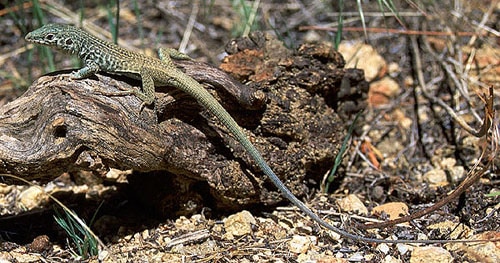
The western whiptail (Aspidoscelis tigris), previously known as Cnemidophorus tigris, is a lizard species found across the southwestern United States and northern Mexico. It inhabits a variety of environments, from deserts to woodlands, often seeking refuge in burrows. This species is distinguished by its slender body, small grainy scales on its back, and larger belly scales, frequently featuring light stripes.
Key Facts
- ›Widespread in the southwestern United States and northern Mexico.
- ›Inhabits diverse habitats including deserts, shrublands, woodlands, and riparian areas.
- ›Possesses a long, slender body with small dorsal scales and larger ventral scales.
- ›Diet primarily consists of insects, spiders, and scorpions.
- ›Known for its tail dropping defense mechanism to evade predators.
- ›Is a bisexual species, with both males and females present.
Western Whiptail
Southwestern United States, Northern Mexico
Desert, Semiarid Shrubland, Woodland, Open Dry Forest, Riparian Growth, Areas With Sparse Vegetation
- Long and Slender Body.
- Small Grainy Scales On Its Back.
- Larger Rectangular Scales On Its Belly.
- Upper Side Often Has Light Stripes.
- Throat Can Be Pinkish Or Somewhat Orange In Adults.
- Hatchlings Are Orange-Yellow With Dark Brown-Black Spots Or Stripes.
Insects, Spiders, Scorpions, Lepidopterans, Crickets, Grasshoppers, Beetles
- Lives In Burrows.
- Drops Tail When Attacked By A Predator.
- Activity Period Varies By Geographic Location .
- Adults May Aestivate During Midsummer Months In the Northern Parts of Its Range.
About Aspidoscelis tigris
The Western Whiptail
The western whiptail, scientifically known as Aspidoscelis tigris and formerly Cnemidophorus tigris, is a species of lizard native to the southwestern United States and northern Mexico. This adaptable reptile inhabits a wide array of environments, ranging from arid deserts and semiarid shrublands to woodlands and riparian areas, often preferring locations with sparse vegetation and utilizing burrows for shelter.
Physical Characteristics
This species is characterized by its long, slender body. Its dorsal surface is covered with small, grainy scales, contrasting with larger, rectangular scales on its belly. Adult western whiptails frequently display light stripes along their backs, and their throats can exhibit a pinkish or somewhat orange hue. Hatchlings are notable for their orange-yellow coloration marked with dark brown-black spots or stripes.
Distribution and Habitat
The western whiptail's range is extensive, covering much of the southwestern United States, including states like Arizona, California, Colorado, Idaho, Nevada, New Mexico, Oregon, and Utah, as well as northern Mexico. They thrive in hot, dry climates and are often found in habitats featuring vegetation such as sagebrush or shadscale, relying on burrows to escape extreme temperatures.
Behavior and Ecology
Western whiptails are diurnal and their activity patterns are influenced by latitude. In the northern parts of their range, they emerge from hibernation in May, and adults may experience aestivation during the hottest summer months. In contrast, activity in the southern regions can begin as early as April and extend through late August.
A distinctive defensive behavior of the western whiptail is its ability to drop its tail when threatened by a predator. The detached tail continues to move, serving as a distraction that allows the lizard to escape. This is a strenuous process for the lizard, requiring significant energy to regenerate the lost tail.
Reproduction
The western whiptail is a bisexual species, meaning it reproduces sexually with both males and females. This is a notable characteristic, as many other species within the Aspidoscelis genus are entirely female and reproduce parthenogenetically. Mating typically occurs in early June in the northern parts of its range, with females laying a single clutch of eggs in late June, which usually hatch by mid-August. In the southern parts of its range, females may lay eggs as early as May and can produce up to two clutches per year.
Source: Wikipedia ↗
Frequently Asked Questions
Where can the western whiptail be found?
The western whiptail is widely distributed throughout the western United States and northern Mexico. In the US, it is found in states like Arizona, California, Colorado, Idaho, Nevada, New Mexico, Oregon, and Utah.
What kind of habitats do western whiptails prefer?
These lizards are adapted to hot, dry regions and can be found in a variety of habitats. This includes deserts with sparse vegetation like sagebrush, semiarid shrublands, woodlands, chaparral, and riparian areas.
What is the physical appearance of a western whiptail?
The western whiptail has a long, slender body. Its back is covered in small, grainy scales, while its belly has larger, rectangular scales. Adults often display light stripes on their upper side, and their throats may be pinkish or orange.
What do western whiptails eat?
Their diet primarily consists of small invertebrates. This includes insects such as lepidopterans, crickets, grasshoppers, and beetles, as well as spiders and scorpions. They capture prey using their jaws.
How does the western whiptail defend itself from predators?
When threatened, the western whiptail can detach its tail, which continues to move to distract the predator. This is a last resort as it is energetically costly for the lizard to regrow its tail.
What is the reproductive behavior of the western whiptail?
Unlike many other Aspidoscelis species, the western whiptail is bisexual, meaning both males and females exist. Mating typically occurs in early June in the northern parts of its range, with egg-laying in late June and hatching in mid-August. Females lay one clutch per year, though in the southern range, they may lay two clutches and lay eggs as early as May.
Are there different types of western whiptails?
Yes, there are numerous subspecies of the western whiptail, with 16 currently recognized as valid. These subspecies have developed in different regions due to the lizard's non-migratory nature.
Related Lizards

Tiger whiptail
The western whiptail is a lizard species found across the southwestern United States and northern Mexico, inhabiting diverse arid and semi-arid environments. Characterized by its long, slender body, small grainy back scales, and larger belly scales, it often displays light stripes and a pinkish or orange throat. This species is known for its unique tail-dropping defense mechanism and its bisexual reproduction, unlike many of its all-female relatives.

Central Netted Dragon
The Central Netted Dragon is a medium-sized lizard native to arid and semi-arid regions of Australia, characterized by a distinctive net-like pattern on its reddish-brown to orange-brown body. It is a diurnal, terrestrial species known for its burrowing behavior and a diet that includes insects and vegetation. These dragons are popular pets and are commonly found in zoos.

Gray checkered whiptail
The gray checkered whiptail (Aspidoscelis dixoni), also known as Dixon's whiptail, is a lizard species found in northern Mexico and the southwestern United States. It is characterized by its gray coloration, thin body, and long tail adorned with 10-12 longitudinal white or yellow stripes, often with checkering. This diurnal and insectivorous species prefers rocky, semi-arid habitats with sparse vegetation and reproduces asexually through parthenogenesis.