
Trachylepis striata
The African striped skink (Trachylepis striata), also known as the striped skink, is a species of lizard found across East and Southern Africa. It is characterized by its brown or bronze coloration with two prominent lengthwise yellow stripes along its back. These skinks typically reach a total length of 25 cm, with their tails often being lost as a defense mechanism against predators.
Key Facts
- ›Widespread throughout East and Southern Africa.
- ›Adults reach a total length of up to 25 cm.
- ›Distinguished by two yellow stripes running lengthwise along its back.
- ›Tails are frequently shed as a defense against predators.
- ›Belongs to the skink family (Scincidae).

Striped Skink
East Africa, Southern Africa
- Brown Or Bronze-Colored Body.
- Two Yellowish Stripes Running Lengthwise On Either Side of the Spine.
- Total Length Up To 25 cm .
- Tails Are Often Missing.
- Tail Shedding Is A Defense Mechanism Against Predators.
About Trachylepis striata
The African striped skink, scientifically recognized as Trachylepis striata and commonly known as the striped skink, is a widespread lizard species native to East and Southern Africa. It belongs to the diverse family of skinks, Scincidae.
Description and Characteristics
This species is characterized by its brown or bronze coloration, distinguished by two prominent yellowish stripes that run lengthwise along its back, flanking the spine. Both males and females of Trachylepis striata typically reach a total length of up to 25 centimeters (9.8 inches), including their tail. A notable characteristic is the frequent absence of their tails, a common adaptation where the tail is shed as a defense mechanism to evade predators.
Distribution and Habitat
The African striped skink is widely distributed across a significant geographical range encompassing both East Africa and Southern Africa. Specific details regarding its preferred habitat types are not extensively documented in available records, though its broad distribution suggests adaptability to various environments within these regions.
Taxonomy
Historically, some populations were classified as subspecies, such as T. s. punctatissima, T. s. sparsa, and T. s. wahlbergii. However, these have since been elevated to their own distinct species levels, clarifying the taxonomic status of Trachylepis striata.
Source: Wikipedia ↗
Frequently Asked Questions
What is the African striped skink?
The African striped skink, scientifically known as Trachylepis striata, is a species of lizard belonging to the skink family (Scincidae). It is commonly referred to as the striped skink.
Where can the African striped skink be found?
This lizard species is widespread and naturally occurs across significant portions of East Africa and Southern Africa.
What does the African striped skink look like?
Trachylepis striata typically exhibits a brown or bronze coloration. Its most distinctive feature is the presence of two yellowish stripes that run lengthwise along either side of its spine.
How large do African striped skinks get?
Both male and female African striped skinks can grow to a total length, including their tail, of approximately 25 centimeters (9.8 inches).
Why do African striped skinks often have missing tails?
The tails of African striped skinks are often missing due to predation. Shedding their tails is a common defense mechanism to escape from predators.
Related Lizards
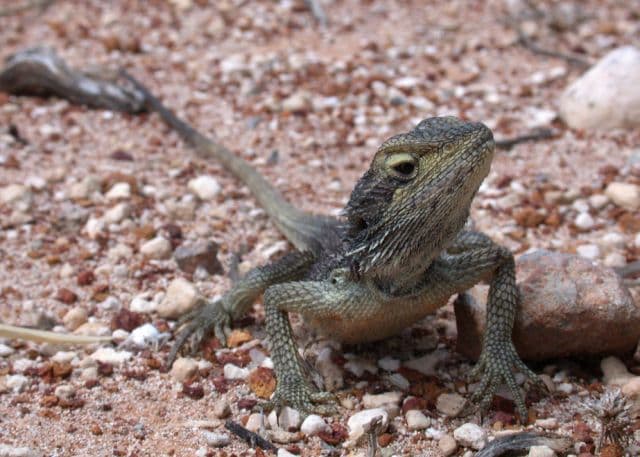
Abrolhos bearded dragon
The Abrolhos bearded dragon (Pogona minor minima) is a small agamid lizard endemic to the islands of the Houtman Abrolhos archipelago off the coast of Western Australia. It is characterized by its smaller size compared to related bearded dragons and inhabits sandy or limestone outcrop environments.

Algerian sand racer
The Algerian sand racer, scientifically known as Psammodromus algirus, is a lizard species found in southwestern Europe and northwestern Africa. It typically inhabits dense bushy vegetation and can be found at high elevations, though it is more common at lower altitudes. This species is characterized by its metallic brownish dorsal coloration with conspicuous white or yellowish stripes.

Amphiglossus decaryi
The rock skink, scientifically known as Flexiseps decaryi, is a species of skink found exclusively on the island of Madagascar. As a member of the skink family, it is characterized by its smooth, overlapping scales and typically elongated body. Its specific ecological niche and behavioral patterns are not extensively detailed in available records.