
Trapelus ruderatus
Trapelus ruderatus·Agamidae
Trapelus ruderatus, also known as Olivier's agama or the Baluch ground agama, is a species of lizard native to parts of Western Asia and the Middle East. It is characterized by its ground-dwelling habits and its distribution across arid and semi-arid regions.
Key Facts
- ›Found in Azerbaijan, Syria, Lebanon, Jordan, Saudi Arabia, Iraq, Iran, and Pakistan.
- ›Commonly referred to as Olivier's agama or the Baluch ground agama.
- ›Inhabits arid and semi-arid environments.
- ›Belongs to the agama family.
- ›A species of ground agama.

Olivier's Agama, Baluch Ground Agama
Azerbaijan, Syria, Lebanon, Jordan, Saudi Arabia, Iraq, Iran, Pakistan
About Trapelus ruderatus
Trapelus ruderatus, also widely recognized as Olivier's agama or the Baluch ground agama, is a species of lizard found across a significant portion of Western Asia and the Middle East. Its natural habitat is characterized by arid and semi-arid conditions, where it thrives as a ground-dwelling reptile.
Distribution and Habitat
The geographical range of Trapelus ruderatus is extensive, encompassing countries such as Azerbaijan, Syria, Lebanon, Jordan, Saudi Arabia, Iraq, Iran, and Pakistan. This wide distribution highlights its adaptability to diverse dry environments within these regions.
Source: Wikipedia ↗
Frequently Asked Questions
What is Trapelus ruderatus commonly called?
Trapelus ruderatus is commonly known as Olivier's agama or the Baluch ground agama. These names reflect its geographical distribution and its classification within the agama family.
Where can Trapelus ruderatus be found?
This species has a wide distribution across several countries in Western Asia and the Middle East. Its natural range includes Azerbaijan, Syria, Lebanon, Jordan, Saudi Arabia, Iraq, Iran, and Pakistan.
What type of habitat does Trapelus ruderatus prefer?
Trapelus ruderatus is typically found in arid and semi-arid environments. These are the natural conditions that support its ground-dwelling lifestyle and provide suitable conditions for survival.
Related Lizards
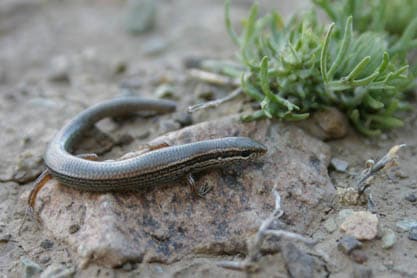
Ablepharus pannonicus
The Asian snake-eyed skink (Ablepharus pannonicus) is a species of skink native to a wide range across Asia and parts of the Middle East. It is characterized by its snake-like appearance and is found in diverse arid and semi-arid environments.

Acanthodactylus longipes
The long fringe-fingered lizard (Acanthodactylus longipes) is a species of lizard belonging to the Lacertidae family, native to northwestern Africa. It is characterized by its fringe-like scales on its toes, which aid in locomotion on sandy substrates. This oviparous species is found across a wide range of arid and semi-arid environments within the region.
Asian snake-eyed skink
The Asian snake-eyed skink (Ablepharus pannonicus) is a species of skink native to a wide range across Western and Central Asia, as well as parts of the Middle East. It is characterized by its small size and its distribution across various arid and semi-arid environments.