
Underwood's Spectacled Tegu
Underwood's spectacled tegu (Gymnophthalmus underwoodi) is a unisexual lizard species that reproduces through parthenogenesis. It is found in grasslands across South America and various Caribbean islands. This microteiid lizard is recognized for its unique reproductive strategy and its distribution across a wide range of tropical environments.
Key Facts
- ›Unisexual species that reproduces via parthenogenesis.
- ›Found in grasslands of South America and the Caribbean.
- ›Name honors British herpetologist Garth Underwood.
- ›Known to lay between one and four eggs per clutch.
- ›Captive specimens have laid up to eleven eggs within four months.

Underwood's Spectacled Tegu
Dominican Republic, Dominica, Antigua and Barbuda, Barbados, Cuba, Guadeloupe, Martinique, Saint Martin, Trinidad and Tobago, Us Virgin Islands, Saint Vincent and the Grenadines, Grenada, Sint Eustatius, Saba, Guyana, Suriname, Colombia, Venezuela, Potentially Brazil, Potentially French Guiana
About Underwood's Spectacled Tegu
Underwood's spectacled tegu, scientifically known as Gymnophthalmus underwoodi, is a species of microteiid lizard notable for its unique reproductive strategy and broad distribution across South America and the Caribbean. This lizard is exclusively female and reproduces through parthenogenesis, a form of asexual reproduction where an embryo develops from an unfertilized egg.
Distribution and Habitat
The natural habitat of G. underwoodi is grassland. Its range is extensive, encompassing numerous Caribbean islands including Barbados, Cuba, Dominica, and Trinidad and Tobago, as well as parts of South America such as Guyana, Suriname, Colombia, and Venezuela. There is also a potential presence in Brazil and French Guiana.
Reproduction
As a unisexual species, Gymnophthalmus underwoodi does not require males for reproduction. Captive specimens have demonstrated the capacity to lay between one and four eggs per clutch, with some individuals laying up to eleven eggs within a four-month period. This remarkable reproductive method contributes to the species' ability to colonize and thrive in various environments.
Etymology
The specific name, underwoodi, honors British herpetologist Garth Underwood, recognizing his contributions to the study of West Indian herpetiles. The species was first described by Chapman Grant in 1958, with the holotype collected in Barbados.
Source: Wikipedia ↗
Frequently Asked Questions
What is a spectacled tegu?
A spectacled tegu is a common name for lizards belonging to the genus Gymnophthalmus. Underwood's spectacled tegu, Gymnophthalmus underwoodi, is one such species known for its unique characteristics.
How does Underwood's spectacled tegu reproduce?
Underwood's spectacled tegu is a unisexual species, meaning it reproduces asexually through parthenogenesis. This involves the development of an embryo from an unfertilized egg.
Where is Gymnophthalmus underwoodi found?
This lizard species has a wide geographic distribution, being found in South America, including countries like Guyana, Suriname, Colombia, and Venezuela. It is also present on numerous Caribbean islands such as Barbados, Cuba, and Trinidad and Tobago.
What kind of habitat does Underwood's spectacled tegu prefer?
The natural habitat of Gymnophthalmus underwoodi is grassland. They thrive in these open, grassy environments across their extensive range.
How many eggs does Underwood's spectacled tegu lay?
Captive specimens of Underwood's spectacled tegu have been observed laying between one and four eggs per clutch. Within a four-month period, a single individual has been recorded laying up to eleven eggs.
Who is Garth Underwood and why is the lizard named after him?
Garth Underwood was a British herpetologist whose work on West Indian reptiles was recognized by naming this species after him. He had collected specimens from Barbados that were later designated as paratypes for this species.
Related Lizards
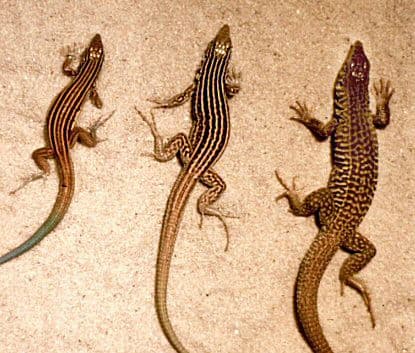
Aspidoscelis neomexicana
The New Mexico whiptail (Aspidoscelis neomexicana) is a unique, all-female lizard species native to the southwestern United States and northern Mexico, notable for its parthenogenetic reproduction. Characterized by its slender body, seven pale yellow stripes, and a blue or blue-green throat, this diurnal lizard inhabits a variety of semi-arid environments.

Gymnophthalmus underwoodi
Gymnophthalmus underwoodi, commonly known as Underwood's spectacled tegu, is a species of microteiid lizard native to South America and the Caribbean. It is a unisexual species that reproduces through parthenogenesis, laying clutches of one to four eggs. Its natural habitat is grassland.
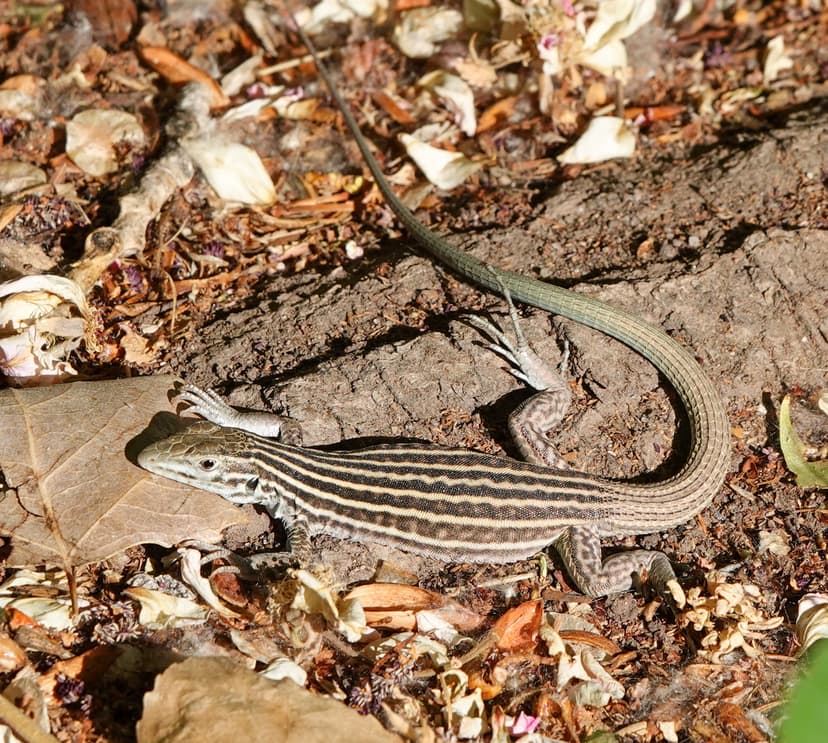
New Mexico whiptail
The New Mexico whiptail (Aspidoscelis neomexicanus) is an all-female lizard species native to the southwestern United States and northern Mexico. It is known for its unique reproductive strategy, being both a hybrid and parthenogenetic, meaning it can reproduce without males. This species is characterized by its brown or black coloration with seven pale yellow stripes and a slender body with a long tail.