
Uromastyx flavifasciata
Uromastyx flavifasciata is a medium-sized, desert-adapted spiny-tailed lizard found in the arid and desert regions of North Africa, including parts of Algeria, Mali, and Niger. It is characterized by its beige or green-brown coloration, patterned back, and a distinctive spiny tail. This species is well-adapted to survive severe drought periods by collecting moisture from dew and its burrow.
Key Facts
- ›Found in rocky, arid, and desert habitats.
- ›Native to Algeria, Mali, and Niger.
- ›Average length is around 50 cm.
- ›Possesses a characteristic spiny tail.
- ›Adapted to survive severe drought conditions.
- ›Coloration is typically beige or green-brown with back patterns.

Algeria, Mali, Niger
Medium-Sized Lizard For Its Genus., Average Length Around 50 cm., Typically Beige Or Green-Brown Coloration., Features Patterns On Their Backs., Possesses A Characteristic Spiny Tail.
Nurtures Morning Dew For Moisture., Collects Moisture From Burrows., Adapted To Survive Severe Drought Periods.
About Uromastyx flavifasciata
Uromastyx flavifasciata is a subspecies of spiny-tailed lizard belonging to the family Agamidae. It is found in rocky, arid, and desert habitats across North Africa, with its natural range encompassing parts of Algeria, Mali, and Niger. While some sources consider it a distinct species, it is more commonly recognized as a subspecies of Uromastyx dispar.
Physical Characteristics and Adaptations
This lizard is a medium-sized desert-adapted species within its genus, typically reaching an average length of around 50 centimeters. Uromastyx flavifasciata is usually characterized by its beige or green-brown coloration, often adorned with patterns on its back. A distinctive feature is its characteristic spiny tail. The species exhibits remarkable adaptations for survival in arid environments, including the ability to collect morning dew and moisture from their burrows, which allows them to endure severe drought periods.
Source: Wikipedia ↗
Frequently Asked Questions
What is Uromastyx flavifasciata?
Uromastyx flavifasciata is a subspecies of spiny-tailed lizard belonging to the family Agamidae. It is a medium-sized, desert-adapted reptile known for its patterned back and distinctive spiny tail.
Where is Uromastyx flavifasciata found?
This lizard is found in rocky, arid, and desert habitats across North Africa. Its natural range includes parts of Algeria, Mali, and Niger.
What are the physical characteristics of Uromastyx flavifasciata?
Uromastyx flavifasciata typically measures around 50 cm in length. They are usually beige or green-brown with patterns on their backs and possess a characteristic spiny tail.
How does Uromastyx flavifasciata survive in arid environments?
This species is well-adapted to arid conditions. They are capable of nurturing morning dew and moisture from their burrows, which allows them to survive severe drought periods.
Is Uromastyx flavifasciata considered a separate species?
While sometimes treated as a distinct species, Uromastyx flavifasciata is more commonly recognized as a subspecies of Uromastyx dispar.
Related Lizards
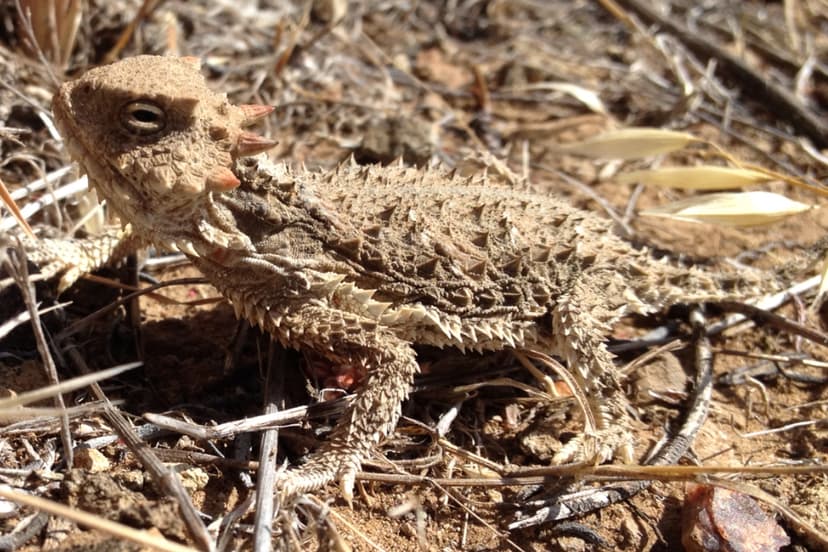
Phrynosoma platyrhinos
The desert horned lizard (Phrynosoma platyrhinos) is a medium-sized lizard native to western North America, characterized by its flat body, fringe scales, and distinctive "horns" formed by large, pointed cranial scales. They inhabit desert climates and arid to semiarid plains, preferring areas with shrub cover and loose soil for burrowing. Primarily feeding on invertebrates, especially ants, these lizards are known for their camouflage and unique defensive behaviors.

Trachylepis quinquetaeniata
The African five-lined skink (Trachylepis quinquetaeniata) is a medium-sized lizard native to north-central Africa, characterized by its glossy scales and distinctive five stripes running from head to tail. Its coloration varies with age, sex, and season, but typically features an olive-brown base with blue, black, and yellowish markings, especially on its bright blue tail. This adaptable species inhabits both rocky and grassland environments, often making its home on trees or man-made structures.

Aspidoscelis tesselata
The checkered whiptail (Aspidoscelis tesselatus) is a parthenogenic lizard species native to the southwestern United States and northern Mexico. Characterized by its slender body, long tail, and variable coloration of brown or black blotching on a pale yellow or white base, it is an energetic and fast-moving reptile. It inhabits semi-arid, rocky canyon and hilled regions.