
Varanidae
Varanidae is a family of carnivorous and frugivorous lizards that includes the Komodo dragon, the largest living lizard. These lizards are known for their intelligence, large home ranges, and high stamina, with some arboreal species specializing in fruit consumption. The family has a fossil record dating back to the Late Cretaceous period.
Key Facts
- ›Includes the Komodo dragon, the world's largest living lizard.
- ›Comprises carnivorous and frugivorous lizard species.
- ›Known for intelligence, large home ranges, and high stamina.
- ›Fossil record extends to the Late Cretaceous period.
- ›Some arboreal species primarily consume fruit.

Monitor Lizards
Australia, Southeast Asia, Mongolia, Europe, North America, China, Philippines
- Limbs Show Positive Allometry .
- Feet Become Smaller Relative To Limb Segment Lengths In Larger Species.
Carnivorous, Frugivorous
Forage Widely, Have Large Home Ranges, Exhibit High Stamina, Considered Intelligent
About Varanidae
What are Varanidae?
The Varanidae, commonly known as monitor lizards, represent a distinct family within the lizard suborder Anguimorpha. This group is characterized by its members' carnivorous and, in some cases, frugivorous diets. The family encompasses the well-known Komodo dragon, recognized as the largest living lizard, along with species like the crocodile monitor and savannah monitor, as well as the goannas native to Australia and Southeast Asia. Their closest living relatives are the earless monitor lizard and the Chinese crocodile lizard.
Biology and Behavior
Monitor lizards are reputed to be among the most intelligent lizards, a trait that likely aids their survival. Most species are known to forage extensively and maintain large home ranges, demonstrating considerable stamina. While the majority are carnivorous, a notable exception exists in three arboreal species from the Philippines (Varanus olivaceus, Varanus mabitang, and Varanus bitatawa), which are primarily frugivores, subsisting mainly on fruits. Anatomically, varanids exhibit positive allometry in their limbs, meaning limb size increases disproportionately with body size, though their feet tend to become proportionally smaller as individuals grow larger.
Evolutionary History
The fossil record for the Varanidae family is substantial, with the oldest known members dating back to the Late Cretaceous period. These ancient specimens have been discovered primarily in Mongolia. The taxonomic classification of the Varanidae has seen some variation, particularly concerning the inclusion of the earless monitor lizard. Different researchers have proposed definitions that either include or exclude this species, leading to its placement within Varanidae or in a separate family, Lanthanotidae, depending on the classification system used.
Source: Wikipedia ↗
Frequently Asked Questions
What are monitor lizards known for?
Monitor lizards are reputed to be among the most intelligent lizards. They are also known for their ability to forage widely, possess large home ranges, and exhibit high stamina.
What is the diet of Varanidae species?
Most Varanidae species are carnivorous. However, three arboreal species found in the Philippines are primarily frugivores, meaning they mainly eat fruit.
When do the oldest Varanidae members date back to?
The oldest known members of the Varanidae family have been identified from fossils dating to the Late Cretaceous period. These fossils have been found in Mongolia.
What are some of the famous species within the Varanidae family?
The Varanidae family includes well-known species such as the Komodo dragon, crocodile monitor, savannah monitor, and the goannas found in Australia and Southeast Asia.
Are monitor lizards intelligent?
Yes, monitor lizards are widely considered to be among the most intelligent of all lizard species. This intelligence likely contributes to their success in foraging and adapting to various environments.
Related Lizards
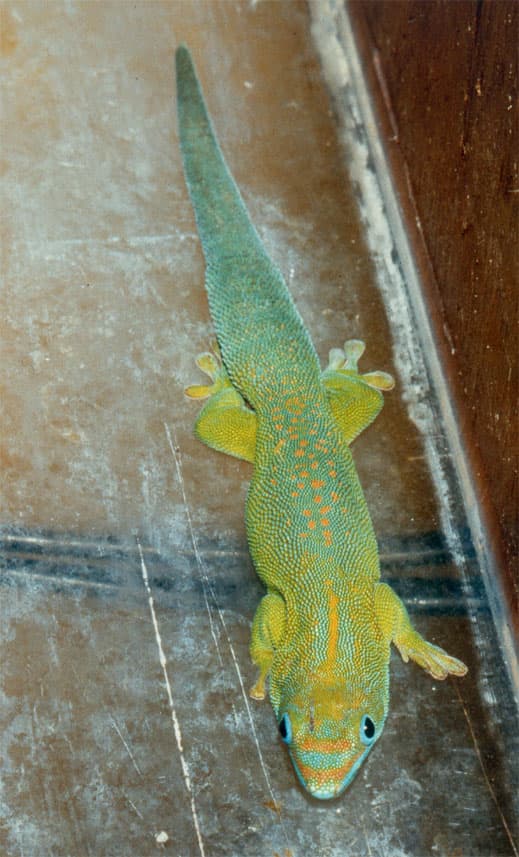
Phelsuma flavigularis
The yellow-throated day gecko (Phelsuma flavigularis) is an endangered, diurnal gecko native to eastern Madagascar's rainforests. This medium-sized species is characterized by its bluish-green body, red snout bars, and a distinctive yellow throat. It primarily inhabits trees and feeds on insects and nectar.

Jerdon's forest lizard (Calotes jerdoni)
Jerdon's forest lizard (Calotes jerdoni) is a species of agamid lizard found in South Asia and China. It is characterized by its compressed body, green dorsal coloration often with spots, and its ability to rapidly change to dark brown. Primarily insectivorous, it also consumes bird eggs, nestlings, and frogs, and is known to be non-venomous and harmless to humans.

Sphaerodactylus
Sphaerodactylus is a genus of geckos native to the Americas, distinguished by their small size, round pupils, and unique digits that end in adhesive pads. Some species within this genus, like S. ariasae and S. parthenopion, are among the smallest reptiles globally, measuring around 1.6 cm in snout-vent length. Fossil evidence suggests their presence in Dominican amber.