
Varanus ornatus
The ornate monitor, formerly classified as Varanus ornatus, is now understood to represent forest-dwelling forms of the Nile monitor (Varanus niloticus) and the West African Nile monitor (Varanus stellatus). These large lizards are characterized by their dark, olive-green to black backs with distinctive yellow or cream ocelli bands, and yellowish undersides with gray banding. They inhabit closed-canopy forests across West and Middle Africa.
Key Facts
- ›Formerly recognized as a distinct species (Varanus ornatus), now considered forest forms of Varanus niloticus or Varanus stellatus.
- ›Native to West and Middle Africa, specifically inhabiting closed-canopy forests.
- ›Adults can reach up to two meters in length.
- ›Distinguished by dark backs with yellow/cream ocelli bands and yellowish undersides with gray banding.
- ›The number of ocelli bands on the body was historically used to differentiate it, with 4-5 bands proposed for Varanus ornatus versus 6-9 for Varanus niloticus.
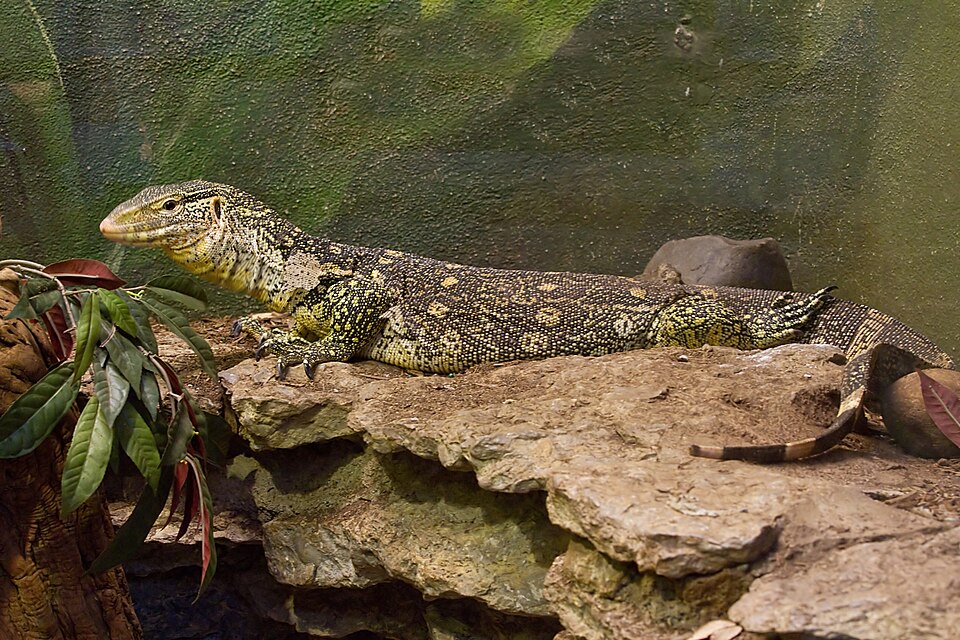
Ornate Monitor
West Africa, Middle Africa
- Large Monitor Lizards, Reaching Up To Two Meters In Length.
- Back Color Ranges From Olive Green To Black.
- Features Cross Bands of Yellow Or Cream-Colored Ocelli On the Back.
- Additional Bands Are Present On the Tail.
- Ventral Side Is Yellowish With Gray Banding.
- Historically, 4-5 Ocelli Bands On the Body Were Proposed To Distinguish It From Varanus Niloticus .
About Varanus ornatus
The Ornate Monitor: A Forest Dweller of West and Middle Africa
The term "ornate monitor" historically referred to a distinct group of monitor lizards, often designated as Varanus ornatus or a subspecies of the Nile monitor (Varanus niloticus ornatus). However, comprehensive genetic analyses conducted in recent years have led to a reclassification. These studies indicate that what was previously identified as the ornate monitor does not represent a valid, separate taxon. Instead, these animals are now understood to be polymorphisms, or variations, of two closely related monitor lizard species: the West African Nile monitor (Varanus stellatus) and the Nile monitor (Varanus niloticus).
These large reptiles are native to the closed-canopy forests of West and Middle Africa. They are characterized by their impressive size, with adults capable of reaching lengths of up to two meters. Physically, ornate monitors display a striking appearance. Their backs are typically a dark hue, ranging from olive green to black, and are adorned with distinctive cross bands of yellow or cream-colored ocelli, which are eye-like markings. These patterns also extend to their tails. The underside of the lizard is generally yellowish, marked with gray banding. Historically, the number of these ocelli bands on the body was considered a distinguishing feature, with ornate monitors proposed to have fewer bands than the broader Nile monitor species, though genetic evidence has superseded this identification method.
Source: Wikipedia ↗
Frequently Asked Questions
What is the current scientific classification of the ornate monitor?
The ornate monitor, once known as Varanus ornatus, is no longer considered a valid species. Comprehensive molecular analyses indicate that these animals are polymorphisms of two distinct species: the West African Nile monitor (Varanus stellatus) and the Nile monitor (Varanus niloticus).
Where are ornate monitors found?
Animals described as ornate monitors are native to closed-canopy forests located in West and Middle Africa. They are specifically associated with these dense forest environments within these regions.
What are the key physical characteristics of the ornate monitor?
They are large lizards, capable of growing up to two meters in length. Their backs are typically dark, ranging from olive green to black, adorned with cross bands of yellow or cream-colored ocelli. The tail also features additional bands, and their ventral side is yellowish with gray banding.
How did the ornate monitor differ from the Nile monitor?
Historically, the ornate monitor was thought to be distinguishable from the Nile monitor by a reduced number of ocelli rows on the body (four or five bands compared to six to nine), a light-colored tongue, and a more massive build. However, genetic studies have reclassified these traits.
Related Lizards

Brookesia superciliaris
The brown leaf chameleon, also known as Brookesia superciliaris, is a small lizard found along the eastern coast of Madagascar and the island of Nosy Boraha. Its appearance is remarkably adapted to mimic a dead leaf, with a laterally squashed body and pronounced horns above its eyes. This species inhabits the floor of evergreen primary forests, and can be found from sea level up to elevations of 1,250 meters.
Abrolhos bearded dragon
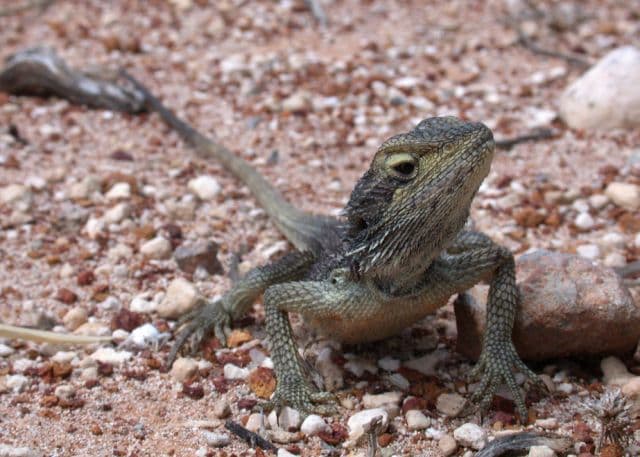
The Abrolhos bearded dragon (Pogona minor minima) is a small agamid lizard endemic to the islands of the Houtman Abrolhos archipelago off the coast of Western Australia. It is characterized by its smaller size compared to related bearded dragons and inhabits sandy or limestone outcrop environments.

Algerian sand racer
The Algerian sand racer, scientifically known as Psammodromus algirus, is a lizard species found in southwestern Europe and northwestern Africa. It typically inhabits dense bushy vegetation and can be found at high elevations, though it is more common at lower altitudes. This species is characterized by its metallic brownish dorsal coloration with conspicuous white or yellowish stripes.