
Galictis
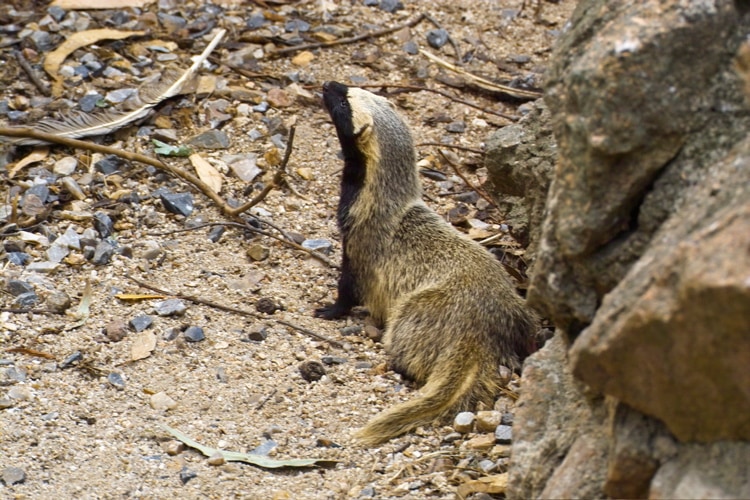
The grison, genus Galictis, is a mustelid native to Central and South America. These animals are characterized by their frosted gray fur along the back, contrasted by black legs, throat, face, and belly, and a distinctive white stripe from the forehead to the back of the neck. They inhabit a variety of semi-open and forested environments and are generally terrestrial, often burrowing underground.
Key Facts
- ›Grisons belong to the genus Galictis and are native to Central and South America.
- ›They possess a distinctive pelage with frosted gray fur on the back, black undersides, and a white stripe on the head and neck.
- ›Grisons are omnivorous, feeding on fruits and small animals.
- ›They are primarily terrestrial, nesting in burrows found in fallen trees or rock crevices.
- ›The genus Galictis first appeared in South America during the early Pleistocene, approximately 2.5 million years ago.
- ›Two extant species exist: the greater grison (Galictis vittata) and the lesser grison (Galictis cuja).
Grison, Huroncito, GrisóN, FurãO
South America, Central America
Semi-Open Shrubland, Woodland, Forest
- Terrestrial
- Burrowing
- Nesting In Holes In Fallen Trees Or Rock Crevices
- Often Live Underground
About Galictis
Grison (Genus Galictis)
The grison, scientifically classified under the genus Galictis, is a group of mustelids native to the diverse landscapes of Central and South America. The genus name itself is derived from Greek words for 'weasel' and 'marten', hinting at their family ties and general appearance.
Physical Characteristics and Habitat
Grisons are recognized for their distinctive appearance, often compared to a smaller, more slender honey badger. Their bodies are typically up to 60 cm (24 inches) in length, with an average weight ranging from 1 to 3 kg (2.2 to 6.6 lb). The most striking feature of their pelage is the frosted gray fur covering their back, sharply contrasted by black legs, throat, face, and belly. A prominent white stripe runs from the forehead along the neck, further defining their facial features.
These animals are adaptable to a variety of environments, inhabiting semi-open shrublands, woodlands, and low-elevation forests. They are primarily terrestrial creatures, demonstrating a tendency to burrow and create nests in natural cavities such as holes in fallen trees or rock crevices. Grisons often make their homes underground, utilizing these sheltered spaces for safety and raising young.
Diet and Behavior
The diet of the grison is omnivorous, reflecting their opportunistic feeding habits. They consume a mix of fruits found in their habitats and small animals, including various mammals. Limited information exists on their behavior, partly due to a unique anatomical challenge: their necks are exceptionally wide in comparison to their heads, which has historically made radio-tracking studies problematic and thus less data has been gathered on their daily activities.
Evolutionary History and Species
The evolutionary lineage of grisons traces back to the early Pleistocene epoch in South America, approximately 2.5 million years ago. It is theorized that they may have descended from North American fossil genera like Trigonictis and Sminthosinus from the Pliocene. Currently, the genus Galictis encompasses two recognized extant species: the greater grison (Galictis vittata), with a broad distribution across Central and South America, and the lesser grison (Galictis cuja), whose range is confined to the southern regions of South America. Several fossil species, including Galictis hennigi, Galictis sanandresensis, and Galictis sorgentinii, have been identified from paleontological finds in Argentina.
Source: Wikipedia ↗
Frequently Asked Questions
What are grisons?
Grisons are mustelids belonging to the genus Galictis. They are native to Central and South America and are known for their distinctive gray and black fur with a white head stripe.
Where do grisons live?
Grisons are found in a variety of habitats across Central and South America, ranging from semi-open shrub and woodland to low-elevation forests. They are generally terrestrial and often burrow or nest in natural cavities.
What do grisons eat?
Grisons are omnivorous. Their diet consists of fruits as well as small animals, including mammals.
What is the difference between the greater and lesser grison?
The genus Galictis contains two extant species: the greater grison (Galictis vittata) and the lesser grison (Galictis cuja). The lesser grison is slightly smaller than the greater grison. The greater grison has a wider geographic range, extending from South America through Central America to southern Mexico, while the lesser grison is restricted to the southern half of South America.
What are the physical characteristics of a grison?
Grisons measure up to 60 cm in length and weigh between 1 and 3 kg. They have a frosted gray coat along the back, with black legs, throat, face, and belly. A prominent white stripe runs from the forehead to the back of the neck.
Related Mustelids, Otters & Raccoons
Bassariscus
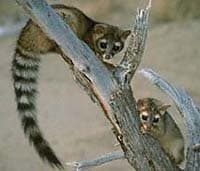
Bassariscus is a genus of two extant species, the ringtail and the cacomistle, belonging to the family Procyonidae. These animals are closely related to raccoons, diverging approximately 10 million years ago. Known for their semi-arid to tropical forest habitats, they are distinguished by a more digitigrade stance compared to other procyonids.

Arctonyx
Hog badgers are three species within the genus Arctonyx, a group of mustelids belonging to the subfamily Melinae, which also includes true badgers. These distinct species were identified through a 2008 study, expanding the genus from a single species to three: the greater hog badger, the northern hog badger, and the Sumatran hog badger.

Enhydra
Enhydra is a genus of mustelids that includes the modern sea otter and two extinct species. It represents the sole living genus within the bunodont otters, characterized by non-blade carnassials with rounded cusps. The genus is believed to have originated in the Atlantic, with its lineage later becoming established in the North Pacific.