
Bassariscus
Bassariscus is a genus of two extant species, the ringtail and the cacomistle, belonging to the family Procyonidae. These animals are closely related to raccoons, diverging approximately 10 million years ago. Known for their semi-arid to tropical forest habitats, they are distinguished by a more digitigrade stance compared to other procyonids.
Key Facts
- ›The genus Bassariscus contains two living species: the ringtail (Bassariscus astutus) and the cacomistle (Bassariscus sumichrasti).
- ›Genetic studies suggest Bassariscus is the most ancient extant procyonid genus, diverging from raccoons about 10 million years ago.
- ›They inhabit semi-arid regions of the southwestern United States, all of Mexico, and moist tropical forests of Central America.
- ›Their leg stance is more digitigrade than other raccoons, leading some classifications to propose a separate family, Bassaricidae.
- ›The genus name derives from Greek 'bassaris' (fox) with a Latinized diminutive ending '-iscus'.
- ›Two extinct species, Bassariscus casei and Bassariscus sonoitensis, also existed in the Pliocene and Pleistocene epochs.
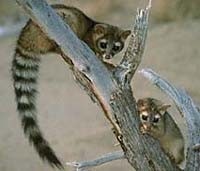
Ringtail, Ring-Tailed Cat, Cacomistle
North America, Central America
Semi-Arid, Forest, Tropical Forest
Digitigrade Stance
About Bassariscus
The genus Bassariscus comprises two living species: the ringtail (Bassariscus astutus) and the cacomistle (Bassariscus sumichrasti). These members of the family Procyonidae are recognized as the most ancient extant genus within their family, having diverged from raccoons approximately 10 million years ago during the Tortonian Age of the Miocene epoch. Later diversification within the genus led to the emergence of two extinct species, Bassariscus casei and Bassariscus sonoitensis, during the Pliocene and Pleistocene, respectively.
Habitat and Distribution
Species within the Bassariscus genus inhabit a varied geographical range. Their natural habitats extend from semi-arid regions in the southwestern United States across the entirety of Mexico. Furthermore, their distribution includes moist tropical forests found in Central America.
Taxonomy and Physical Characteristics
The genus's taxonomic placement is sometimes debated due to a distinguishing physical trait: a more digitigrade stance in their legs compared to the plantigrade stance of other procyonids. This difference has led some taxonomists to propose classifying the genus into a separate family, Bassaricidae. The genus name itself originates from a combination of the Greek word "bassaris" (fox) and a Latinized diminutive suffix "-iscus."
Source: Wikipedia ↗
Frequently Asked Questions
What species are included in the Bassariscus genus?
The genus Bassariscus includes two living species: the ringtail (Bassariscus astutus) and the cacomistle (Bassariscus sumichrasti). Historically, two extinct species, Bassariscus casei and Bassariscus sonoitensis, were also part of this genus.
What is the relationship of Bassariscus to raccoons?
Genetic studies indicate that the closest relatives of Bassariscus are raccoons. The two lineages are believed to have separated approximately 10 million years ago during the Miocene epoch.
Where do Bassariscus species live?
Species within the Bassariscus genus are found in a range of habitats. Their distribution includes semi-arid areas in the southwestern United States, the entirety of Mexico, and moist tropical forests extending into Central America.
What is unique about the physical characteristics of Bassariscus?
A distinctive physical trait of Bassariscus is their digitigrade stance, meaning they walk more on their toes. This contrasts with the plantigrade stance of other members of the Procyonidae family, leading some to suggest a separate family classification for the genus.
What is the origin of the name Bassariscus?
The genus name 'Bassariscus' is derived from the Greek word 'bassaris,' meaning fox, combined with the Latinized diminutive suffix '-iscus'. This nomenclature was proposed by Elliott Coues in 1887.
Related Mustelids, Otters & Raccoons
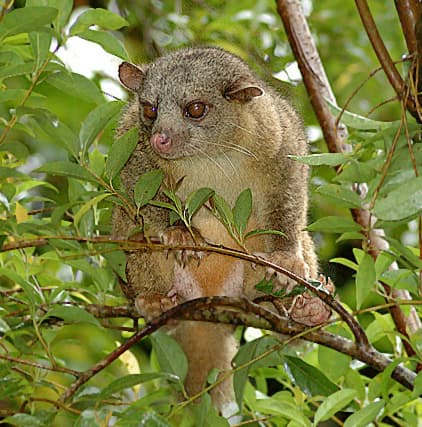
Bassaricyon
Bassaricyon, commonly known as olingos, are small arboreal mammals belonging to the procyonid family, native to the rainforests of Central and South America. They are nocturnal and share some morphological similarities with kinkajous, though they possess distinct features such as less specialized tails and different scent glands. Their evolutionary history is closely linked to coatis, with considerable diversification occurring in northwestern South America.
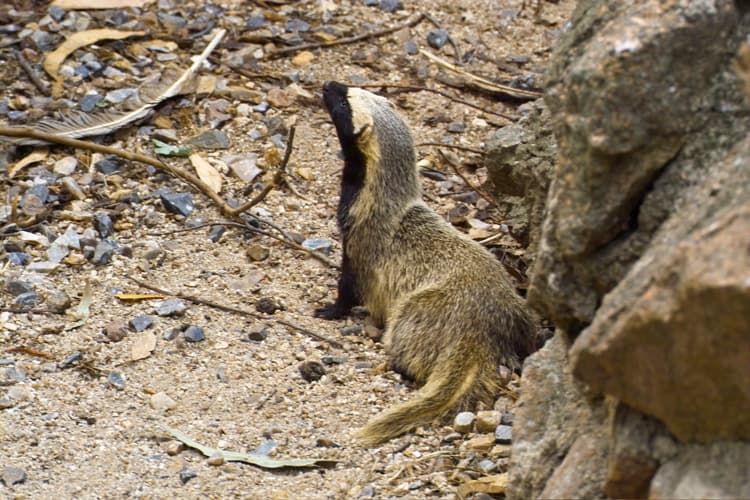
Galictis
The grison, genus Galictis, is a mustelid native to Central and South America. These animals are characterized by their frosted gray fur along the back, contrasted by black legs, throat, face, and belly, and a distinctive white stripe from the forehead to the back of the neck. They inhabit a variety of semi-open and forested environments and are generally terrestrial, often burrowing underground.

Eira
The tayra (Eira barbara) is a large, agile omnivore belonging to the mustelid family, native to the Americas and the sole species in its genus. Known for its long body, short dark fur with a unique chest patch, and arboreal adaptations, the tayra inhabits tropical and subtropical forests across Central and South America. It is an opportunistic feeder, adept at climbing and utilizing its sense of smell to locate prey.