
Acampe
Acampe is a genus of monopodial, epiphytic orchids native to tropical Asia and Africa. Known for their slow-growing, vine-like habit and thick, leathery leaves, these orchids produce small to medium-sized, fragrant yellow flowers with orange or red stripes. The genus name "Acampe" comes from the Greek word for "rigid," referring to their inflexible flowers.
Key Facts
- ›Acampe orchids are monopodial and epiphytic, forming large vegetative masses.
- ›They are characterized by thick, leathery, distichous leaves.
- ›Flowers are typically yellow, barred with orange or red stripes, and possess a fringed, white labellum with red markings.
- ›The genus name "Acampe" means "rigid" in Greek, describing the flowers' inflexibility.
- ›Acampe orchids are distributed across tropical Asia and tropical Africa, including Madagascar and Indian Ocean islands.
- ›Due to their large size and small flowers, they are rarely cultivated.

Acp
Epiphytic, Monopodial
About Acampe
Acampe, abbreviated as Acp in the horticultural trade, is a genus of monopodial, epiphytic orchids belonging to the Vandaceous group. These plants are distributed across tropical Asia, with populations found from India eastward to China and southward to Malaysia and the Philippines. Their range also extends to tropical Africa, Madagascar, and the islands of the Indian Ocean. The genus name "Acampe" originates from the Greek word "akampas," meaning "rigid," a descriptor alluding to the small, brittle, and inflexible nature of their flowers.
Characteristics
Acampe orchids are characterized by their slow-growing, vine-like habit, often forming substantial vegetative masses in their natural environments. They possess thick, leathery leaves that are distichous, meaning they are arranged in two opposite rows along the stem. The flowers, while small to medium in size, are notable for their fragrance. They are typically yellow, adorned with orange or red stripes. The inflorescence is a racemose type, bearing a few to many flowers. The sepals and petals are similar and brittle. The labellum, or lip, is ear-shaped, fringed, and saccate (sac-shaped) or has a spur, usually featuring red markings at its base. The column of the flower is short and fleshy, bearing two waxy pollinia, which are the pollen masses.
Cultivation and Distribution
Due to their large growth habit and the relatively small size of their flowers, Acampe species are rarely cultivated by orchid enthusiasts. The genus encompasses eight recognized species as of May 2014, with species like Acampe carinata, Acampe ochracea, and Acampe rigida having broad distributions across various Asian countries. Acampe pachyglossa is notable for its distribution in Africa and islands of the Indian Ocean. Acampe also participates in intergeneric hybridization, forming hybrids such as × Aracampe (with Arachnis) and × Vancampe (with Vanda).
Source: Wikipedia ↗
Frequently Asked Questions
What does the name Acampe mean?
The name Acampe is derived from the Greek word "akampas," meaning "rigid." This name refers to the small, brittle, and inflexible nature of the orchid's flowers.
What are the typical characteristics of Acampe orchids?
Acampe orchids are slow-growing vines that can form substantial vegetative masses. They are noted for their thick, leathery leaves arranged in two rows. The flowers are fragrant, small to medium-sized, and typically yellow with orange or red stripes.
Where are Acampe orchids found naturally?
This genus is distributed across tropical Asia, from India eastward to China and southward to Malaysia and the Philippines. They are also found in tropical Africa, Madagascar, and the islands of the Indian Ocean.
What do Acampe flowers look like?
Acampe flowers are generally yellow, marked with orange or red stripes. The sepals and petals are similar in appearance and are brittle. The lip, or labellum, is white, ear-shaped, fringed, and saccate or spurred, often featuring red markings at its base.
Why are Acampe orchids not commonly cultivated?
Acampe orchids are rarely cultivated primarily because of their large size and relatively small flowers. These characteristics make them less appealing for typical orchid growers who often prefer larger blooms or more compact plant forms.
Related Orchid species

Calanthe
Calanthe, commonly known as Christmas orchids, is a genus of approximately 220 terrestrial orchid species found in tropical and subtropical regions worldwide, with a notable concentration in Southeast Asia. These orchids are distinguished by their thick roots, small oval pseudobulbs, large corrugated leaves, and delicate yet showy flowers that typically feature narrow sepals and petals and a lobed labellum.

Acanthophippium
Acanthophippium is a genus of thirteen orchid species within the Orchidaceae family, native to regions spanning the Indian subcontinent to the southwest Pacific. These terrestrial orchids are distinguished by their prominent, cup- or urn-shaped flowers that resemble tulips and are known for their strong fragrance.
Crepidium
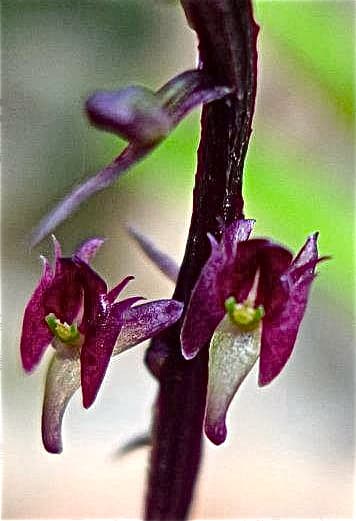
Crepidium, also known by its Chinese name 沼兰属 (zhao lan shu) and commonly as spur orchids, is a genus of approximately three hundred species of evergreen orchids. These plants are predominantly terrestrial, characterized by short, ground-hugging stems, large pleated leaves, and small, non-resupinate flowers with spreading sepals and petals. The genus is widely distributed across the tropics, with a significant diversity found in New Guinea.