
Acanthophippium
Acanthophippium is a genus of thirteen orchid species within the Orchidaceae family, native to regions spanning the Indian subcontinent to the southwest Pacific. These terrestrial orchids are distinguished by their prominent, cup- or urn-shaped flowers that resemble tulips and are known for their strong fragrance.
Key Facts
- ›Acanthophippium is a genus of terrestrial orchids with thirteen recognized species.
- ›The genus name "Acanthophippium" derives from Greek words meaning "spiny saddle," referencing the labellum.
- ›These orchids are distributed across a wide area, from the Indian subcontinent to Southeast Asia, New Guinea, and the southwest Pacific.
- ›Flowers are typically cup- or urn-shaped, fleshy, waxy, and about 4 cm long, often exhibiting stripes or spots.
- ›Blossoms are generally odiferous, possessing a very strong fragrance.
- ›Acanthophippium species are allied with genera such as Calanthe, Cephalantheropsis, Phaius, and Spathoglottis.

Indian Subcontinent, Taiwan, China, Japan, Southeast Asia, New Guinea, Southwest Pacific
Terrestrial, Myco-Heterotrophic
About Acanthophippium
Acanthophippium is a genus of orchids comprising thirteen recognized species, belonging to the family Orchidaceae. The genus name itself is derived from the Greek words "acanthos" (spiny) and "ephippion" (saddle), a reference to the characteristic saddle-like structure of the plant's labellum. These orchids are primarily terrestrial, though some species can also be myco-heterotrophic, meaning they derive nutrients from fungi.
Distribution and Habitat
The natural distribution of Acanthophippium species is extensive, stretching from the Indian subcontinent across to Taiwan, China, Japan, Southeast Asia, New Guinea, and extending into the southwest Pacific. As terrestrial orchids, they grow in soil, with mature plants reaching heights of up to 80 cm. Their rhizomes are short, and they possess fleshy pseudobulbs that can grow up to 25 cm tall. Each pseudobulb typically supports two to three large, plicate leaves that are lanceolate and parallel-veined, potentially reaching lengths of up to 65 cm.
Floral Characteristics
The inflorescence of Acanthophippium arises laterally from the pseudobulbs and bears between three to six flowers. These flowers are subtended by large, smooth bracts. The blossoms themselves are a striking feature: they are prominent, large, and shaped like a cup or urn, with a fleshy, waxy texture. Measuring approximately 4 cm in length, their tulip-like appearance is unusual for an orchid. The flower colors vary widely, including dull yellow, red, shades of orange, and pink, often adorned with stripes or spots. A notable characteristic of these flowers is their strong, often odiferous fragrance.
Taxonomy and Relationships
The genus Acanthophippium was first formally described by Carl Ludwig Blume in 1825, using the spelling "Acanthophippium." While some sources have historically used the variant spelling "Acanthephippium," the original spelling is maintained by authoritative sources such as the World Checklist of Selected Plant Families. Acanthophippium is taxonomically allied with several other orchid genera, including Calanthe, Cephalantheropsis, Phaius, and Spathoglottis.
Source: Wikipedia ↗
Frequently Asked Questions
What does the name Acanthophippium mean?
The genus name Acanthophippium is derived from the Greek words 'acanthos' meaning "spiny" and 'ephippion' meaning "saddle." This name refers to the distinctive saddle-like shape of the orchid's labellum.
Where are Acanthophippium orchids found naturally?
Acanthophippium orchids are distributed across a broad geographic range. Their natural habitats extend from the Indian subcontinent, through China, Japan, Southeast Asia, and New Guinea, to the southwest Pacific region.
What are the characteristics of Acanthophippium flowers?
The flowers of Acanthophippium are notable for their prominent, large size and their unusual cup- or urn-shape, which resembles a tulip. They are typically fleshy, waxy, and about 4 cm long, often marked with stripes or spots in a variety of colors.
Are Acanthophippium orchids fragrant?
Yes, Acanthophippium flowers are generally odiferous and are known for possessing a very strong fragrance. This strong scent is a distinctive characteristic of the genus.
How tall do Acanthophippium plants grow?
The terrestrial species of Acanthophippium can grow up to 80 cm tall. The plants have short rhizomes and fleshy pseudobulbs that can reach up to 25 cm in height, from which large leaves emerge.
What is the typical growth habit of Acanthophippium?
Acanthophippium are primarily terrestrial orchids, meaning they grow in the ground. Some species may also exhibit myco-heterotrophic tendencies, relying on fungi for nutrients.
Related Orchid species

Calanthe
Calanthe, commonly known as Christmas orchids, is a genus of approximately 220 terrestrial orchid species found in tropical and subtropical regions worldwide, with a notable concentration in Southeast Asia. These orchids are distinguished by their thick roots, small oval pseudobulbs, large corrugated leaves, and delicate yet showy flowers that typically feature narrow sepals and petals and a lobed labellum.

Acampe
Acampe is a genus of monopodial, epiphytic orchids native to tropical Asia and Africa. Known for their slow-growing, vine-like habit and thick, leathery leaves, these orchids produce small to medium-sized, fragrant yellow flowers with orange or red stripes. The genus name "Acampe" comes from the Greek word for "rigid," referring to their inflexible flowers.
Bletilla
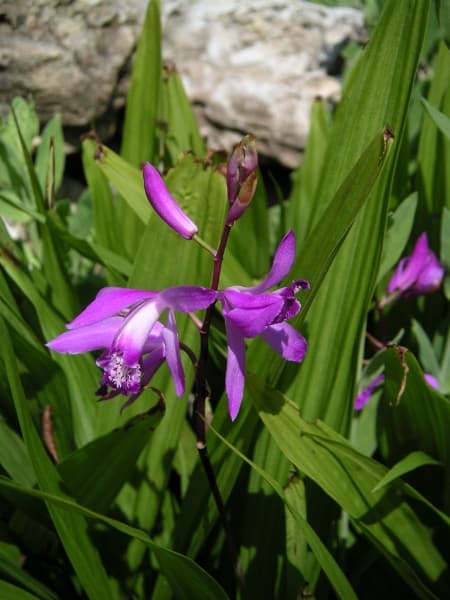
Bletilla, commonly known as the urn orchid, is a temperate, terrestrial orchid genus found across East Asia and Southeast Asia. Its pseudobulbs resemble spreading corms, and the plants are characterized by pleated leaves and racemes of flowers that emerge in spring and early summer, varying in color from white to purple. Bletilla striata, the most common species, is particularly noted for its hardiness and ease of cultivation.