
Acriopsis
Acriopsis
Acriopsis, commonly known as chandelier orchids or 合萼兰属 (he e lan shu), is a genus of epiphytic herbs in the Orchidaceae family. Native to regions spanning India, Southeast Asia, New Guinea, and Australia, these orchids are distinguished by their many small, non-resupinate flowers with unique column projections and a grasshopper-like appearance.
Key Facts
- ›Acriopsis orchids are epiphytic herbs found in humid rainforests.
- ›They possess spherical or cylindrical pseudobulbs and creeping rhizomes.
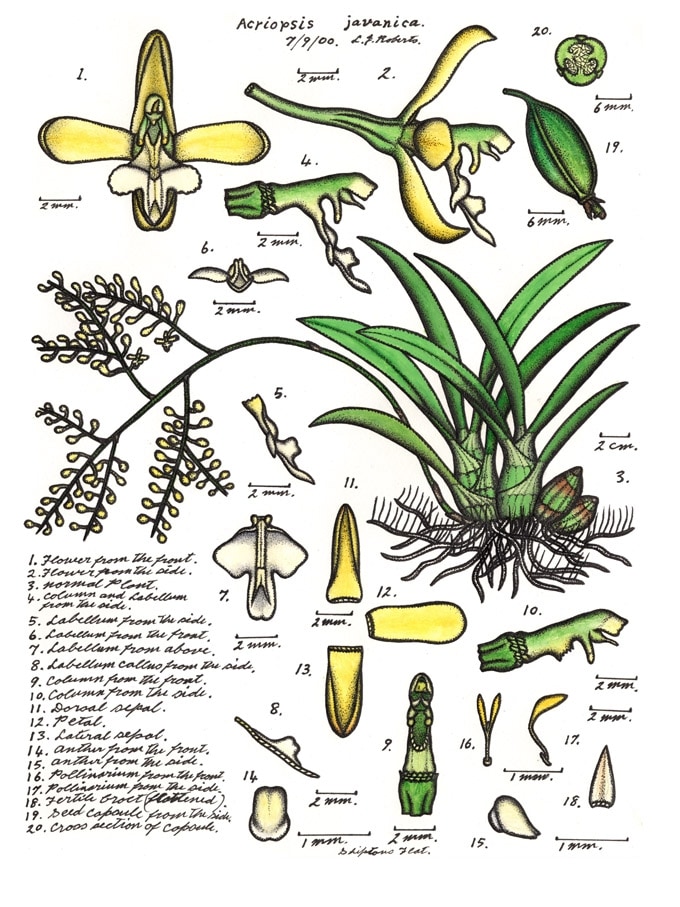
- ›Flowers are small, non-resupinate, with fused lateral sepals and a three-lobed labellum.
- ›The genus name "Acriopsis" derives from Greek words for "grasshopper-like appearance."
- ›Their specialized roots can grow upwards and branch to feed on debris.
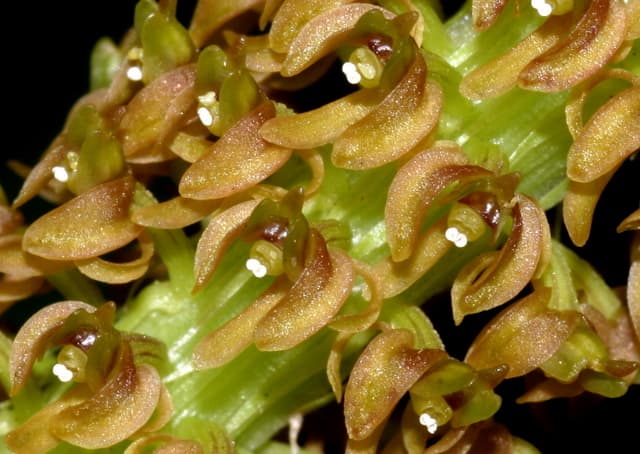
Chandelier Orchids, 合萼兰属
Epiphytic
About Acriopsis
Acriopsis, recognized by the common name "chandelier orchids" and in Chinese as 合萼兰属 (he e lan shu), is a genus of herbaceous flowering plants belonging to the Orchidaceae family. These orchids are characterized by their epiphytic growth habit, meaning they grow on other plants, typically trees, rather than in soil. They are found across a broad geographical range that includes India, Yunnan, Southeast Asia, New Guinea, Melanesia, Micronesia, and Queensland, Australia.
Growth and Morphology
Plants within the Acriopsis genus typically feature spherical or cylindrical pseudobulbs and possess creeping, branched rhizomes from which thin, white roots emerge. These roots are noteworthy for their specialized aerial growth, developing branches that facilitate the absorption of nutrients from airborne litter and debris. Each plant usually bears two to three leaves. The genus is known for producing numerous small flowers, which are non-resupinate. The flowers have lateral sepals that are fused along their edges, spreading petals, and a distinctive three-lobed labellum. A unique feature of the Acriopsis column is the presence of projections that extend in a hood-like manner beyond the anther, contributing to the genus's characteristic appearance.
Taxonomy and Naming
The genus Acriopsis was first formally described by Carl Ludwig Blume in 1825. The scientific name "Acriopsis" is derived from the Ancient Greek words "akris," meaning "locust" or "grasshopper," and "opsis," meaning "having the appearance of" or "like." This etymology reflects the grasshopper-like shape observed in the orchid's column.
Habitat and Distribution
Acriopsis orchids primarily inhabit low-lying, humid rainforest environments. While they generally prefer these conditions, some species may ascend to medium altitudes. Their distribution spans a wide area, encompassing numerous regions in Asia and Oceania. The specific species, such as Acriopsis indica and Acriopsis liliifolia, have detailed distributions within these broader regions, with some varieties like Acriopsis liliifolia var. liliifolia being found across many islands and mainland areas from Assam and Sikkim to New Guinea and the Caroline Islands.
Source: Wikipedia ↗
Frequently Asked Questions
What are chandelier orchids?
Chandelier orchids, also known by the genus name Acriopsis, are a group of flowering plants belonging to the Orchidaceae family. They are characterized by their epiphytic growth habit and numerous small flowers, which contribute to their common name.
Where are Acriopsis orchids found naturally?
Acriopsis orchids are distributed across a wide geographic range, including India, Yunnan, Southeast Asia, New Guinea, Melanesia, Micronesia, and Queensland, Australia. They typically inhabit low, humid rainforest environments.
What makes the flowers of Acriopsis unique?
The flowers of Acriopsis are non-resupinate and feature lateral sepals that are joined along their edges. They also have spreading petals and a distinct three-lobed labellum. A notable characteristic is the column, which has projections that form a hood-like structure over the anther.
What is the origin of the name Acriopsis?
The genus name Acriopsis comes from the Ancient Greek words "akris," meaning "locust" or "grasshopper," and "opsis," meaning "having the appearance of" or "like." This name was chosen due to the grasshopper-like shape of the orchid's column.
How do Acriopsis orchids obtain nutrients?
These orchids have specialized root systems that grow upwards and branch out into the air. These aerial roots are adapted to absorb nutrients from litter and other debris that accumulate around them, supplementing their epiphytic lifestyle.
Related Orchid species
Dienia
Dienia, commonly known as snout orchids, is a genus of six species of evergreen orchids found across Southeast Asia, Australia, Micronesia, and Melanesia. These plants are characterized by their fleshy, above-ground stems, large pleated leaves, and small, non-resupinate flowers with a distinctive short, tongue-like labellum. While primarily terrestrial, some species can grow as epiphytes.

Eria
Eria is a diverse genus of orchids comprising over 50 species. These orchids are predominantly found across Asia and Oceania, with their native habitats extending from China and the Himalayas to Southeast Asia and various Pacific islands. The genus is characterized by its broad distribution and the significant number of species that have been reclassified into other genera over time.

Geodorum
Geodorum is a genus of eight deciduous, terrestrial orchid species found across southern Japan, tropical Asia, Australia, and the southwest Pacific islands. These orchids are distinguished by their underground pseudobulbs, broad pleated leaves, and small to medium-sized, bell-shaped or tube-shaped flowers that hang downwards on a drooping flowering stem.