
Geodorum
Geodorum
Geodorum is a genus of eight deciduous, terrestrial orchid species found across southern Japan, tropical Asia, Australia, and the southwest Pacific islands. These orchids are distinguished by their underground pseudobulbs, broad pleated leaves, and small to medium-sized, bell-shaped or tube-shaped flowers that hang downwards on a drooping flowering stem.
Key Facts
- ›Geodorum orchids are terrestrial herbs with underground pseudobulbs.
- ›They possess broad, pleated leaves and bell-shaped or tubular flowers.
- ›The flowering stem droops, positioning the labellum as the lowest part of the flower.
- ›The genus is native to southern Japan, tropical Asia, Australia, and islands of the southwest Pacific.
- ›There are eight accepted species within the Geodorum genus.
- ›The name Geodorum is derived from Greek words meaning 'earth' and 'leaf', referencing their terrestrial habit.

Shepherds' Crooks, 地宝兰属
Southern Japan, Tropical Asia, Australia, Southwest Pacific Ocean Islands, India, Southeast Asia, Malaysia, Philippines, Indonesia, China, New Guinea, New Caledonia, Western Australia, Northern Territory, Queensland, New South Wales, Laos, Myanmar, Thailand, Vietnam, Hainan, Yunnan, Guizhou, Assam, Orissa, Chhattisgarh, Cambodia, Guangdong, Bangladesh, Peninsular Malaysia
Terrestrial
About Geodorum
Geodorum, also commonly known as shepherds' crooks, is a genus of terrestrial orchids belonging to the family Orchidaceae. This genus comprises eight distinct species, characterized by their deciduous nature and underground pseudobulbs. Geodorum orchids are found across a wide geographic range, extending from southern Japan and tropical Asia to Australia and various islands in the southwest Pacific Ocean.
Description and Characteristics
These orchids are herbaceous plants that grow in soil, with their pseudobulbs situated close to the surface. Emerging from the pseudobulb are several broad, pleated leaves, with the largest typically at the top. Each leaf possesses a stalk that wraps around those beneath it. The genus is further defined by its flowering stems, which emerge from the pseudobulb and bear a cluster of flowers. These flowers are generally bell-shaped or tubular and are notable for their drooping inflorescence, which positions the labellum, or lip, as the lowest part of the flower. Unlike some related genera, Geodorum species lack a spur or pouch on their labellum. The sepals and petals are similar in size and do not spread widely, contributing to the flowers' less open appearance.
Taxonomy and Naming
The genus Geodorum was first formally described in "The Botanist's Repository for New, and Rare Plants" by Henry Cranke Andrews, featuring an illustration and description of what is now known as Geodorum terrestre. The authorship of the description is attributed to George Jackson. The scientific name, Geodorum, is derived from the Ancient Greek words 'ge' (earth) and 'doron' (leaf), a nomenclature that aptly reflects the terrestrial habit of the orchids within this genus.
Distribution and Species
Geodorum species are distributed throughout India, Southeast Asia including Malaysia, the Philippines, and Indonesia. Two species are endemic to China, and others are found in New Guinea and New Caledonia. Geodorum terrestre is notable for its presence in Western Australia, the Northern Territory, Queensland, and New South Wales. As of October 2018, eight species were recognized by the World Checklist of Selected Plant Families, including Geodorum attenuatum, Geodorum densiflorum, Geodorum duperreanum, Geodorum eulophioides, Geodorum laxiflorum, Geodorum recurvum, Geodorum siamense, and Geodorum terrestre.
Source: Wikipedia ↗
Frequently Asked Questions
What are the common names for Geodorum orchids?
Geodorum orchids are commonly known as shepherds' crooks. In Chinese, they are referred to as 地宝兰属 (di bao lan shu).
Where are Geodorum orchids found naturally?
This genus is distributed across southern Japan, tropical Asia, Australia, and islands in the southwest Pacific Ocean. Specific regions include India, Southeast Asia, China, New Guinea, and New Caledonia.
What is the growth habit of Geodorum orchids?
Geodorum orchids are terrestrial herbs, meaning they grow in soil. They have underground pseudobulbs that anchor them and from which their leaves and flower stalks emerge.
Describe the flowers of Geodorum orchids.
The flowers are typically bell-shaped or tubular and are small to medium in size. The sepals and petals do not open widely, and the entire flowering stem droops, causing the labellum to be the lowest part of the flower.
What is the meaning behind the scientific name Geodorum?
The name Geodorum comes from the Ancient Greek words 'ge' meaning 'earth' and 'doron' meaning 'leaf'. This name was chosen to reflect the terrestrial nature of these orchids.
Related Orchid species

Anthogonium
Anthogonium is a monotypic genus of orchids, meaning it contains only one species, Anthogonium gracile. This orchid is native to a wide range of regions across Asia, including India, Nepal, Bhutan, and Southeast Asian countries. Its distinctive characteristic is being the sole representative of its genus.
Erythrorchis
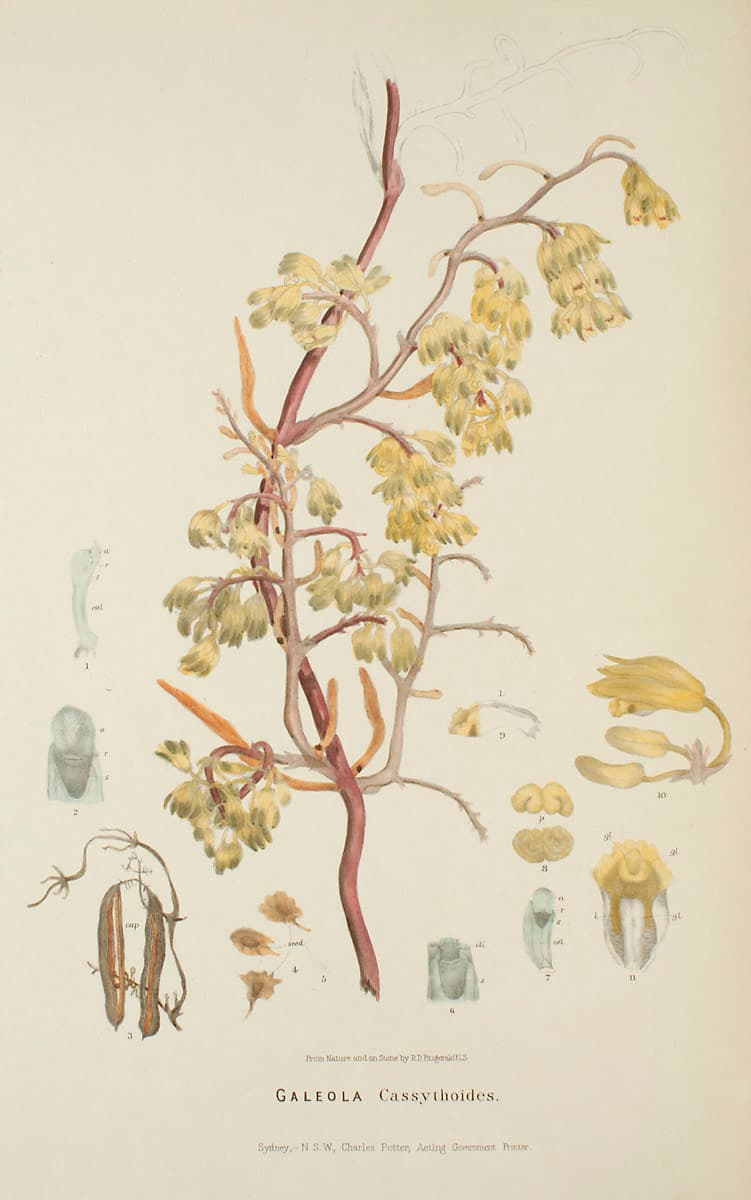
Erythrorchis, also known as bootlace orchids or by its Chinese name 倒吊兰属 (dao diao lan shu), is a genus of two species of climbing, leafless orchids in the Orchidaceae family. These myco-heterotrophic vines cling to tree trunks with small roots and produce densely crowded flowers on branched stems, distinguished by their fleshy sepals and petals and a wide labellum.

Holcoglossum
Holcoglossum is a genus of orchids belonging to the family Orchidaceae, native to regions spanning Assam, China, Taiwan, and Indo-China. These perennial plants are characterized by their short shoots, terete or triangular leaves with a grooved upper surface, and distinctive white flowers with a three-lobed lip and elongated spur. They are typically epiphytic or lithophytic, growing at higher altitudes and preferring cool environments.