
Aerangis
Aerangis is a genus of orchids within the Orchidaceae family, named from Greek words for "air" and "urn" due to the lip's shape. Native to tropical Africa, Madagascar, the Comoro Islands, and Sri Lanka, these orchids are distinguished by their large, waxy, star-shaped flowers, typically white, cream, or yellow, often featuring a long spur and a pleasant nocturnal fragrance.
Key Facts
- ›The genus name 'Aerangis' is derived from Greek words meaning 'air' and 'urn'.
- ›Aerangis orchids are primarily found in tropical Africa, with extensions to Madagascar, the Comoro Islands, and Sri Lanka.
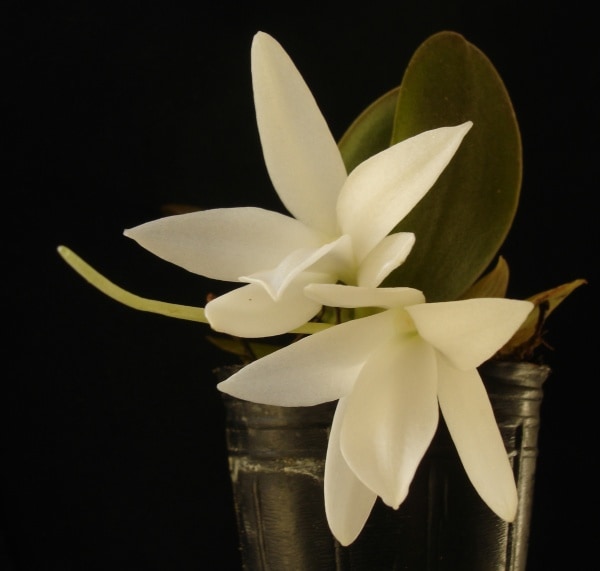
- ›They are characterized by large, waxy, star-shaped flowers that are usually white, cream, or yellow.
- ›A notable feature is their long, nectar-filled spur, which can be longer than the flower itself.
- ›These orchids emit an agreeable fragrance during the night.
- ›Most species are epiphytic, growing on trees, but some are lithophytic, growing on rocks.
Aergs
Epiphytic, Lithophytic
About Aerangis
The genus Aerangis, abbreviated as Aergs in the horticultural trade, belongs to the Orchid family (Orchidaceae). Its name originates from the Greek words 'aer' (air) and 'angos' (urn), a nomenclature inspired by the shape of the flower's lip. Aerangis serves as the type genus for the subtribe Aerangidinae, which has recently been incorporated into the subtribe Angraecinae.
Distribution and Habitat
Approximately 50 species within this genus are recognized, predominantly found across tropical Africa. The geographical distribution also extends to the Comoro Islands, Madagascar, and Sri Lanka. In their natural environment, Aerangis species are typically small orchids that grow as epiphytes, attaching to trees, or as lithophytes, growing on rocks.
Floral Characteristics
A defining feature of Aerangis orchids is their large, waxy, star-shaped flowers, which are generally white, cream-colored, or yellow. These blooms possess a distinctive long, nectar-filled spur, often exceeding the length of the flower itself. The inflorescence consists of a single stem bearing multiple flowers on a long raceme. The lip of the flower is flat and resembles the petals and sepals in form. A notable characteristic is that these orchids emit an agreeable fragrance during the night.
Morphology
The plant structure of Aerangis includes a single stem and six to ten parallel-veined, fleshy, evergreen leaves. This robust foliage supports the production of their often spectacular floral displays.
Taxonomy and Cultivation
The genus was formally described by Heinrich Gustav Reichenbach in 1865, with Aerangis flabellifolia Rchb. f. designated as the type species. Despite their attractive qualities and relative ease of cultivation, Aerangis orchids are not as commonly found in collections as some other genera, although around 15 species are readily available to growers. Intergeneric hybrids involving Aerangis have also been registered, demonstrating its compatibility in breeding programs with related genera.
Source: Wikipedia ↗
Frequently Asked Questions
What does the name Aerangis mean?
The name Aerangis is derived from the Greek words 'aer', meaning 'air', and 'angos', meaning 'urn'. This name refers to the distinctive urn-like shape of the orchid's lip.
Where are Aerangis orchids native to?
Aerangis species are predominantly found in tropical Africa. Their native range also extends to the Comoro Islands, Madagascar, and Sri Lanka.
What are the typical flower characteristics of Aerangis orchids?
Aerangis orchids typically produce large, waxy, star-shaped flowers. The colors are generally white, cream-colored, or yellow. They are also known for having a long spur that is often longer than the flower itself.
Do Aerangis orchids have a scent?
Yes, Aerangis orchids are known to emit an agreeable smell. This fragrance is typically released during the night.
How do Aerangis orchids grow in nature?
Most species of Aerangis are epiphytic, meaning they grow on other plants, typically trees. Some species can also be lithophytic, growing on rocks.
Are Aerangis orchids difficult to cultivate?
The text suggests that Aerangis orchids are rather easy to grow and are not often found in collections, implying they are accessible for cultivation.
Related Orchid species

Bryobium
Bryobium, commonly known as urchin orchids, is a genus of epiphytic or lithophytic plants belonging to the Orchidaceae family. Native to tropical Asia and northern Australia, these orchids are distinguished by their large, fleshy pseudobulbs, leathery leaves, and small, often hairy flowers that typically do not open widely.

Cynorkis
Cynorkis is a genus of orchids belonging to the subtribe Orchidinae. These species are found across mainland Africa, the Comoro Islands, the Mascarene Islands, and Madagascar. The genus is characterized by its diverse species native to these specific African and Indian Ocean island regions.

Lemurella
Lemurella is a genus of flowering plants belonging to the orchid family, Orchidaceae. These orchids are native to Madagascar and the Comoro Islands. The genus currently includes four recognized species, each contributing to the unique floral diversity of its native regions.