
Bryobium
Bryobium
Bryobium, commonly known as urchin orchids, is a genus of epiphytic or lithophytic plants belonging to the Orchidaceae family. Native to tropical Asia and northern Australia, these orchids are distinguished by their large, fleshy pseudobulbs, leathery leaves, and small, often hairy flowers that typically do not open widely.
Key Facts
- ›Bryobium orchids are found in tropical Asia and northern Australia.
- ›They possess large, fleshy pseudobulbs and leathery leaves.
- ›Flowers are typically white, cream-colored, or pinkish and often hairy.
- ›These orchids grow epiphytically on trees or lithophytically on rocks.
- ›The genus name 'Bryobium' derives from Greek words meaning 'moss' and 'life'.
- ›Flowers are characterized by sepals fused to the column and a lobed labellum.

Urchin Orchids
Epiphytic, Lithophytic
About Bryobium
Bryobium, known commonly as urchin orchids, is a genus of flowering plants within the Orchidaceae family. These orchids are primarily found thriving in the tropical regions of Asia and extending to northern Australia. Their characteristic growth habit involves them being either epiphytic, meaning they grow on trees, or lithophytic, growing on rocks and boulders, typically in humid rainforest environments.
Description and Characteristics
Plants in the Bryobium genus are distinguished by their substantial, fleshy pseudobulbs, which are often enveloped by papery bracts when young. Each pseudobulb can support up to three leaves that are flat and leathery in texture. The flowers themselves are typically small and often possess a hairy appearance. They are usually presented in shades of white, cream, or pink and are known for not opening very widely, with a bloom period lasting only a few days. Morphologically, the dorsal sepal remains free, while the lateral sepals are fused to the base of the column. The petals are distinct from each other and generally smaller than the sepals. A notable feature is the labellum, which frequently exhibits a three-lobed structure, with the side lobes standing erect.
Taxonomy and Etymology
The genus Bryobium was formally established and described by John Lindley in 1836. The name 'Bryobium' itself is derived from ancient Greek roots: 'bryon', meaning 'moss', and 'bios', meaning 'life'. This etymology appears to be a direct reference to the moss-like appearance or habitat often associated with the plants in this genus, highlighting their tendency to grow in environments where mosses are prevalent.
Source: Wikipedia ↗
Frequently Asked Questions
What are the common names for the genus Bryobium?
The genus Bryobium is commonly known as urchin orchids. In some contexts, it may also be referred to by its Chinese name, 藓兰属 (xian lan shu).
Where are Bryobium orchids found naturally?
Bryobium orchids are distributed across a wide range, from tropical Asia to northern Australia. Their natural habitats include regions such as China, the Indian subcontinent, Southeast Asia, and various islands in the Pacific.
What is the growth habit of Bryobium orchids?
Bryobium orchids exhibit an epiphytic or lithophytic growth habit. This means they typically grow on the upper parts of rainforest trees or cling to rocks and boulders, rather than rooting in soil.
Describe the flowers of Bryobium orchids.
The flowers of Bryobium are generally small and often hairy. They are usually white, cream-colored, or pinkish and tend not to open very widely, lasting for a few days. The structure includes lateral sepals fused to the column and a typically three-lobed labellum.
What do the pseudobulbs and leaves of Bryobium look like?
Plants in the Bryobium genus have relatively large, fleshy pseudobulbs that are often covered by papery bracts when young. Each pseudobulb supports up to three flat, leathery leaves.
Related Orchid species
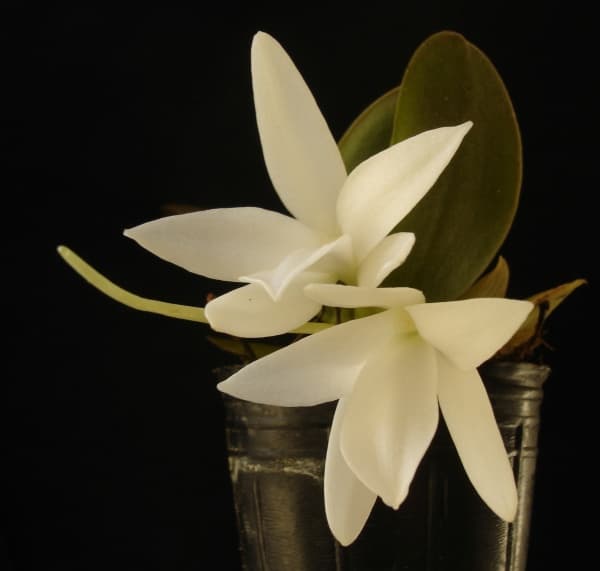
Aerangis
Aerangis is a genus of orchids within the Orchidaceae family, named from Greek words for "air" and "urn" due to the lip's shape. Native to tropical Africa, Madagascar, the Comoro Islands, and Sri Lanka, these orchids are distinguished by their large, waxy, star-shaped flowers, typically white, cream, or yellow, often featuring a long spur and a pleasant nocturnal fragrance.

Acianthus
Acianthus, commonly known as mosquito orchids, is a genus of terrestrial orchids found in New Caledonia, Australia, and New Zealand. These plants are distinctive for their small, mosquito-like flowers, typically green, pinkish, or purplish, which bloom in the cooler months and blend with their surroundings.

Bromheadia
Bromheadia, commonly known as reed orchids, is a genus of approximately 29 species of evergreen terrestrial and epiphytic orchids. Native to tropical Asia and extending to northern Australia, these orchids are characterized by their unbranched stems with leaves arranged in two rows and their distinctive labellum that acts as a landing platform. The flowers, appearing singly and in succession, are typically white, creamy yellow, or reddish.