
Anguloa
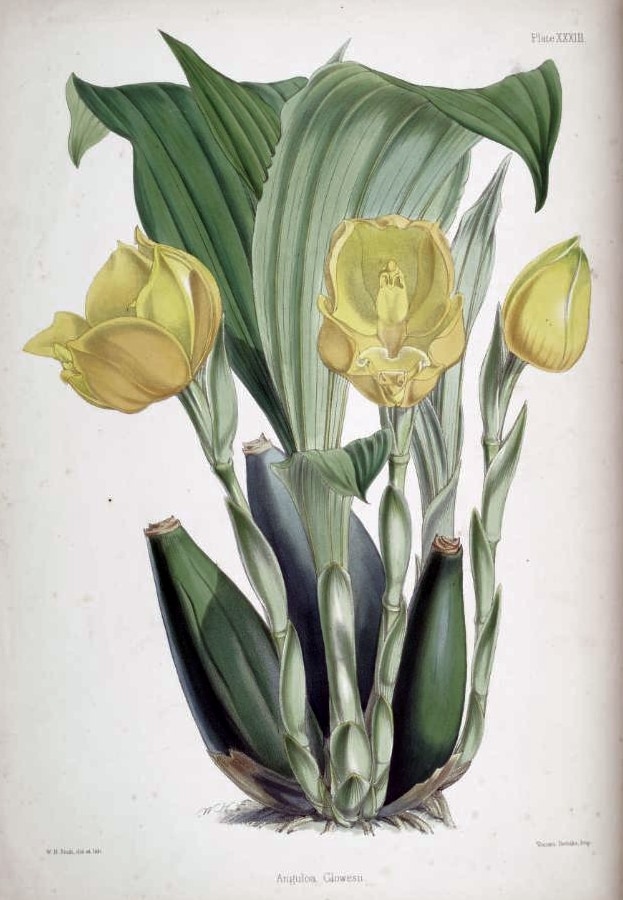
Anguloa, commonly known as tulip orchids, is a genus of about 13 species closely related to Lycaste. Native to the forest floor at high elevations in South America, these terrestrial orchids are distinctive for their large, waxy flowers resembling tulips and their unique pollination mechanism involving a rocking lip. They are also known for their strong cinnamon fragrance.
Key Facts
- ›Anguloa orchids are terrestrial, and occasionally epiphytic, plants found at high elevations.
- ›Their flowers are large, waxy, and shaped like tulips, with colors ranging from greenish-white to yellow and red depending on the species.
- ›These orchids possess a strong cinnamon scent.
- ›A unique pollination mechanism involves a rocking lip that traps visiting orchid bees.
- ›The genus was described in 1798 and named in honor of Francisco de Angulo, Director-General of Mines of Spain.
Tulip Orchids, Cradle Orchid
Terrestrial, Epiphytic
Orchid Bee
About Anguloa
Anguloa, commonly recognized as tulip orchids, represents a small genus within the Orchidaceae family, distinguished by its close relationship to the genus Lycaste. The genus was formally described by botanists José Antonio Pavón and Hipólito Ruiz López in 1798. Its establishment was in honor of Francisco de Angulo, who held the significant position of Director-General of Mines of Spain.
Distribution and Habitat
These striking orchids are found naturally on the forest floor, thriving in the humid, high-elevation environments of South America. Their native range encompasses countries including Venezuela, Colombia, Ecuador, Bolivia, and Peru. Anguloa orchids are known to grow terrestrially, and in some instances, epiphytically.
Botanical Characteristics
Tulip orchids are characterized by their substantial size, featuring fleshy pseudobulbs that can exceed 20 cm in length. The leaves are long, lanceolate, and plicate, with mature plants capable of producing leaves over 1 meter in length. Typically, two to four leaves emerge from the base of each pseudobulb, and these are deciduous, shedding at the commencement of each new growth cycle.
Floral Features and Scent
The flowers of Anguloa are a notable feature, exuding a potent fragrance reminiscent of cinnamon. Their appearance is waxy, and in wild species, they present in one of two primary color palettes: a greenish-white hue or a spectrum from yellow to red. Each inflorescence typically bears a single flower, originating from the base of a new pseudobulb. While white tulip orchids may produce up to six inflorescences per pseudobulb, other varieties can yield as many as twelve. The sepals are notably bulbous, contributing to the flower's resemblance to a tulip, which gives the genus its common name. The flower's lip is distinctly three-lobed, and the column is equipped with four pollinia.
Pollination Mechanism
Anguloa orchids possess a fascinating and specialized pollination mechanism. When a pollinator, such as an orchid bee, interacts with the flower, the lip exhibits a unique rocking motion. This movement is so distinctive that the orchid is sometimes called a cradle orchid. In Colombia, it is known locally as "cuna de Venus." When a bee lands at the flower's opening, its weight causes the flower to tip forward, and the lip moves downward, granting the bee access. Once inside, a shift in the center of gravity causes the flower to tip back, and the lip flips upward, pressing the bee against the rostellum and sticky pollinia. Upon the bee's departure and subsequent return visits, this same maneuver ensures that the pollinia are effectively deposited onto the flower's stigma, facilitating fertilization.
Source: Wikipedia ↗
Frequently Asked Questions
What are Anguloa orchids commonly called?
Anguloa orchids are commonly known as tulip orchids due to the shape of their flowers. They are also sometimes referred to as cradle orchids or, in Colombia, as 'cuna de Venus' (cradle of Venus), owing to their unique pollination mechanism.
Where do Anguloa orchids grow in the wild?
Anguloa orchids are found growing on the forest floor at high elevations. Their natural distribution includes Venezuela, Colombia, Ecuador, Bolivia, and Peru.
What is distinctive about Anguloa flowers?
The flowers of Anguloa are large and waxy, with sepals that form a bulbous shape resembling a tulip. They also emit a strong scent of cinnamon and feature a lip that rocks back and forth, playing a crucial role in pollination.
How do Anguloa orchids get pollinated?
Pollination occurs when an orchid bee lands on the flower's opening, causing the rocking lip to tip the flower forward and allow the bee inside. The flower then tips back, trapping the bee against the reproductive parts, ensuring pollen is transferred to the stigma on subsequent visits.
What colors do Anguloa flowers come in?
The flower colors of wild Anguloa species vary. Some species have greenish-white flowers, while others display shades of yellow to red. These color differences are used to divide the genus into two sections.
Related Orchid species

Brassavola
Brassavola is a genus of 21 orchid species, named in honor of Antonio Musa Brassavola, an Italian nobleman and physician. These orchids are widespread across Mexico, Central America, the West Indies, and South America, distinguished by their succulent leaves and fragrant, nocturnal blooms. They are primarily epiphytic, with a few also growing as lithophytes.

Hofmeisterella
Hofmeisterella is a genus of miniature, epiphytic orchids native to South America, found in cool, mountainous rainforests. The genus is characterized by its stemless growth, fleshy leaves, and relatively large, yellow flowers that often display a purple sheen at their base. Two species are currently recognized, primarily found in regions like Venezuela, Colombia, Ecuador, Peru, and Bolivia.

Gongora
Gongora is a genus of orchids belonging to the family Orchidaceae, comprising around 65 species primarily found in Central America and tropical South America, with a significant concentration in Colombia. These epiphytic plants are distinguished by their pendulous inflorescences bearing numerous flowers that hang upside down, often with distinctive fragrances and waxy blooms. The genus is named in honor of Antonio Caballero y Gongora, a Spanish viceroy and governor.