
Brassavola
Brassavola is a genus of 21 orchid species, named in honor of Antonio Musa Brassavola, an Italian nobleman and physician. These orchids are widespread across Mexico, Central America, the West Indies, and South America, distinguished by their succulent leaves and fragrant, nocturnal blooms. They are primarily epiphytic, with a few also growing as lithophytes.
Key Facts
- ›The genus Brassavola comprises 21 orchid species.
- ›They are found throughout Mexico, Central America, the West Indies, and South America.
- ›Brassavola orchids typically produce a single white or greenish-white flower, or a small cluster.
- ›Most species are strongly fragrant, emitting a citrusy scent at night to attract moths.
- ›They are predominantly epiphytic, with some also growing as lithophytes.
- ›Brassavola species have been extensively used in hybridization with genera like Cattleya and Laelia.

Epiphytic, Lithophytic
Moth
About Brassavola
Brassavola is a genus of orchids that includes 21 species, named in 1813 by Scottish botanist Robert Brown in honor of the Italian nobleman and physician Antonio Musa Brassavola. This genus is commonly abbreviated as 'B.' in trade journals. Brassavola orchids are found across a wide geographic range, encompassing Mexico, Central America, the West Indies, and South America.
These orchids are characterized by their epiphytic growth habit, meaning they typically grow on other plants, primarily trees, though a few species also grow as lithophytes on rocks. A distinctive feature of Brassavola plants is a single, apical, and succulent leaf that grows from an elongated pseudobulb.
The flowers of Brassavola species are generally white or greenish-white. Each plant may produce a single flower or a raceme of a few flowers. The floral structure includes three narrow, long sepals and two lateral petals of a similar color. The lip of the flower is broad, sometimes fringed, and partially enfolds the column. The column itself features a pair of sickle-shaped ears on each side and contains twelve, or sometimes eight, pollinia.
A notable characteristic of most Brassavola orchids is their strong, citrusy fragrance, which is released exclusively at night. This nocturnal scent serves as an attractant for specific moth pollinators. The duration of the flowers' bloom can vary significantly between species, ranging from five to thirty days.
Historically, Brassavola nodosa holds a special place in orchid cultivation. In 1698, it was the first tropical orchid to be introduced from the Caribbean island of Curaçao to Holland. This event is credited with initiating the propagation of this orchid and fostering a broader fascination with orchids in general.
Brassavola species are closely allied with the genera Cattleya and Laelia and have been extensively utilized in hybridization efforts. They form the 'B' component in the names of various intergeneric hybrids, such as × Brassolaeliocattleya (Blc.).
Source: Wikipedia ↗
Frequently Asked Questions
What is Brassavola?
Brassavola is a genus of 21 orchid species belonging to the family Orchidaceae. They are known for their succulent leaves and fragrant flowers that bloom at night.
Where are Brassavola orchids found naturally?
Brassavola species are widespread across Mexico, Central America, the West Indies, and South America. They thrive in their native habitats as epiphytes, often found growing on trees, and some also grow on rocks.
What do Brassavola flowers look like?
The flowers of Brassavola orchids are typically white or greenish-white. They feature three narrow sepals and two lateral petals, with a broad lip that may be fringed and partially enfolds the column.
Are Brassavola orchids fragrant?
Yes, most Brassavola orchids are very fragrant, emitting a distinct citrusy smell. This fragrance is notable because it is only released at night, serving to attract specific moth pollinators.
How long do Brassavola flowers last?
The longevity of Brassavola flowers varies depending on the specific species. Their blooms can last anywhere from five to thirty days.
What is the significance of Brassavola nodosa?
Brassavola nodosa holds historical significance as the first tropical orchid to be brought from Curaçao to Holland in 1698. This event marked the beginning of widespread orchid propagation and growing interest in orchids.
Related Orchid species
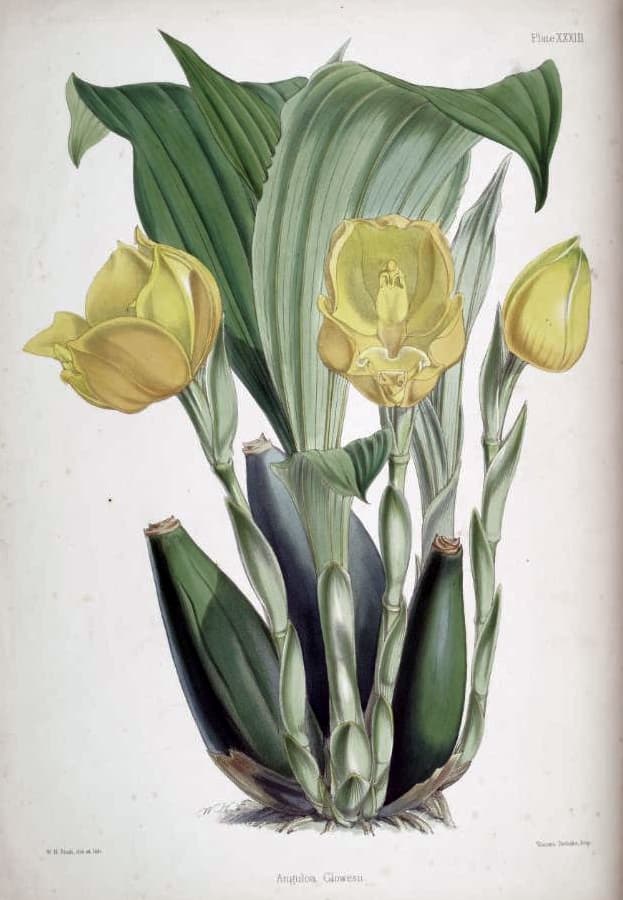
Anguloa
Anguloa, commonly known as tulip orchids, is a genus of about 13 species closely related to Lycaste. Native to the forest floor at high elevations in South America, these terrestrial orchids are distinctive for their large, waxy flowers resembling tulips and their unique pollination mechanism involving a rocking lip. They are also known for their strong cinnamon fragrance.

Corymborkis
Corymborkis is a genus of terrestrial orchids found across tropical regions worldwide. These evergreen plants are known for their leafy stems, pleated leaves, and widely-opening flowers, which are typically greenish-white and arranged in crowded clusters. The genus name itself reflects the characteristic bunched arrangement of their blooms.

Dendrophylax
Dendrophylax is a genus of leafless neotropical orchids native to Mexico, Central America, the West Indies, and Florida. These orchids are distinctive for their photosynthetic roots, which form the bulk of the plant, and ephemeral leaves reduced to scales. One notable species, Dendrophylax lindenii, gained prominence through its mention in "The Orchid Thief."