
Anoectochilus
Anoectochilus
Anoectochilus, commonly known as marbled jewel orchids or filigree orchids, is a genus of approximately fifty terrestrial orchid species found in moist, deeply shaded areas across the Himalayas, Southeast Asia, and the Pacific Islands. These orchids are distinctive for their dark leaves adorned with striking silvery or reddish veins and their relatively large, velvety flowers with a uniquely structured labellum.
Key Facts
- ›Terrestrial herbs with a creeping rhizome and wiry roots.
- ›Leaves are typically dark green or brownish-purple with a network of silvery or reddish veins.
- ›Flowers are relatively large, hairy, velvety, and resupinate.
- ›The labellum is a prominent feature, divided into an epichile and hypochile, with a fringed or toothed claw.
- ›They are found in moist environments with deep shade.
- ›The genus is distributed from the Himalayas to Southeast Asia, Australia, New Guinea, Melanesia, and Hawaii.

Marbled Jewel Orchids, Filigree Orchids
Himalayas, South China, Southeast Asia, Australia, New Guinea, Melanesia, Hawaii
Terrestrial
About Anoectochilus
Anoectochilus is a genus of orchids belonging to the family Orchidaceae, comprising approximately fifty species. These plants are commonly referred to as marbled jewel orchids or filigree orchids, a nod to their distinctive aesthetic qualities. They are primarily found in moist environments that are characterized by deep shade, with their natural distribution extending across a wide geographic range.
Description and Characteristics
Orchids within the Anoectochilus genus are terrestrial, perennial, and deciduous herbs. They possess a characteristic creeping, above-ground rhizome from which wiry, woolly roots emerge. The leaves are typically arranged in a rosette and are notable for their broad, thin structure. Their coloration is often a dark green or brownish-purple, dramatically contrasted by an intricate network of silvery or reddish veins, which gives them their 'marbled' appearance.
The flowers of Anoectochilus are relatively large and exhibit a velvety texture. They are resupinate and borne on a short spike. A key distinguishing feature is the arrangement of the floral parts: the dorsal sepal and petals form a hood over the column, while the lateral sepals spread outwards. The labellum, or lip, is particularly prominent and complex. It is divided into two main sections – an upper 'epichile' and a lower 'hypochile' – which are separated by a narrow section. The hypochile contains a cylinder-shaped spur with two large glands. The connection between the hypochile and epichile is made by a 'claw' that may feature spreading teeth or a long fringe. Following flowering, the plants produce a hairy capsule containing a large number of winged seeds.
Distribution and Habitat
The geographical range of Anoectochilus species is extensive, extending from the Himalayas through south China and across Southeast Asia. Their presence also reaches Australia, New Guinea, Melanesia, and even Hawaii. Across this broad area, they are consistently found in habitats that offer consistent moisture and significant shade, typically in forest understories or similar sheltered locations.
Taxonomy and Naming
The genus Anoectochilus was first formally described by Carl Ludwig Blume in 1825. The first species he detailed was Anoectochilus setaceus, which consequently became the type species for the genus. The genus name itself is derived from Ancient Greek words: 'anoiktos' (ἀνοικτός), meaning "opened," and 'cheilos' (χεῖλος), meaning "lip," a reference to the distinctive structure of the orchid's labellum.
Cultural Significance
In China, the species Anoectochilus roxburghii holds particular significance. It is known locally by names such as Jinxianlian (金线莲) or Jinxianlan (金线兰). This particular orchid is not only valued for its ornamental beauty but is also incorporated into culinary practices and holds a place in traditional Chinese medicine.
Source: Wikipedia ↗
Frequently Asked Questions
What are Anoectochilus orchids commonly called?
Anoectochilus orchids are commonly known as marbled jewel orchids or filigree orchids. These names refer to their distinctive leaf coloration and intricate vein patterns.
What are the key physical characteristics of Anoectochilus orchids?
These orchids are terrestrial herbs featuring a creeping rhizome and dark-colored leaves with contrasting silvery or reddish veins. Their flowers are relatively large and velvety, with a notable labellum that is significantly different from the sepals and petals.
Where are Anoectochilus orchids found naturally?
The natural distribution of Anoectochilus orchids spans from the Himalayas to south China, Southeast Asia, Australia, New Guinea, Melanesia, and Hawaii. They thrive in moist areas that receive deep shade.
What makes the flowers of Anoectochilus unique?
The flowers of Anoectochilus are characterized by their relatively large size, velvety texture, and a distinct labellum. This labellum is divided into two sections, an epichile and a hypochile, and is connected by a claw that can have spreading teeth or a long fringe.
How are Anoectochilus orchids used in China?
In China, Anoectochilus roxburghii, known as Jinxianlian or Jinxianlan, is utilized in cooking, for ornamental purposes, and in traditional medicine.
Related Orchid species

Eria
Eria is a diverse genus of orchids comprising over 50 species. These orchids are predominantly found across Asia and Oceania, with their native habitats extending from China and the Himalayas to Southeast Asia and various Pacific islands. The genus is characterized by its broad distribution and the significant number of species that have been reclassified into other genera over time.
Dienia
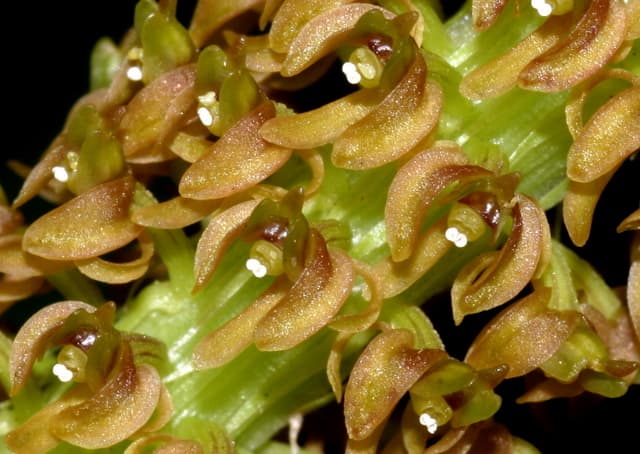
Dienia, commonly known as snout orchids, is a genus of six species of evergreen orchids found across Southeast Asia, Australia, Micronesia, and Melanesia. These plants are characterized by their fleshy, above-ground stems, large pleated leaves, and small, non-resupinate flowers with a distinctive short, tongue-like labellum. While primarily terrestrial, some species can grow as epiphytes.

Hylophila
Hylophila is a genus of flowering plants belonging to the orchid family, Orchidaceae. These orchids are native to Southeast Asia, New Guinea, and Melanesia. The genus is distinguished by its placement within the Orchidaceae family and its specific geographic distribution.