
Chroniochilus
Chroniochilus·Endangered (recommended for C. sinicus)
Chroniochilus is a genus of flowering plants belonging to the orchid family, Orchidaceae. Native to Southeast Asia, including regions like Yunnan, Thailand, Malaysia, and Indonesia, this genus is distinguished by its small flowers with a distinctive conical, fleshy, and mobile labellum that lacks a spur. The scientific name itself, derived from Greek words for "lasting" and "lip," hints at the enduring nature of its floral structures.
Key Facts
- ›Contains 5 species found in Yunnan, Thailand, Malaysia, and Indonesia.
- ›Flowers are small and borne on racemose inflorescences.
- ›The labellum is conical, fleshy, mobile, and lacks a spur.
- ›The androecium consists of two pollinia.
- ›Chroniochilus sinicus blooms from August to October.
- ›Chroniochilus sinicus has been recommended for endangered status.

August, September, October
About Chroniochilus
Chroniochilus is a genus of flowering plants belonging to the vast Orchidaceae family, commonly known as orchids. This genus encompasses five distinct species, all of which are native to various regions across Southeast Asia. Their natural distribution spans from Yunnan in China, through Thailand and Malaysia, and extends to parts of Indonesia. The genus is characterized by its production of small flowers, which are typically borne on racemose inflorescences, meaning they are arranged along an unbranched stem.
Generative Characteristics
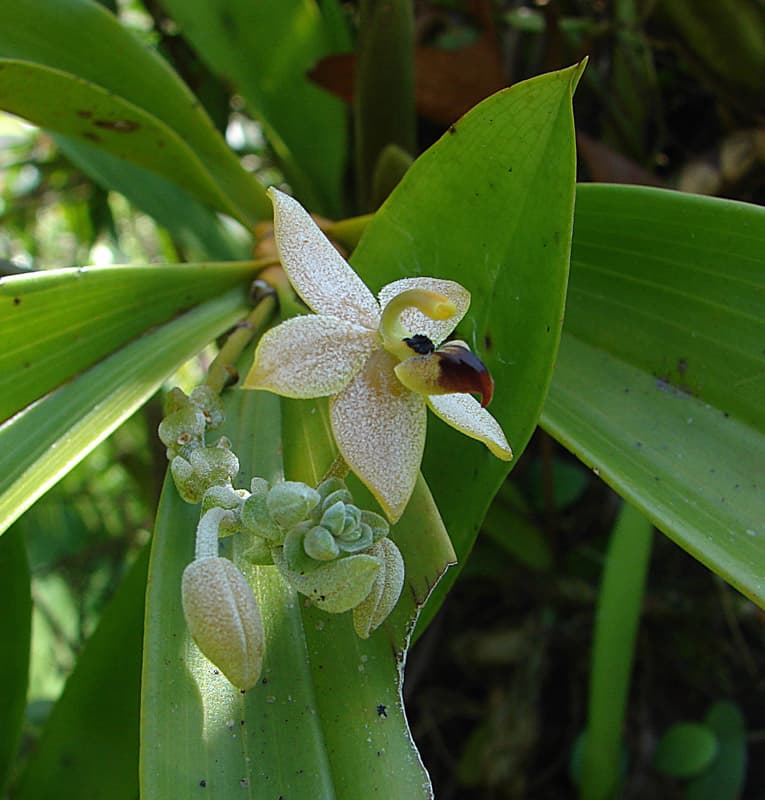
A notable feature of Chroniochilus orchids is their labellum, the specialized petal that often serves to attract pollinators. In this genus, the labellum is described as being conical, fleshy, and mobile. Crucially, it does not possess a spur, which is a common appendage in many other orchid species. The reproductive structure, known as the androecium, consists of two pollinia, which are masses of pollen. For the species Chroniochilus sinicus, flowering has been observed to occur during the months of August, September, and October.
Etymology and Conservation
The scientific name Chroniochilus is derived from ancient Greek roots. The word 'chronios' translates to 'lasting' or 'persistent,' while 'cheilos' means 'lip.' This nomenclature likely alludes to the enduring or stable nature of the orchid's lip structure. Regarding conservation, Chroniochilus sinicus has been specifically assessed, with recommendations suggesting its categorization as endangered (EN) according to the criteria of the IUCN Red List. This designation indicates a significant threat to the survival of this particular species in its natural habitat.
Source: Wikipedia ↗
Frequently Asked Questions
What are the native regions for Chroniochilus orchids?
Chroniochilus orchids are native to a range of Southeast Asian countries. These include Yunnan in China, Thailand, Malaysia, and Indonesia. Specific species have more localized distributions within these broader regions.
What are the distinctive features of Chroniochilus flowers?
Chroniochilus orchids produce small flowers, typically on racemose inflorescences. A key characteristic is their labellum, which is conical, fleshy, mobile, and notably lacks a spur, distinguishing it from many other orchid genera.
What is the meaning behind the name Chroniochilus?
The generic name Chroniochilus is derived from two Greek words. 'Chronios' means lasting or persistent, while 'cheilos' means lip. Together, the name likely refers to the enduring or persistent nature of the orchid's lip.
When does Chroniochilus sinicus bloom?
The flowering period for Chroniochilus sinicus is recorded to occur from August to October. This indicates a late summer to early autumn blooming season for this particular species.
What is the conservation status of Chroniochilus sinicus?
It has been recommended that Chroniochilus sinicus be categorized as endangered (EN) according to the IUCN Red List criteria. This suggests that the species faces a high risk of extinction in the wild.
Related Orchid species

Geodorum
Geodorum is a genus of eight deciduous, terrestrial orchid species found across southern Japan, tropical Asia, Australia, and the southwest Pacific islands. These orchids are distinguished by their underground pseudobulbs, broad pleated leaves, and small to medium-sized, bell-shaped or tube-shaped flowers that hang downwards on a drooping flowering stem.
Callostylis
Callostylis is a genus of orchids native to Southeast Asia, ranging from Assam and southern China to Java. Previously considered a synonym of the genus Eria, it is now an accepted name. The genus is recognized for its diverse species found across various regions within its native range.

Anthogonium
Anthogonium is a monotypic genus of orchids, meaning it contains only one species, Anthogonium gracile. This orchid is native to a wide range of regions across Asia, including India, Nepal, Bhutan, and Southeast Asian countries. Its distinctive characteristic is being the sole representative of its genus.