
Chysis
Chysis
Chysis is a genus of orchids native to the Americas, ranging from Mexico to Peru. These orchids are characterized by their unique spindle-shaped pseudobulbs and soft, ribbed leaves, and their flowers typically display a color palette from white to orange-yellow. They are commonly found in cultivation and are often grown mounted due to their pendulous growth habit.
Key Facts
- ›Chysis orchids originate from Mexico to Peru.
- ›They have distinctive spindle-shaped pseudobulbs and soft, papery leaves.
- ›Flower colors range from white to orange-yellow.
- ›The genus name 'Chysis' is derived from Greek for 'melting', referring to the fused pollinia.
- ›These orchids are epiphytic, growing in shady and damp conditions.
- ›They require intermediate temperatures and should not be allowed to dry out completely, even during rest periods.
Epiphytic
White, Orange-Yellow
About Chysis
Chysis is a genus of orchids belonging to the family Orchidaceae, encompassing approximately ten accepted species. These orchids are native to a broad geographical area extending from Mexico southward to Peru. While several species exist, only a select few are commonly encountered in cultivation.
Description and Characteristics
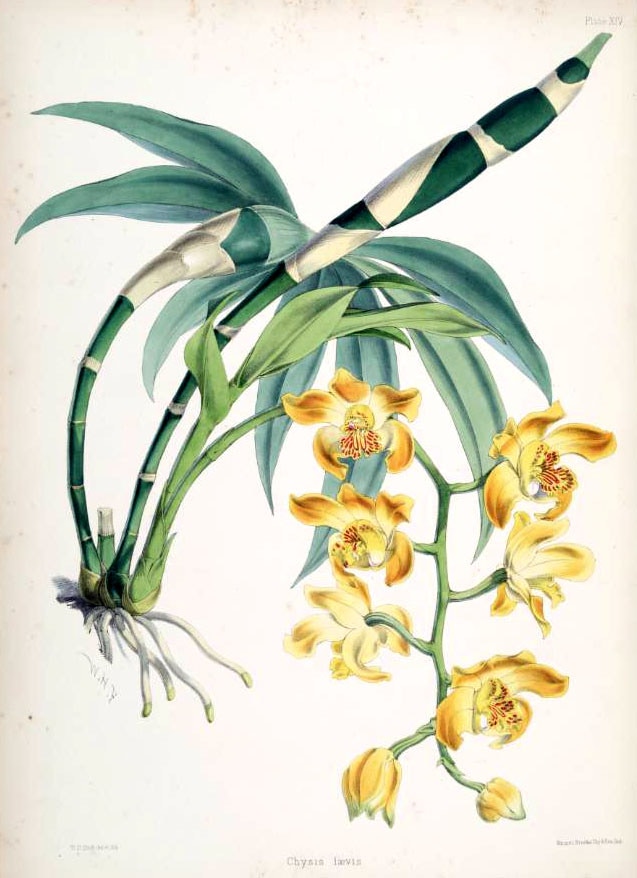
The defining features of the Chysis genus include elongated, spindle-shaped pseudobulbs that are typically pendulous and can vary in thickness depending on the species. The leaves are notably soft and papery, with prominent ribs, and possess a capacity to tolerate more light than their texture might suggest. Chysis orchids are generally partially deciduous, though their leaves often persist for two years.
The inflorescences are multi-flowered and emerge from the base of the pseudobulb concurrent with new growth. Flower coloration in this genus commonly ranges from white, as observed in Chysis bractescens, to various shades of orange-yellow, exemplified by Chysis aurea and Chysis laevis. The pollinia, the pollen masses, are frequently fused, a characteristic that inspired the genus name 'Chysis,' derived from the Greek word for 'melting.'
Cultivation and Growth Habits
Chysis orchids are epiphytic, meaning they naturally grow on other plants, typically trees, and are found in shady, damp environments at elevations up to 1000 meters. They are best cultivated under intermediate temperature conditions. Due to their natural pendulous habit, they are often grown mounted on supports, although certain species adapt well to pot culture. During periods of active growth, these orchids require generous watering and feeding. Watering should be reduced once the season's growth has concluded, but complete drying out of the potting medium is to be avoided even during the rest period, and the pseudobulbs should never be allowed to shrivel.
Source: Wikipedia ↗
Frequently Asked Questions
What are the natural origins of Chysis orchids?
Chysis orchids are native to a broad geographic region stretching from Mexico down to Peru. They are found in various ecosystems within this range.
What do Chysis orchids look like?
These orchids are recognized by their elongated, spindle-shaped pseudobulbs and their leaves, which are soft, papery, strongly ribbed, and long. The plants often exhibit a pendulous growth habit.
What colors do Chysis flowers come in?
The flowers of Chysis orchids typically display a range of colors. This includes shades of white, as seen in Chysis bractescens, and hues of orange-yellow, characteristic of species like Chysis aurea and Chysis laevis.
How should Chysis orchids be watered?
During their active growth phase, Chysis orchids should be watered and fed heavily. Watering should be reduced once the season's growth is complete, but the plants should never be allowed to dry out entirely, even during their rest period. Pseudobulbs should also be prevented from shriveling.
What are the ideal growing conditions for Chysis orchids?
Chysis orchids are epiphytic and thrive in shady and damp conditions, typically found up to 1000 meters in elevation. They prefer intermediate temperatures and are often grown mounted due to their pendulous nature, though some species adapt well to pots.
Related Orchid species

Dracula
Dracula is an 1897 Gothic horror novel by Irish author Bram Stoker, narrated through various documents like letters and diary entries. The story follows Jonathan Harker's journey to the castle of Count Dracula in Transylvania, who then moves to England and becomes the subject of a hunt by Abraham Van Helsing and his companions. The novel is celebrated for its terrifying atmosphere and has profoundly influenced the popular conception of vampires, becoming the most portrayed literary character.

Gongora
Gongora is a genus of orchids belonging to the family Orchidaceae, comprising around 65 species primarily found in Central America and tropical South America, with a significant concentration in Colombia. These epiphytic plants are distinguished by their pendulous inflorescences bearing numerous flowers that hang upside down, often with distinctive fragrances and waxy blooms. The genus is named in honor of Antonio Caballero y Gongora, a Spanish viceroy and governor.

Dryadella
Dryadella is a genus of miniature orchids, recognized for their small, often conspicuously spotted flowers borne at the base of the leaves. Originally part of the Masdevallia genus, these orchids are native to a wide range across Central and South America, from Mexico to Argentina. Many species thrive when mounted on cork or treefern, with some, like Dryadella edwallii, being particularly amenable to cultivation.