
Dracula
Dracula is an 1897 Gothic horror novel by Irish author Bram Stoker, narrated through various documents like letters and diary entries. The story follows Jonathan Harker's journey to the castle of Count Dracula in Transylvania, who then moves to England and becomes the subject of a hunt by Abraham Van Helsing and his companions. The novel is celebrated for its terrifying atmosphere and has profoundly influenced the popular conception of vampires, becoming the most portrayed literary character.
Key Facts
- ›Published in 1897 by Bram Stoker, Dracula is a seminal work of Gothic horror.
- ›The narrative is told through an epistolary structure, using letters, diary entries, and newspaper articles.
- ›Count Dracula, a Transylvanian nobleman and vampire, moves to England to spread his influence.
- ›The novel draws inspiration from folklore, history, and literary predecessors like Polidori's 'the Vampyre' and Le Fanu's 'Carmilla'.
- ›Dracula is considered the most portrayed literary character in history, with over 700 adaptations.
- ›The novel explores themes of race, religion, gender, and sexuality within the context of the Victorian era.

Epiphytic, Lithophytic
Spring, Summer, Autumn, Winter
Orchid Bark, Sphagnum Moss, Charcoal, Perlite
Flies
About Dracula
Dracula: The Genus
The genus Dracula is a fascinating group of orchids, primarily found in the cloud forests of the Andes mountains in South America, with significant populations in Ecuador, Colombia, and Peru. These orchids are characterized by their often unusual, bat-like flower shapes, which have led to their common name, derived from the Latin for 'little dragon'. The genus was established in 1978 and separated from the large genus Masdevallia due to distinct morphological differences, particularly in their lip and column structures.
Habitat and Growth
Dracula orchids are typically found growing in cool, humid, and shaded environments, often at high altitudes. They are predominantly epiphytic, growing on trees, but some species can also be found as lithophytes, growing on moss-covered rocks. Their natural habitat is characterized by high humidity, consistent moisture, and moderate temperatures, with little diurnal temperature fluctuation. This makes them challenging yet rewarding plants for orchid enthusiasts to cultivate, requiring specific conditions to thrive.
Flora and Pollination
The flowers of Dracula species are diverse in color and form, ranging from deep purples and browns to greens, yellows, and whites. Many species possess a mild fragrance, often attractive to flies, which are their primary pollinators. The intricate structure of the flowers, with their prominent sepals and distinctive lip, is adapted to attract these specific insect visitors. The genus boasts a significant number of species, each with unique characteristics and horticultural appeal.
Cultivation
Cultivating Dracula orchids requires mimicking their native cloud forest conditions. They generally prefer low to medium indirect light, consistent moisture without waterlogging, and high humidity. Cool to intermediate temperatures are ideal, with a preference for nighttime drops that simulate their natural environment. A well-draining potting medium, such as a mix of orchid bark, sphagnum moss, and charcoal, is essential to prevent root rot. With the right care, Dracula orchids can provide a unique and captivating display of botanical beauty.
Source: Wikipedia ↗
Frequently Asked Questions
What is the plot of Bram Stoker's Dracula?
The novel begins with Jonathan Harker visiting Count Dracula's castle in Transylvania. Dracula then travels to England, where he preys on the town of Whitby, particularly Lucy Westenra. A group led by Abraham Van Helsing hunts Dracula to prevent him from fully establishing himself and to save Mina Murray, Harker's fiancée, from his curse.
Who inspired Bram Stoker's Count Dracula?
While figures like Vlad the Impaler and Countess Elizabeth Báthory have been suggested, scholarly consensus is not firm. Henry Irving, the actor, is also noted as a significant inspiration for Dracula's physical presence and aristocratic bearing. Bram Stoker found the name 'Dracula' itself in a history of Wallachia and Moldavia, believing it meant 'devil'.
What are the key literary influences on Dracula?
Dracula incorporates elements from Gothic literature, including aristocratic villains and supernatural themes. It shows similarities to Wilkie Collins' 'The Woman in White' and the works of Ann Radcliffe. Literary vampires from earlier works like John William Polidori's 'The Vampyre' and Sheridan Le Fanu's 'Carmilla' also provided thematic and character inspirations.
How was Dracula received upon publication?
Upon its publication in May 1897, Dracula received a mixed critical reception. Some reviewers praised its terrifying atmosphere, while others found it too horrific. While it was not a significant financial success for Stoker during his lifetime, it gained critical acclaim and immense popularity in the 20th century.
Why is Dracula so widely adapted?
Dracula became public domain in the United States due to an incorrect copyright filing by Stoker. This allowed publishers and filmmakers to adapt the story and its characters freely, leading to countless interpretations across literature, film, and other media. Its enduring themes and iconic villain have ensured its continued relevance.
Related Orchid species
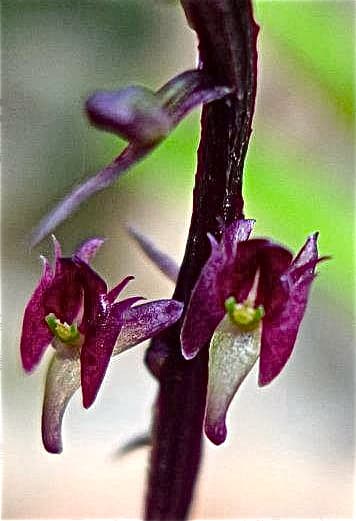
Crepidium
Crepidium, also known by its Chinese name 沼兰属 (zhao lan shu) and commonly as spur orchids, is a genus of approximately three hundred species of evergreen orchids. These plants are predominantly terrestrial, characterized by short, ground-hugging stems, large pleated leaves, and small, non-resupinate flowers with spreading sepals and petals. The genus is widely distributed across the tropics, with a significant diversity found in New Guinea.
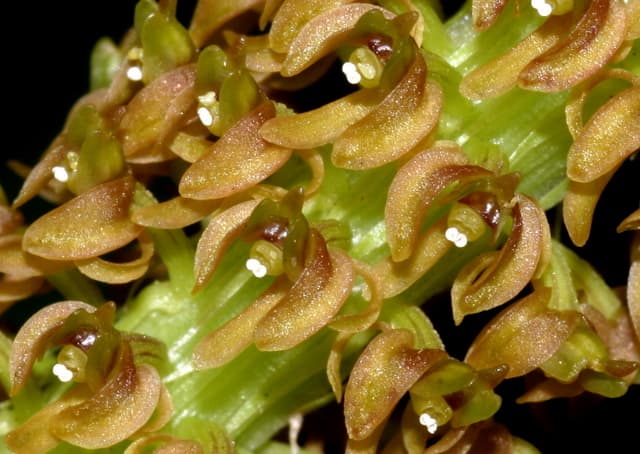
Dienia
Dienia, commonly known as snout orchids, is a genus of six species of evergreen orchids found across Southeast Asia, Australia, Micronesia, and Melanesia. These plants are characterized by their fleshy, above-ground stems, large pleated leaves, and small, non-resupinate flowers with a distinctive short, tongue-like labellum. While primarily terrestrial, some species can grow as epiphytes.

Lecanorchis
Lecanorchis is a genus of leafless, terrestrial orchids belonging to the subfamily Vanilloideae. These myco-heterotrophic plants are found in the mountain forests of various Asian regions and New Guinea, distinguished by their dull-colored flowers with a distinctive hairy lip. They are characterized by a cup-like calyculus and an elongated gynostemium.