
Corybas
Corybas
Corybas, commonly known as helmet orchids, is a genus of about 120 species of small, perennial, terrestrial herbs in the orchid family. Native to a wide range including Australia, New Zealand, Southeast Asia, and the Himalayas, these orchids are distinctive for their single, fungus-like flower, dominated by a large dorsal sepal and labellum, often resembling a helmet.
Key Facts
- ›Consists of approximately 120 species of small, perennial, deciduous herbs.
- ›Nearly always terrestrial, with a single leaf and a single flower on a short stalk.
- ›Flowers are resupinate, dull-colored, and often resemble the fruiting body of a fungus.
- ›Found across a broad geographic distribution including Australia, New Zealand, Southeast Asia, and the Himalayas.
- ›Pollination is thought to be achieved by small insects, possibly attracted by the fungus-like appearance of the flowers.

Helmet Orchids
Australia, New Zealand, New Guinea, Southeast Asia, Himalayas, Southern China, Pacific Islands, Sub-Antarctic Islands, India, Malay Peninsula, Borneo, Philippines, New Caledonia, Vanuatu, Ponape, Indonesia, Solomon Islands, Tahiti, Samoa, Society Islands
Terrestrial, Epiphytic
Autumn, Winter, Spring, Tropical Regions: Most Months
Small Insects
About Corybas
Corybas, commonly known as helmet orchids, represents a genus of approximately 120 species within the Orchidaceae family. These plants are typically small, perennial, deciduous herbs, almost exclusively growing as terrestrial species. Their structure is characterized by a single leaf at the base and a solitary flower borne on a short stalk. The flower's appearance is quite distinctive, often resembling the fruiting body of a fungus, with a prominent dorsal sepal forming a hood-like structure over the column and a large, concave labellum.
Distribution and Habitat
The natural distribution of Corybas species is extensive, spanning regions such as Australia, New Zealand, New Guinea, Southeast Asia, the Himalayas, southern China, numerous Pacific islands, and a few sub-Antarctic islands. Within these areas, they are primarily found in moist, shady locations. Australian species, for instance, often grow amongst dense moss, on decaying logs, or in similar damp environments.
Description and Ecology
Corybas orchids are sympodial herbs that lack true roots, instead relying on a fleshy, spherical underground tuber from which new tubers develop via root-like stolons. The single leaf can be heart-shaped, kidney-shaped, or nearly round, usually situated at ground level. The flower itself is resupinate and dull-colored. The dorsal sepal is significantly larger than the lateral sepals and petals, curving forward to create a hooded effect. The labellum is a substantial part of the flower, often deeply concave or tube-shaped. Flowering times vary, occurring between autumn and spring in temperate zones and throughout most months in tropical areas. The resulting fruit is a dehiscent capsule containing up to 500 seeds, which is dispersed as the flower stem elongates up to 30 cm.
Ecologically, pollination is believed to be facilitated by small insects, potentially attracted by the flowers' fungal mimicry. Studying these orchids can be challenging due to their short-lived and inconspicuous flowers, as well as their difficulty in preservation as herbarium specimens. While many species may form clonal colonies, the extent of this characteristic across the genus is not fully understood.
Source: Wikipedia ↗
Frequently Asked Questions
What are Corybas orchids commonly called?
Corybas orchids are commonly known as helmet orchids. This name likely refers to the distinctive shape of their flowers, which are often compared to a helmet.
Where are Corybas orchids found naturally?
Species of Corybas are found in a wide range of regions, including Australia, New Zealand, New Guinea, Southeast Asia, the Himalayas, southern China, many Pacific islands, and a few sub-Antarctic islands.
What is unique about Corybas flowers?
The flowers of Corybas are typically dull-colored and resupinate, often resembling the fruiting body of a fungus. A prominent feature is the large dorsal sepal that curves forward, forming a hood, and a similarly large, concave labellum.
How do Corybas orchids grow?
These orchids are usually terrestrial herbs, meaning they grow in soil. They possess an underground tuber and typically have a single leaf at the base and a single flower on a short stem.
When do Corybas orchids bloom?
In temperate regions, flowering occurs between autumn and spring. In tropical regions, blooming can happen in most months of the year.
Related Orchid species
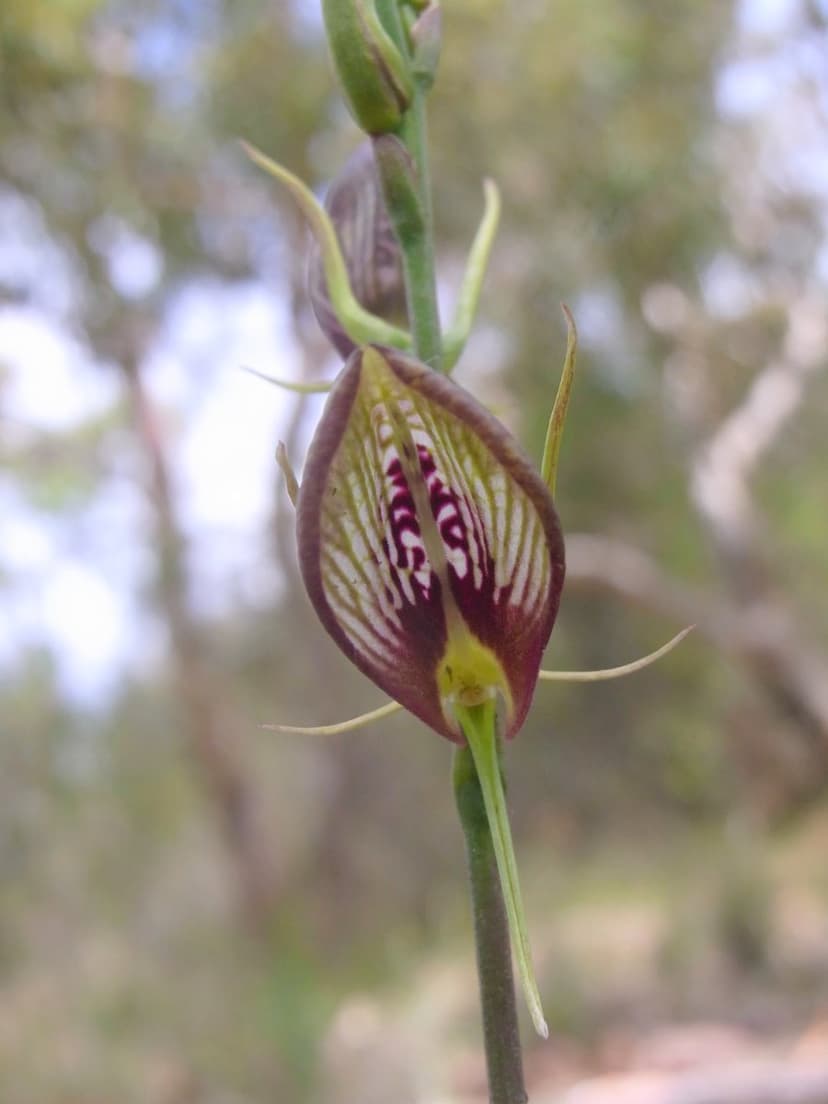
Cryptostylis
Cryptostylis, commonly known as tongue orchids, is a genus of terrestrial orchids found in South Asia, Southeast Asia, and the South Pacific. These orchids are distinguished by their prominent labellum, which is the most conspicuous part of the flower, and their unique pollination strategy involving wasps attempting to mate with the flowers. At least some species are pollinated through a process called pseudocopulation, where male wasps mistake the flower for a female wasp.
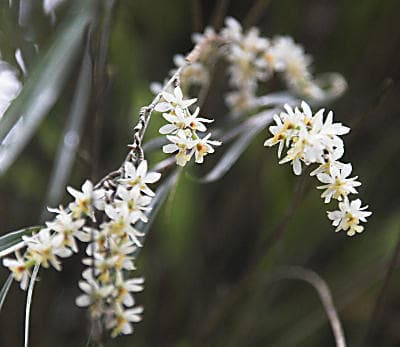
Earina
Earina is a genus of orchids belonging to the family Orchidaceae, with seven recognized species primarily found on various Pacific Ocean islands. The New Zealand species are notable for their epiphytic or lithophytic growth habit on mossy tree trunks and rocks, producing abundant, tiny flowers that can create a spectacular display.

Dipodium
Dipodium, commonly known as hyacinth orchids, is a genus of approximately forty orchid species native to tropical, subtropical, and temperate regions across Southeast Asia, New Guinea, the Pacific Islands, and Australia. This genus is distinguished by its large, often colorful flowers borne on tall stems, and includes species that are either terrestrial or climbing, some with leaves and some leafless.