
Corycium
Corycium
Corycium is a genus of terrestrial orchids found in Eastern and Southern Africa, with a significant presence in the fynbos region of South Africa. These orchids are characterized by their tubers, scattered leaves, and dense, often brown, green, or purple flower spikes. A distinctive feature is the hood formed by the uppermost tepals and the lip joined to the column.
Key Facts
- ›Comprises approximately 14 species of terrestrial orchids.
- ›Native to Eastern and Southern Africa, with 10 species found in South Africa's fynbos.
- ›Known as monkshood orchids in South Africa.
- ›Possess a tuberous resting stage.
- ›Flowers are typically borne on dense spikes and can be brown, green, or purple.
- ›The uppermost tepals are connivent into a hood, and the lip joins the column.

Monkshood Orchids
Terrestrial
About Corycium
Corycium is a genus of terrestrial orchids comprising some 14 species. These orchids are primarily found in Eastern and Southern Africa, with a significant concentration of ten species native to the fynbos region of South Africa. In their native South African habitats, Corycium orchids are commonly known as monkshood orchids.
Growth and Morphology
The life cycle of Corycium orchids includes a tuberous resting stage. During their active growing period, they exhibit numerous leaves that are scattered along the stem, though they tend to be more densely clustered near the base of the plant. The inflorescences are characterized by dense spikes of flowers that are not considered particularly striking in appearance, often displaying colors such as brown, green, or purple.
A distinctive morphological feature of Corycium flowers is the structure of the tepals. The uppermost three tepals are connivent, meaning they are joined together to form a hood-like structure. Additionally, the lateral sepals are almost united. The lip of the flower is fused to the column and bears an appendage that covers the anthers, contributing to the unique floral architecture of the genus.
Source: Wikipedia ↗
Frequently Asked Questions
What are Corycium orchids?
Corycium is a genus of terrestrial orchids native to Eastern and Southern Africa. They are known for their tubers, scattered leaves, and dense flower spikes.
Where are Corycium orchids found?
These orchids are found across Eastern and Southern Africa. A notable concentration of ten species exists within the fynbos biome of South Africa.
What do Corycium flowers look like?
Corycium flowers are typically borne on dense spikes and are often described as brown, green, or purple. The uppermost three tepals form a hood, and the lip is attached to the column.
Do Corycium orchids grow in soil?
Yes, Corycium orchids are terrestrial, meaning they grow in the soil, typically from a tuberous resting stage.
What are the common names for Corycium orchids?
In South Africa, Corycium orchids are commonly referred to as monkshood orchids.
Related Orchid species

Jumellea
Jumellea is a genus of orchids comprising 55 species, primarily found in Madagascar, the Comoros, Mascarenes, and eastern Africa. Named in honor of French botanist Henri Lucien Jumelle, these orchids often display adaptations for pollination by hawk moths, though self-pollination is also observed in some species like Jumellea stenophylla.
Crepidium
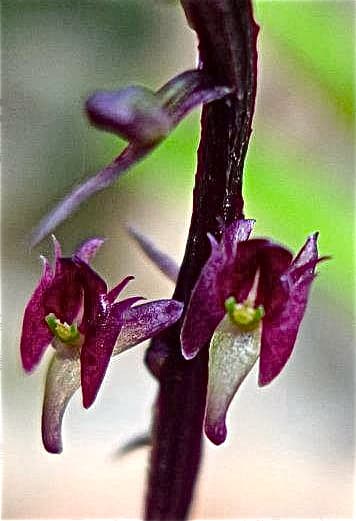
Crepidium, also known by its Chinese name 沼兰属 (zhao lan shu) and commonly as spur orchids, is a genus of approximately three hundred species of evergreen orchids. These plants are predominantly terrestrial, characterized by short, ground-hugging stems, large pleated leaves, and small, non-resupinate flowers with spreading sepals and petals. The genus is widely distributed across the tropics, with a significant diversity found in New Guinea.

Lecanorchis
Lecanorchis is a genus of leafless, terrestrial orchids belonging to the subfamily Vanilloideae. These myco-heterotrophic plants are found in the mountain forests of various Asian regions and New Guinea, distinguished by their dull-colored flowers with a distinctive hairy lip. They are characterized by a cup-like calyculus and an elongated gynostemium.